By Brian Mugenyi
“I would like to thank the Bank of Uganda for telling the leadership and they are the data accredit and whatever we are doing is because of their support and the Ministry of Labour and Gender and Ministry of Finance, Planning and Economic Development. We want to thank the World Bank for the GROW Project and we’ve always got 100 per cent support from Serena.”

The remarks by GROW Project Coordinator Dr. Ruth Kasolo Biyinzika brought into sharp focus the institutions, partnerships and data systems behind Uganda’s growing effort to expand suitable financial services for women.
Dr. Biyinzika was speaking on Saturday, August 29, 2026, during the closing ceremony of the Women’s Market in Kampala, where Hon. Mary Grace Kuteesa, State Minister for Gender and Culture Affairs, was the Chief Guest.
Her message was clear: Uganda must now move beyond strategies and commitments and turn them into financial services capable of responding to the different needs of women in business.

At the centre of that agenda is data.
Dr. Biyinzika said financial institutions need to collect and use disaggregated data to understand the different segments of women they serve, arguing that such information is essential for designing financial products that reflect the realities of women-owned businesses.
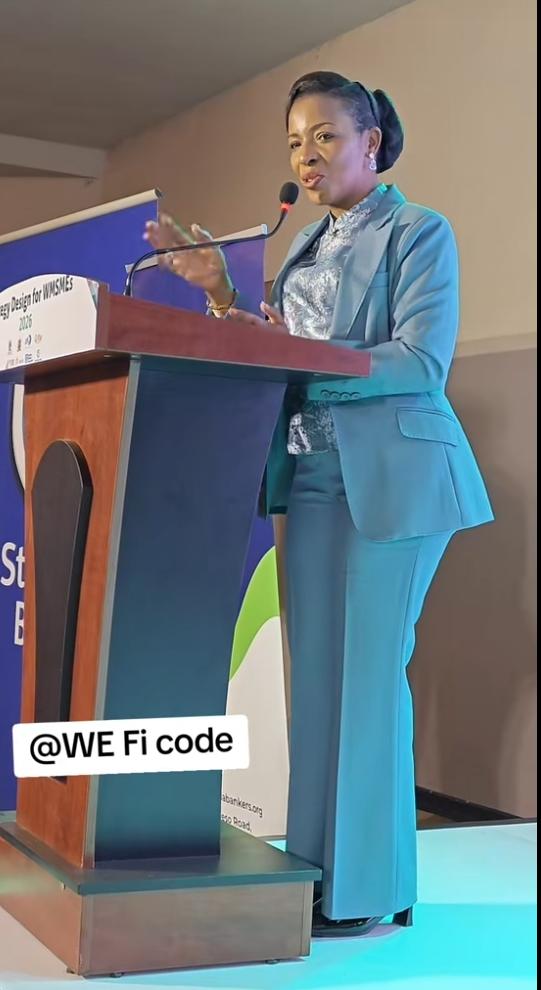
“Bank of Uganda are telling a data-centric journey and by March next year we shall be registered in many of these processes, and we want to talk in figures,” she said.
That statement captures the shift taking place in Uganda’s women’s financial inclusion agenda—from broad policy language to measurable economic evidence.

THE WOMEN’S MARKET IS NOT ONE MARKET
A woman operating a small retail business does not have the same financial needs as a farmer, manufacturer, professional or established company owner.
Their businesses have different cash-flow patterns, risks, capital requirements and growth prospects.
Dr. Biyinzika said this is why financial institutions must improve their understanding of the different segments of women they serve.
The WE-Fi Code is part of this effort, with a focus on strengthening institutions’ ability to collect data that distinguishes different categories of women entrepreneurs.
Such information can enable financial institutions to understand where demand exists, which groups are underserved and what products could be developed to respond to those needs.
For the economy, this is more than a data exercise.
It is about ensuring that capital reaches productive enterprises in ways that support growth.
FROM STRATEGY TO BUSINESS
The broader message from the Women’s Market was that financial inclusion should not end with simply giving women access to a financial institution.
The more important question is whether the service they receive is suitable.
A business needs finance that matches its size, cash flow and stage of development.
Working capital may help a trader purchase stock.
Equipment finance may allow a manufacturer to increase production.
Investment capital may allow an established business to enter new markets.
The right financial product can therefore become a growth instrument.
The wrong one may do little to change the fortunes of an enterprise.
That is why the collection and analysis of disaggregated data matters.
THE WOMEN’S MARKET PLAYBOOK
The initiative also highlighted the Women’s Market Playbook, developed with the involvement of the Financial Alliance for Women.
The playbook provides a framework for financial institutions to better understand women as a diverse customer and enterprise market.
Its significance is that it encourages institutions to move away from a one-size-fits-all approach.
The women’s market must instead be understood through evidence.
Who are the women customers?
What businesses do they operate?
What financing do they need?
What prevents them from accessing it?
And what happens after they receive financial services?
These are the questions that can help turn data into better business decisions.
55 FINANCIAL-SECTOR STAKEHOLDERS
Dr. Biyinzika recognised 55 stakeholders from financial institutions for coming on board to support the women’s market agenda.
Their participation places the financial sector at the centre of implementation.
Among the institutions recognised were Centenary Bank, Vision Bank, Finance Trust Bank, FINCA, Housing Finance Bank, Opportunity Bank, Ecobank, Citi Bank, Stanbic Bank and UGAFODE, alongside other participating institutions.
The significance of the 55 stakeholders is not merely in their presence.
Their value will be measured by what their institutions do with the strategy and the data.
They are expected to translate market understanding into products, services and financing opportunities that respond to women’s actual business needs.
SERENA AND THE WORLD BANK
Dr. Biyinzika also recognised the contribution of Serena Cavicchi, a Senior Social Development Specialist at the World Bank and Task Team Lead for Uganda’s GROW Project.
She credited Serena’s support and leadership in the project and linked the progress to the World Bank’s backing of the initiative.
“We want to thank the World Bank for the GROW Project and we’ve always got 100 per cent support from Serena,” Dr. Biyinzika said.
She also thanked the Bank of Uganda, the Ministry of Labour and Gender and the Ministry of Finance, Planning and Economic Development for their contribution.
Her comments highlight the partnership behind the programme.
Government provides policy leadership.
The central bank supports the financial and data environment.
Development partners provide resources and technical support.
Financial institutions provide services.
Women entrepreneurs remain at the centre of the system.
WHY THE DATA-CENTRIC APPROACH MATTERS
Financial institutions cannot design effective products for markets they do not understand.
Disaggregated data can reveal differences that broad statistics conceal.
It can show which women are borrowing, which are saving and which remain outside formal financial services.
It can identify the sectors in which women-owned enterprises are concentrated.
It can also show where financing is failing to reach viable businesses.
For financial institutions, this can improve market intelligence.
For government, it can improve policy design.
For women entrepreneurs, it can create the possibility of financial services better matched to the realities of their enterprises.
KUTEESA: CHIEF GUEST
The closing ceremony was attended by Hon. Mary Grace Kuteesa, State Minister for Gender and Culture Affairs, who served as Chief Guest.
Her participation reinforced the government’s role in creating an environment in which women can participate more strongly in economic activity.
The event brought government, financial institutions and development partners into one conversation about women as economic actors rather than simply beneficiaries of development programmes.
THE BUSINESS CASE FOR WOMEN
There is a larger economic argument behind the women’s market agenda.
When a woman-owned business receives appropriate finance, it can buy more stock, invest in equipment, increase production and enter new markets.
As businesses expand, they can employ workers and purchase goods and services from other enterprises.
The effect can spread through local economies.
This makes women’s financial inclusion both a development issue and a business opportunity for financial institutions.
A bank that understands its women customers can develop stronger products and build long-term commercial relationships.
FROM ACCESS TO IMPACT
The next step is to move from financial access to measurable impact.
It is not enough to know that women have opened accounts or interacted with a bank.
The more important questions are whether they have received suitable finance, whether their businesses have expanded and whether the financing has helped create income and employment.
This is where Dr. Biyinzika’s emphasis on figures becomes important.
“We want to talk in figures,” she said.
Figures can demonstrate what is happening on the ground.
They can show how much financing is reaching women-owned enterprises.
They can reveal which sectors are receiving capital.
They can show how many businesses are growing.
And they can identify groups that remain underserved.
MARCH 2027
Dr. Biyinzika pointed to March 2027 as an important milestone in the process, saying further registration and progress would be recorded across the initiatives underway.
But the real benchmark will not be registration alone.
The test will be whether institutions are collecting useful information and using it to change financial services.
The ultimate objective is to turn evidence into better products and better products into stronger businesses.
FROM PLAYBOOK TO PROFIT
The Women’s Market Playbook provides the strategy.
The WE-Fi Code strengthens the data approach.
The World Bank provides support through GROW.
The Bank of Uganda and government ministries provide institutional backing.
The 55 financial-sector stakeholders provide the financial-sector platform.
But the decisive step is implementation.
The women entrepreneurs who need capital will ultimately judge the success of the programme through what they can access, how suitable it is and what it enables them to achieve.
A strategy is successful when it changes behaviour.
A financial product is successful when it solves a real business problem.
And financial inclusion becomes economic transformation when finance helps enterprises grow.
THE FIGURES MUST TELL THE STORY
Dr. Biyinzika’s call to “talk in figures” offers a powerful standard for the next phase.
The numbers should eventually reveal whether more women are accessing appropriate financial services and whether those services are generating measurable economic outcomes.
They should tell the story of businesses expanding.
They should show jobs being created.
They should reveal new investment.
They should demonstrate increased resilience and stronger participation in formal markets.
That is the economic story Uganda needs to tell.
The Women’s Market closing ceremony may have ended, but the real assignment has only begun.
The institutions have the strategy.
They have the partnerships.
They have the data agenda.
Now they must prove that these tools can change the financial reality of women entrepreneurs.
From playbook to profit, the journey will be complete only when strategies become products, products become capital, capital becomes business growth, and business growth becomes jobs, incomes and sustainable economic opportunity for Uganda’s women.