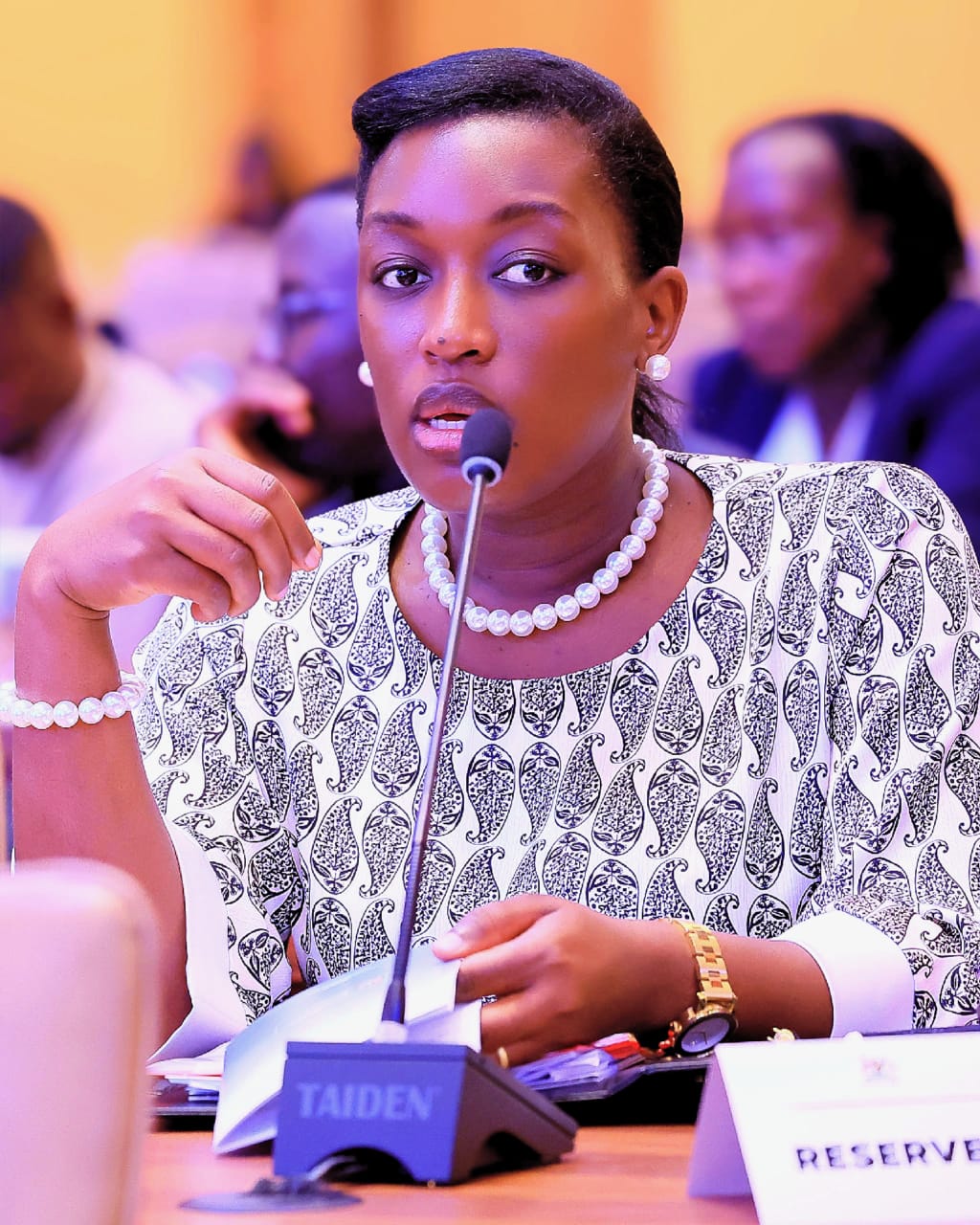
Mao said his meeting with the URSB Board and Top Management on August 18 was aimed at briefing them about measures he had taken following a directive from President Museveni contained in a July 24, 2026 letter
By Our reporter

Kampala: The Justice and Constitutional Affairs Minister, Hon. Norbert Mao has thrown his weight behind the Uganda Registration Services Bureau (URSB), insisting that the government agency’s impressive record of performance should not be overshadowed by the ongoing investigations involving some of its top officials.

In a strongly worded statement issued on Tuesday, August 18, 2026, Mao said the URSB remains one of Uganda’s best-performing government agencies and a regional benchmark, while assuring its Board and Management that the institution must continue operating normally as investigations proceed.
The Minister also revealed that he will seek an opportunity for the URSB Board and Management to meet President Yoweri Museveni and present their side of the story, particularly because some of the decisions taken against senior officials were made before the Board and Management had been given an opportunity to be heard.

The move sets the stage for a potentially significant engagement between the President and the leadership of an institution that has been at the centre of Uganda’s business registration, intellectual property, company regulation and anti-money laundering systems.
Mao said his meeting with the URSB Board and Top Management on August 18 was aimed at briefing them about measures he had taken following a directive from President Museveni contained in a July 24, 2026 letter.
But rather than allowing the controversy to paralyse the institution, Mao said the meeting resolved that the Board and Management should cooperate fully with investigators while simultaneously protecting institutional stability, boosting staff morale and ensuring that thousands of Ugandans who depend on URSB services are not inconvenienced.
“I assured the meeting that, as the line Minister, I will ensure that we strengthen the internal governance structures of the URSB so that lawful decisions of the Board are not undermined or disrupted,” Mao said.
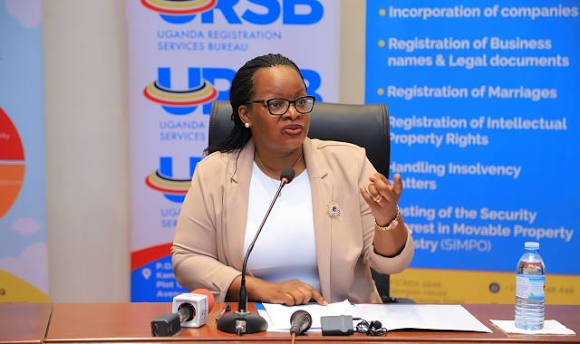
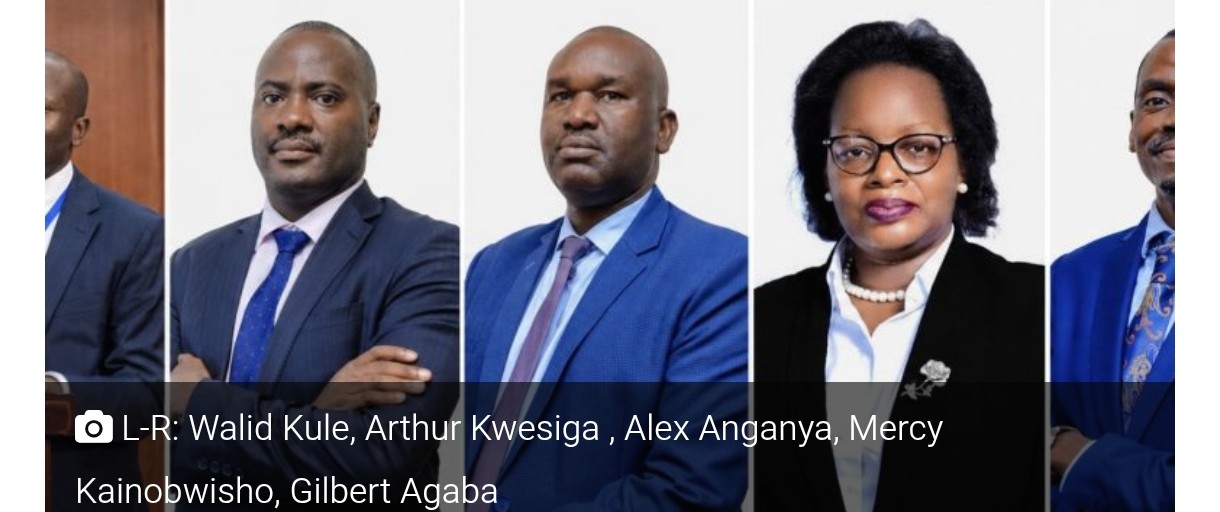
The Minister’s intervention comes after five senior URSB officials were sent on mandatory leave to facilitate ongoing investigations.
Those affected are Registrar General Mercy K. Kainobwisho, Deputy Registrar General Alex Anganya, Commissioner ICT and Innovation Arthur Kwesiga, Commissioner Registration Services Gilbert Agaba and Assistant Commissioner Registration Services Walid Kule.
Mao stressed that the decision was taken in line with the President’s directive and after consultation with the URSB Board Chairman.
Mao being welcomed by URSB board chair Amb Butagira at the Agency’s headquarters on Tuesday
He also made it clear that the mandatory leave is intended to protect the integrity of the investigations and will remain in force until the investigations are completed.
The Minister, however, struck a positive tone about the affected institution and its officials, emphasising that URSB’s achievements over the years cannot simply be wished away because of the current developments.
According to Mao, URSB has established itself as one of the best-performing government agencies in Uganda and across the region, with its systems attracting interest from other countries seeking to replicate its successes.
He pointed to a four-day benchmarking visit by then Malawi Minister of Justice Titus Edward Songiso Mvalo in April 2025 as evidence of the agency’s regional standing.
The Malawi delegation visited URSB to study its systems and operations, while Uganda’s continued engagement with Malawi has now created an opportunity for URSB to export its expertise to the neighbouring country.
Mao said he held a bilateral meeting in July this year with Malawi’s current Minister of Justice and Constitutional Affairs, Charles Mhango, on the sidelines of the 68th Series of Meetings of the Assemblies of the Member States of the World Intellectual Property Organization in Geneva, Switzerland.
Following that engagement, URSB is expected to send a team to Malawi to support the growth of the Companies, Registrations and Intellectual Property Centre, which was established after the earlier benchmarking visit and officially launched in June this year.
For Mao, such developments demonstrate the level of confidence that other countries have placed in URSB’s systems and expertise.
The Minister also highlighted the agency’s recent achievement of the ISO 9001:2015 Quality Management System certification in March 2026.
The certification, he said, recognised URSB’s adherence to high standards in transparent public service delivery, efficiency and client satisfaction.
Under the leadership and technical teams currently facing the investigations, URSB has worked to make business registration faster and more efficient while improving the experience of clients seeking government services.
The agency has also been central to Uganda’s efforts to strengthen intellectual property protection and ensure that creatives benefit fairly from their work.
Mao revealed that the Copyright Management System, developed following a Presidential directive, is soon expected to be launched.
The newly established Copyright Department at URSB will be tasked with strengthening enforcement against infringement of intellectual property rights and helping Uganda’s creative industry get better value from its work.
But perhaps one of URSB’s biggest contributions has been in Uganda’s battle to strengthen its anti-money laundering framework.
Mao recalled that when Uganda was placed on the Financial Action Task Force grey list because of weaknesses in its anti-money laundering systems, URSB was at the forefront of efforts to address the shortcomings.
The agency worked with other government institutions to update laws relating to companies and partnerships and ensured that beneficial ownership information could be accessed and monitored through the Financial Intelligence Authority.
Those efforts contributed to Uganda being removed from the FATF grey list on February 23, 2024.
Mao warned, however, that leaving the grey list does not mean the work is over.
Uganda must continue strengthening its compliance systems, particularly with a regional peer review by the Eastern and Southern Africa Anti-Money Laundering Group expected in the future.
The Minister said URSB therefore remains a critical institution in protecting the integrity of Uganda’s corporate sector and financial system.
He noted that the services provided by URSB are directly linked to business activity, industrialisation and Uganda’s wider socio-economic transformation.
It is against this background that Mao raised concerns about the importance of allowing statutory bodies and their Boards to independently exercise their oversight and disciplinary responsibilities in accordance with established procedures.
He argued that good governance requires institutional processes to be respected and that appeals should ordinarily be considered after the process upon which an appeal is based has been completed.
The Minister’s position appears aimed at protecting both institutional governance and the integrity of URSB as investigations continue.
Mao said he remains confident that URSB’s record of performance and impact will ultimately speak for itself.
“I’m confident that the URSB’s record of performance and impact will ultimately exonerate it as an institution,” he said.
Mao being welcomed by URSB board chair Amb Butagira at the Agency’s headquarters on Tuesday
He nevertheless acknowledged the reputational risks that the current controversy could create for the agency, particularly because decisions affecting the Board and Management were taken without first giving them an opportunity to present their side of the story.
It is this concern that has prompted the Minister to seek a meeting between the URSB leadership and President Museveni.
Mao said the proposed meeting would give the Board and Management an opportunity to tell their side of the story directly to the President and address any reputational risks facing the institution.
The Minister’s approach also sends a reassuring message to URSB staff and clients who may be concerned that the controversy could disrupt the agency’s operations.
He stressed that URSB must continue performing its statutory duties even as the investigations proceed.
The Board and Management have consequently been directed to fully cooperate with investigators, preserve and avail all institutional records and support all competent state authorities involved in the investigations.
At the same time, they have been instructed to ensure uninterrupted delivery of URSB’s statutory services.
For an institution responsible for business registration, intellectual property, company records and other critical services, the message is clear: investigations will proceed, but government services must not grind to a halt.
The developments also put the spotlight on the delicate balance between accountability and institutional stability, particularly in a government agency whose systems are relied upon by businesses, investors, creatives and other Ugandans every day.
Mao’s statement therefore seeks to draw a distinction between the ongoing investigations involving individual officials and the broader performance and reputation of URSB as an institution.
Rather than treating the investigations as a verdict, the Minister has emphasised cooperation, due process, institutional continuity and the opportunity for the affected leadership to be heard.
As the probe continues, URSB’s Board and Management are expected to remain available to investigators while keeping the agency’s systems running.
And with Mao preparing to seek an audience with President Museveni, the leadership of URSB could soon have an opportunity to place its account of events directly before the Head of State.
For now, the Minister has backed the institution’s record, urged its officials to cooperate with investigators and promised to work to strengthen its internal governance structures.
The message from the Justice Ministry is therefore one of accountability without institutional paralysis — and investigation without prematurely writing off an agency that has earned regional recognition for its work.
QUESTIONS OVER ATTORNEY GENERAL’S ROUTE TO STATE HOUSE
Mao’s August 18 statement now provides a crucial missing piece of the chronology.
The Minister says that after President Museveni’s July 24 letter, he convened a meeting of the Senior Top Management of the Ministry on August 12.
Present were the Attorney General, Permanent Secretary, Solicitor General and Deputy Solicitor General.
Mao says the meeting discussed the URSB matter and the circumstances under which the Attorney General had escalated it to the President.
The Attorney General explained how the matter had come to his attention from a senior URSB staff member and how he subsequently escalated it to State House.
But Mao says he only received the President’s July 24 letter on August 5.
This chronology has left questions within administrative and governance circles.
If URSB falls under the Ministry of Justice and Constitutional Affairs, and Mao is the responsible political head, why was the Attorney General able to escalate the matter to the President before first consulting or briefing the Minister?
Why was the Minister not part of the initial decision to take the dispute to State House?
Was the normal chain of communication within the Justice Ministry followed?
And why was the President not given the benefit of the Ministry’s institutional position before the matter was escalated?
These questions do not undermine the legitimacy of the investigations.
Nor do they suggest that allegations should be ignored.
They go to a much narrower but important issue of institutional protocol and coordination.
Mao himself has now made clear that the ministry supports cooperation with investigators.
But he also believes that the URSB Board and Management deserve an opportunity to tell their side of the story to the President.
THE AGABA STORY BEHIND THE STORM
At the centre of the original dispute is Gilbert Agaba, the Commissioner for Business Registration, whose relationship with URSB management had deteriorated over a period of time before his allegations eventually reached the Attorney General.
Documents and internal briefs seen by this website indicate that the current crisis did not begin with the presidential directive.
It began as an internal management dispute involving questions about Agaba’s leadership, supervision, communication, teamwork and compliance with management decisions.
According to an internal brief, URSB management had received repeated complaints concerning Agaba’s leadership and working relationships within the Business Registration Department.
The concerns reportedly involved departmental coordination, staff relations, supervision and service delivery.
The issues were also said to have roots in an earlier period when Agaba served as Commissioner for Intellectual Property, where similar concerns about teamwork and cohesion had reportedly been raised.
His subsequent posting to Business Registration was therefore viewed as an opportunity to strengthen leadership within the department.
However, according to management, the situation did not improve.
Among the concerns raised were alleged prolonged absences from duty, inadequate availability to provide leadership to the department, weak supervision and coordination of staff and failure to convene regular departmental meetings.
There were also complaints concerning communication between Agaba and his immediate subordinates.
Management further accused him of failing to implement and report back on assigned management decisions.
The cumulative effect, according to the internal brief, was growing concern about teamwork, cohesion, planning, accountability and service delivery.
Then came the allegation that would eventually become central to the disciplinary process — insubordination against institutional leadership.
MANAGEMENT FIRST TRIED TO FIX IT
Importantly, the dispute was not immediately sent outside URSB.
According to management’s account, several attempts were made internally to resolve the situation.
The Deputy Registrar General responsible for Registries and the Deputy Registrar General responsible for Finance and Administration reportedly intervened.
Agaba was counselled and guided on improving communication, supervision and his working relationship with staff.
Practical measures were proposed to restore normal operations within the department.
But management says the interventions did not resolve the problems.
The Registrar General, Mercy Kainobwisho, subsequently intervened personally.
A meeting was convened in an effort to resolve the impasse.
Agaba was directed to engage his departmental team and agree on clear working arrangements covering supervision, communication, accountability and service delivery.
He was also required to submit the agreed arrangements within a specified period.
According to management, this was not done.
The corrective measures were allegedly not implemented, forcing the matter into the formal disciplinary process under the URSB Human Resource Manual and applicable administrative procedures.
That disciplinary process would later become the launching pad for a much bigger battle.
Gilbert Agaba, the Commissioner for Business Registration
AGABA TAKES THE FIGHT OUTSIDE
As the internal dispute continued, Agaba raised allegations against the institution’s management.
He reportedly first brought the matter to the attention of URSB Board Chairman Ambassador Francis Butagira.
He later referred substantially similar allegations to external institutions, including the Economic Crimes Division of the Uganda Police Force and the Office of the Attorney General.
The allegations included claims of criminal conduct, corruption and misuse of institutional resources.
The URSB Board responded by constituting an Investigation Committee to examine the matter.
The committee was expected to consider both sides — Agaba’s allegations and the management concerns regarding his conduct, leadership and governance.
But before the internal processes could bring the matter to a conclusion, the dispute moved into much higher territory.
THE BOARD CONFRONTS AGABA
On June 8, 2026, Agaba was invited to respond to allegations relating to leadership and governance challenges within the Business Registration Department.
The matter subsequently reached an extraordinary meeting of the URSB Board on July 15.
The Board made findings that were later communicated to Agaba through a warning letter.
Among the findings was that there was inadequate teamwork and cohesion within the Business Registration Department.
The Board pointed to the entire 2025/26 financial year, during which the department reportedly did not hold a departmental meeting or retreat for planning and performance evaluation.
The Board attributed the situation largely to what it considered inadequate leadership, teamwork and cohesion.
It also noted that similar concerns had previously arisen during Agaba’s tenure in the Intellectual Property Department.
Another finding was that Agaba had allegedly failed to implement and report back on management decisions assigned to him.
The Board treated that conduct as insubordination under Section 7.2.4(b)(viii) of the URSB Human Resource Manual.
But another allegation raised the temperature considerably.
According to the Board’s findings, Agaba allegedly referred to the Registrar General as a “criminal” and accused the Registrar General of being in charge of a “criminal enterprise” within URSB.
The Board treated the alleged language as contrary to the same provisions of the Human Resource Manual.
NO FIRING — A CHANCE TO REFORM
Despite the findings, the Board did not immediately recommend Agaba’s dismissal.
Instead, it opted for corrective and progressive measures.
Agaba was directed to submit a written apology to management within five days of receiving the warning.
He was also placed on a proposed 12-month Performance Improvement Plan, under the direct supervision of the Deputy Registrar General responsible for Finance and Administration.
The objective was to improve his leadership and governance approach while restoring professional working relations.
In other words, the Board’s action was presented as an opportunity for correction rather than an immediate termination.
But Agaba rejected the findings and sanctions.
Instead, he pursued the allegations he had raised against the institution through external channels.
That is when the dispute took a dramatic turn.
ENTER ATTORNEY GENERAL MAYANJA
Agaba’s complaints eventually landed before Attorney General Dr Sam Mayanja.
Mayanja then escalated the matter to President Museveni.
A July 8, 2026 letter from the Attorney General to URSB Board Chairman Ambassador Francis Butagira provides an important link in the chain of events.
The letter, titled “Investigations into Agaba Gilbert, Commissioner Business Registration,” acknowledged that Agaba had brought to the Attorney General’s attention allegations of criminal activities allegedly taking place at URSB.
Mayanja said he had escalated the matters to President Museveni for guidance.
He subsequently directed the URSB Board to stop its own investigations and inquiries into Agaba and await guidance from the President.
The instruction stated:
“This is to direct that you and the URSB Board ceases all investigations/inquiries into Mr. Agaba and await the guidance of His Excellency the President.”
The letter was copied to President Museveni and Minister Norbert Mao.
And this is where the protocol question becomes unavoidable.
WHY WAS MAO NOT CONSULTED FIRST?
Mao’s August 18 statement now provides a crucial missing piece of the chronology.
The Minister says that after President Museveni’s July 24 letter, he convened a meeting of the Senior Top Management of the Ministry on August 12.
Present were the Attorney General, Permanent Secretary, Solicitor General and Deputy Solicitor General.
Mao says the meeting discussed the URSB matter and the circumstances under which the Attorney General had escalated it to the President.
The Attorney General explained how the matter had come to his attention from a senior URSB staff member and how he subsequently escalated it to State House.
But Mao says he only received the President’s July 24 letter on August 5.
This chronology has left questions within administrative and governance circles.
If URSB falls under the Ministry of Justice and Constitutional Affairs, and Mao is the responsible political head, why was the Attorney General able to escalate the matter to the President before first consulting or briefing the Minister?
Why was the Minister not part of the initial decision to take the dispute to State House?
Was the normal chain of communication within the Justice Ministry followed?
And was the President given the benefit of the Ministry’s institutional position before the matter was escalated?
These questions do not undermine the legitimacy of the investigations.
Nor do they suggest that allegations should be ignored.
They go to a much narrower but important issue of institutional protocol and coordination.
Mao himself has now made clear that the ministry supports cooperation with investigators.
But he also believes that the URSB Board and Management deserve an opportunity to tell their side of the story.
M7’S DIRECTIVE WIDENS THE BATTLE
On July 24, President Museveni issued a directive to Mao concerning allegations of embezzlement of government funds, abuse of office, maladministration, money laundering and institutional mismanagement at URSB.
The President directed that senior officials step aside pending investigations.
The officials affected include Registrar General Mercy Kainobwisho, Deputy Registrar General Alex Anganya, Commissioner ICT and Innovation Arthur Kwesiga, Commissioner Registration Services Gilbert Agaba and Assistant Commissioner Registration Services Walid Kule.
The order represented a dramatic widening of the original dispute.
What began with allegations involving one Commissioner had now become a broader investigation touching the leadership and operations of the Bureau.
And importantly, the allegations remain allegations under investigation, not findings of guilt.