By Brian Mugenyi
mugenyijj@gmail.com
Kampala: The 2nd International conference on Curriculum development organised by National Curriculum Development Centre provided an avenue for the biggest talk from experts about the future of Uganda’s learners and graduates after studies in different schools and universities.
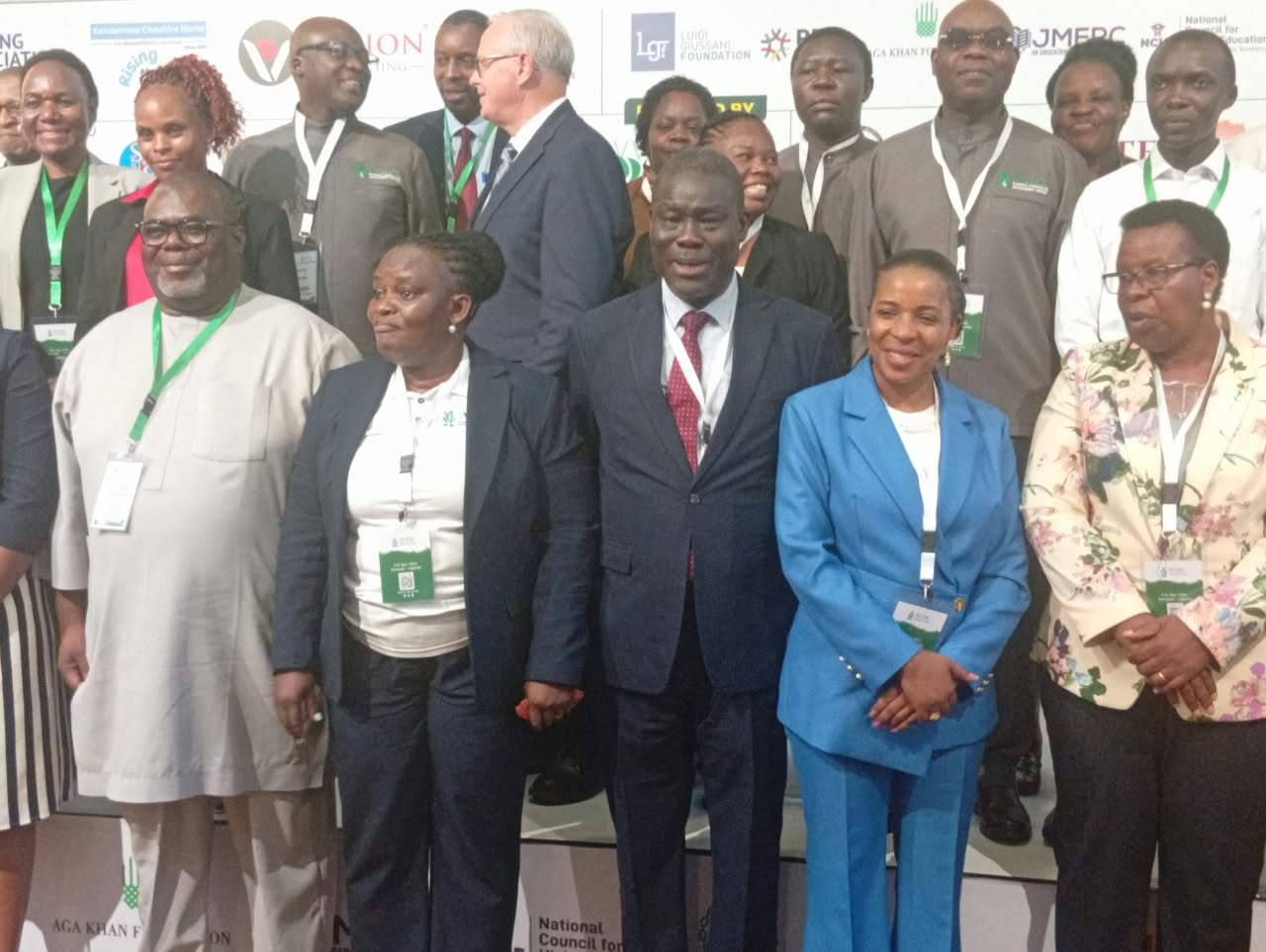
The real test of Uganda’s education system was Dr. Ruth Aisha Biyinzika Kasolo (blue outfit) in the picture.
Speaking in a highly attended conference with over 400 delegates from different countries such as Malaysia and United States of America and scholars from different universities such as Kabale University, Kampala University and others she said the the future of learners should not end at the examination room.
It should begin there.

What happens when a learner leaves school?

What can that young person create, repair, design, produce or solve?
Can a graduate earn a living, start an enterprise and contribute to the country’s development?

Those questions dominated Kasolo’s intervention at the 2nd International Conference on Curriculum Development, held at Speke Resort Munyonyo in Kampala on Thursday, where she challenged government to reignite patriotism in education while radically strengthening practical skills, innovation and employability.
Her message was blunt: Uganda cannot prepare young people for tomorrow using a curriculum designed only for yesterday.
Kasolo called upon President Yoweri Kaguta Museveni and the Government of Uganda to strengthen the education system so that learners leave school not merely as certificate holders, but as skilled, innovative and responsible citizens.
“The patriotic people in different professions have been lost. We used to have teachers, doctors who were passionate and hard working,” Kasolo said.
Her intervention placed patriotism at the centre of a wider curriculum debate—one that increasingly connects education with technology, entrepreneurship, employment and national development.
THE WOMAN BEHIND THE MESSAGE
Dr. Ruth Aisha Biyinzika Kasolo is not an outsider to Uganda’s human-capital debate.
She is the Coordinator of the World Bank-funded Generating Growth Opportunities and Productivity for Women Enterprises (GROW) Project, implemented through the Private Sector Foundation Uganda and the Government of Uganda.
She has more than two decades of experience designing and implementing multilateral development programmes involving institutions including the World Bank, European Union, UK Department for International Development and African Development Bank.
Her professional interests span private-sector development, human-capital enhancement, women’s empowerment, skills development, trade, gender mainstreaming, early-childhood development and financial-services deepening.
Kasolo holds a doctorate in business administration, a master’s degree in business administration and a bachelor’s degree in business administration, in addition to professional training in project management, gender and trade policy, SME development, early-childhood learning and Islamic banking.
Her national profile extends beyond GROW.
The National Curriculum Development Centre lists Dr. Ruth Aisha Kasolo as a member of its Governing Council, placing her directly within an institution responsible for Uganda’s curriculum-development architecture.
She has also served on boards and participated in national conversations on private-sector development and economic transformation. New Vision has previously identified her as a speaker and expert on women’s empowerment, human capital and private-sector development.
In 2023, the Uganda Journalists Association recognised her for her work in empowering Ugandans through social-media education and public engagement.
That background gives particular weight to her intervention on curriculum reform.
She is not simply asking Uganda to change what is taught.
She is asking the country to reconsider why it teaches it.
FROM CLASSROOM TO WORKPLACE
Kasolo believes the modern learner must be equipped for a labour market that changes faster than traditional education systems.
She called for stronger hands-on training, innovation and entrepreneurship so that learners can build livelihoods rather than graduate into years of job searching.
She gave a practical example.
“If you know typing, kindly I argue you to know more skills. Be more into other things and learn from skilled people in business and be entrepreneurs,” she said.
The message is simple: one skill should be the beginning of learning, not its conclusion.
In Kasolo’s vision, a person trained in typing should be able to acquire digital, business, communication or other complementary skills that increase their value in the marketplace.
The same principle, she argues, should apply across professions.
THE PATRIOTISM QUESTION
For Kasolo, technical competence alone is not enough.
Uganda also needs professionals who care about the institutions and communities they serve.
That is why she wants patriotism restored within education and professional life.
She called for institutions and companies to value employees who combine competence with commitment to the country.
Her argument comes at a time when Uganda is attempting to move from a predominantly young population into a productive demographic force.
In a recent New Vision opinion article, Kasolo argued that more than 73% of Uganda’s population is below 30, describing the youth population as both an enormous opportunity and a major socio-economic challenge.
The implication is profound.
If Uganda equips its young population with relevant skills, the demographic dividend could accelerate development.
If it fails, unemployment and underemployment could deepen social and economic pressures.
TRAIN THE TRAINERS
Kasolo also urged government to invest more heavily in refresher training for teachers and trainers.
Her argument is straightforward: teachers cannot prepare learners for a changing world if educators themselves are not continuously updated.
She therefore called on the Ministry of Education and Sports, currently under Acting Minister John Chrysostom Muyingo, to increase support for continuous professional development.
She also commended the work of the National Curriculum Development Centre and called for stronger investment in work-based planning, practical instruction and skills development.
STOP TEACHING FOR JOBS THAT DO NOT EXIST
Perhaps the sharpest part of Kasolo’s intervention was her challenge to universities and other higher-education institutions.
She argued that Uganda should be cautious about approving academic programmes whose graduates face extremely limited employment opportunities.
“We should get away from the traditional way of score in the curriculum and advocate for courses that have observable jobs for the learners,” she told the panel.
The argument touches a painful reality for many families.
Parents spend years financing education.
Students spend years studying.
But after graduation, many discover that their qualifications do not easily translate into employment.
Kasolo believes curriculum planning must therefore become more closely connected to the labour market, emerging industries and entrepreneurship.
A WOMAN WHO CONNECTS EDUCATION TO ECONOMIC TRANSFORMATION
Kasolo’s work through GROW provides another dimension to her argument.
The project is designed to expand opportunities for women entrepreneurs, including access to finance, business development and productivity support. The World Bank identifies Kasolo as a project coordinator within the GROW implementation team.
Her experience has also exposed her to the practical barriers that prevent Ugandans from turning skills into economic opportunity.
That is why her curriculum argument extends beyond classrooms.
She wants education to connect directly to enterprise, markets, finance and productive work.
Her public advocacy has similarly addressed Uganda’s economic transformation, including agricultural value addition, private-sector development and market-relevant skills.
THE EARLY-CHILDHOOD QUESTION
Kasolo also called for stronger attention to early-childhood development and closer alignment between education policies affecting young children.
Her position reflects her wider professional interest in early-childhood development, which New Vision identifies among her areas of expertise.
The argument is that Uganda’s human-capital journey cannot begin at university.
It begins in childhood.
The quality of early learning influences how children develop confidence, curiosity, discipline and the ability to learn.
By the time a young person reaches university, many foundational abilities have already been formed.
FROM TALK TO PRACTICAL ACTION
Kasolo’s strongest appeal was perhaps her demand that education reform should move beyond conferences and policy documents.
She urged government to translate recommendations into practical action.
More funding.
Better teacher training.
Modern skills.
Technology.
Entrepreneurship.
Relevant courses.
Stronger early-childhood education.
And a renewed culture of patriotism.
Her message resonates with the broader purpose of curriculum development: preparing citizens for the world they will actually inhabit.
THE BIGGER QUESTION FOR UGANDA
The 2nd International Conference on Curriculum Development was held under the theme:
“Innovative Curriculum Approaches for Sustainable Education in a Global World.”
The theme captures the challenge facing Uganda.
The global economy is changing.
Technology is changing.
Jobs are changing.
Business models are changing.
Even the meaning of a “career” is changing.
A young person may enter the workforce today and require entirely different skills five years from now.
That reality demands an education system built around continuous learning.
KASOLO’S CALL TO A NEW GENERATION
For Kasolo, the future Ugandan graduate should be more than an examination candidate.
The graduate should be a problem solver.
An entrepreneur.
A responsible citizen.
A skilled worker.
An innovator.
And, above all, a person capable of contributing to national development.
Her appeal to government is therefore larger than curriculum reform.
It is a call to rebuild the relationship between education, patriotism and Uganda’s economic future.
Because the question facing the country is no longer simply whether Ugandans are going to school.
The harder question is:
What kind of Ugandans are schools producing?
Kasolo’s answer is clear.
Uganda needs learners who can think, innovate, work, create wealth, respect their country and adapt to a world that refuses to stand still.
And if that transformation begins in the classroom, she argues, then the classroom must become the first workshop of Uganda’s economic future.