By Brian Mugenyi
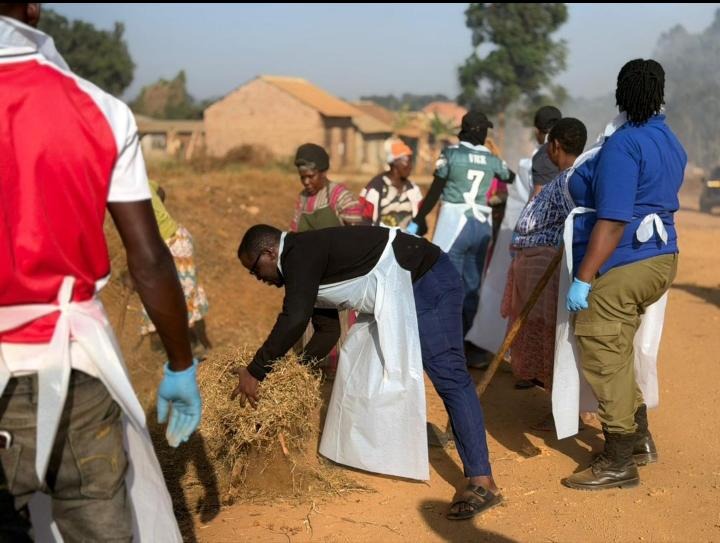
Kyanamukaka,Masaka: The Private Secretary in State House and personal secretary to former Vice President Edward Kiwanuka Ssekandi, Mr Oscar Mutebi, has joined residents of Kyanamukaka to implement the government’s National Cleaning Day policy, turning a national directive into a community-led exercise.

Mr Mutebi joined residents and local leaders in sweeping public spaces, clearing rubbish and encouraging households to make sanitation part of their daily routine.

The exercise is part of the National Cleaning Day programme, a government initiative approved by Cabinet, chaired by President Yoweri Museveni, on August 11, 2025. Government later announced that the last Saturday of every month would be observed as National Cleaning Day, with communities expected to clean homes, markets, schools, health facilities, roads, drainage channels and other public spaces.
The programme was officially launched by Vice President Jessica Alupo on July 25, 2026.
For Mr Mutebi, the significance of the policy lies in whether communities can take ownership of it.
“I am happy to see the Masaka District RDC joining us for this activity. We shall move with you, and you are allowed to join us in these activities. I have always told them to clean our areas,” Mr Mutebi said.

He said maintaining clean surroundings should not be treated as the responsibility of government officials alone, arguing that citizens have a direct role in preventing diseases and protecting their communities.
“It helps us to alleviate diseases, and we should always join in cleaning our areas. I hope next month we shall do the same exercise,” he said.
From policy to community action
The National Cleaning Day policy provides a regular opportunity for collective action, but government has also stressed that it does not replace the responsibility of individuals to maintain cleanliness every day.
That distinction was evident in Kyanamukaka, where Mr Mutebi encouraged residents to see the exercise as part of a wider responsibility rather than a one-day event.
He said communities should continue cleaning their surroundings after the organised exercise.
“The people have been free without security guidance, but the work has been done communally. It helps us to fight diseases in the community,” Mr Mutebi said.
His remarks placed emphasis on community participation rather than enforcement.
The exercise also attracted Masaka District Resident District Commissioner Billy Mulidwa, whose participation Mr Mutebi welcomed.
Mulidwa calls for household cleanliness
Mr Mulidwa said the exercise marked a new chapter in the community’s approach to sanitation, urging residents to begin with their homes.
“Today is a new chapter in the area of maintaining cleanliness, from our homes to our areas,” Mr Mulidwa said.
He urged residents to pay attention to toilets, drinking water and general hygiene, noting that preventing disease at household level could save families from unnecessary expenditure on treatment.
The RDC’s participation also demonstrated the importance of local leaders joining communities in implementing government programmes.
Rather than leaving sanitation to municipal and town-council workers, the exercise brought together political and administrative leaders and residents around a shared responsibility.
Mayor Nakidde: Start with the household
Kyanamukaka Town Council Mayor Zainab Nakidde also urged residents to pay attention to the cleanliness of water containers and the safety of drinking water.
“The jerrycans should be clean, and we should cook clean water,” Mayor Nakidde said.
Her message shifted the discussion from public spaces to household behaviour.
A clean road or trading centre, she suggested, cannot fully protect a community if families continue to compromise hygiene inside their homes.
For parents, the issue is particularly important because children are vulnerable to diseases associated with unsafe water and poor sanitation.
Beyond the broom
The Kyanamukaka exercise raises a broader question about the sustainability of the National Cleaning Day campaign.
A monthly clean-up can remove waste, clear drainage channels and improve public spaces, but lasting change requires residents to alter their everyday habits.
Government itself has said the initiative is intended to promote lasting behavioural change rather than replace daily individual responsibility.
This means the success of the programme will not necessarily be measured by how much rubbish is collected on the designated day.
It will be measured by what happens afterwards.
Whether residents continue disposing of waste properly.
Whether businesses keep their surroundings clean.
Whether drainage channels remain open.
Whether households maintain sanitary toilets.
And whether communities protect their water sources.
The local-government test
The campaign also places responsibility on local governments, which are expected to coordinate sanitation and environmental management within their jurisdictions.
For Kyanamukaka, the involvement of local leaders provides an opportunity to connect national policy with the realities facing residents.
Mr Mutebi said the community should not wait for government officials to arrive before cleaning its surroundings.
Instead, residents should organise themselves and work together.
His argument is that government programmes achieve greater impact when communities become participants rather than spectators.
A campaign that must outlive the cleaning day
The National Cleaning Day was designed as a recurring exercise, with the last Saturday of each month reserved for organised community cleaning.
For Mr Mutebi, that recurrence presents an opportunity to build a culture.
“I hope next month we shall do the same exercise,” he said.
The statement captures the central challenge facing the campaign.
If the broom is picked up only once a month, the programme may remain a periodic clean-up.
But if the exercise encourages households, businesses and communities to maintain their surroundings every day, it could become a vehicle for lasting behavioural change.
For Kyanamukaka, the immediate achievement was visible: residents came together, public spaces were cleaned and leaders participated.
The larger test, however, lies beyond the photographs and the day’s activity.
It is whether the community will remain clean after the brooms have been put away.
That is where a national policy approved in Cabinet meets the everyday responsibility of the citizen.
And in Kyanamukaka, Mr Mutebi’s message is simple: cleanliness should not wait for the next National Cleaning Day.