




Special Investigation Report
By Brian Mugenyi


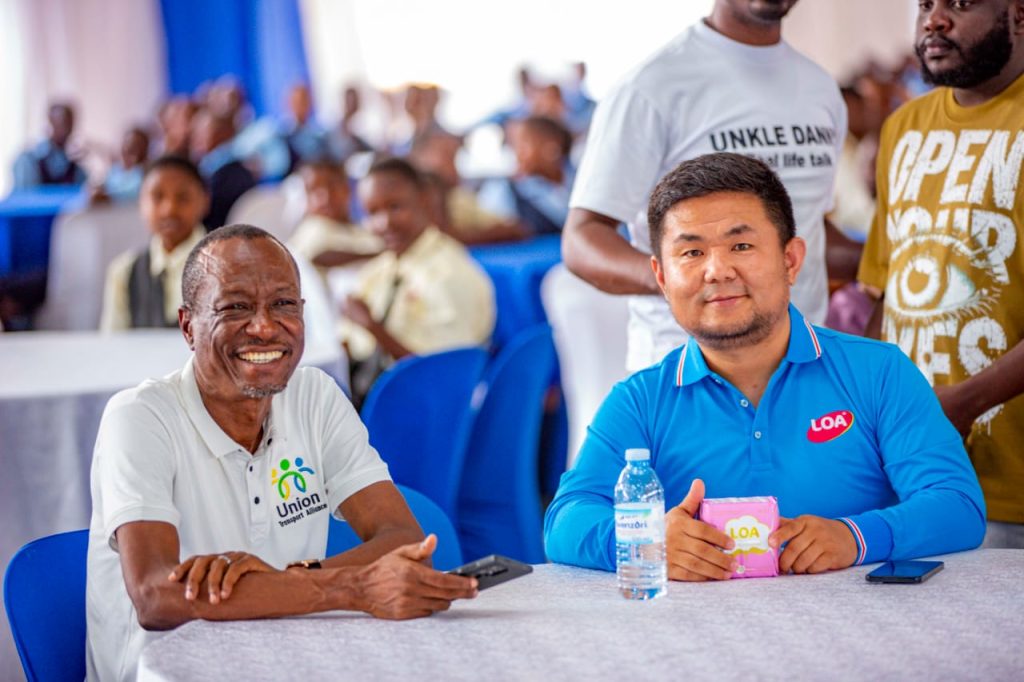
On June 20, 2026, the UMA grounds in Lugogo, Kampala, became the centre of attention as stakeholders gathered for the official launch of Union Transport Alliance’s maiden women’s product — Union Sanitary Pads — a locally manufactured product designed and produced in Uganda.
The event, however, became more than a product launch.

It became a demonstration of a bigger economic vision — the belief that transport should not only move people but also create industries, jobs, businesses and wealth for Ugandans.
Standing before the audience, Mr. Fred Ssenoga, the Managing Director of Union Transport Alliance, dressed in the organisation’s signature white shirt and black attire, delivered a message focused on women empowerment, hygiene, entrepreneurship and the need for Uganda to build stronger indigenous industries.
His message to young girls, women and stakeholders was clear: Uganda’s transformation will depend on building systems that connect citizens to opportunities.
While many listened to the message, one question remained hanging in the air:
Could transport become the foundation of Uganda’s next economic revolution?
For decades, Uganda’s development conversation has revolved around one powerful symbol — the road.
Every kilometre of tarmac has represented hope.
Every bridge has represented connection.
Every transport corridor has carried the promise of economic transformation.
In the 2026/2027 financial year, government committed significant resources towards infrastructure development, including road construction, rehabilitation and improving national connectivity.
The Ministry of Finance, Planning and Economic Development continues to identify infrastructure investment and private-sector participation as key drivers of economic growth.
But beyond the concrete, asphalt and engineering achievements lies a deeper economic question:
After the road is built, who benefits?
Because a road connects destinations.
But an organised transport system connects opportunities.
This is where Union Transport Alliance, founded by Ugandan entrepreneur Fred Ssenoga, enters the national conversation.
Ssenoga’s model challenges the traditional definition of transport.
He argues that Uganda must move beyond viewing transport as only vehicles carrying passengers.
Instead, transport must become an economic ecosystem — linking mobility, manufacturing, entrepreneurship, investment, technology and employment.
THE SHS 692.9BN QUESTION: CAN INFRASTRUCTURE CREATE PROSPERITY?
Uganda’s transport sector is not merely a service industry.
It is the heartbeat of economic activity.
Every morning, millions of Ugandans depend on transport to reach workplaces, schools, markets and businesses.
Farmers require transport to move agricultural products.
Traders depend on logistics to reach consumers.
Manufacturers rely on efficient movement of goods.
Investors require reliable transport networks to reduce operational costs.
But development experts warn that infrastructure alone does not automatically create prosperity.
Infrastructure creates opportunity.
Organisation creates value.
This is the economic argument behind Union Transport Alliance’s model.
As Fred Ssenoga explains:
“A road without organised users can remain a physical structure. A road connected to organised transport networks becomes a marketplace.”
The statement captures one of Uganda’s biggest development questions:
Not only how much money is invested in infrastructure — but what economic activity that infrastructure generates.
UGANDA’S TRANSPORT ECONOMY: THE HIDDEN WEALTH ENGINE
Uganda’s transport sector has grown into one of the country’s most important economic networks.
The increasing number of vehicles, motorcycles, commercial operators and logistics providers demonstrates how deeply transport is connected to daily life.
Behind every motorcycle is more than a rider.
There is a mechanic.
There is a spare parts dealer.
There is a fuel supplier.
There is a family depending on income.
There is a passenger accessing opportunity.
Transport creates thousands of invisible economic relationships every day.
However, for years, many of these activities have operated independently.
The result has been a fragmented sector where potential opportunities remain scattered.
The challenge before Uganda is therefore not only movement.
It is coordination.
THE POLICY GAP: FROM INDIVIDUAL OPERATORS TO ORGANISED SYSTEMS
Uganda’s transport future requires stronger organisation.
Modern transport economies around the world succeed because they operate through coordinated systems involving government, investors, operators, technology providers and communities.
The future cannot depend only on thousands of disconnected operators.
It must involve structured networks capable of attracting investment, creating jobs and supporting local industries.
This is why indigenous initiatives such as Union Transport Alliance are attracting attention among discussions on Uganda’s transport transformation.
The debate is shifting from:
“How many vehicles does Uganda have?”
to:
“How can transport create sustainable economic value?”
PARLIAMENT’S BIG QUESTION: WHAT HAPPENS AFTER THE ROAD?
As Parliament continues debating national development priorities and approving public investment, the transport discussion must move beyond budgets.
The bigger accountability question is:
What economic transformation comes after infrastructure investment?
A successful transport system should create:
New enterprises
Employment opportunities
Local manufacturing
Better logistics systems
Stronger private-sector participation
Wider market access
The responsibility of policymakers is therefore not only to construct infrastructure.
It is to ensure infrastructure creates citizens capable of building wealth.
EDSON KIRABILA: WHY TRANSPORT NEEDS STRATEGIC ORGANISATION
Mr. Edson Kirabila observes that Uganda’s transport challenge is no longer only about movement.
It is about building systems that generate economic value.
“The future of transport requires organised networks where every journey contributes to productivity and economic growth.”
His observation reflects a growing reality:
Without coordination, opportunities remain limited.
With organisation, transport becomes a platform for investment, innovation and industrial growth.
ALICE NATUKUNDA: THE HUMAN FACE OF A TRANSPORT REVOLUTION
Every economic transformation requires more than policies and investment.
It requires people who build trust, communicate ideas and connect communities.
At Union Transport Alliance, Ms. Alice Natukunda, the Brand Ambassador, represents the human connection behind the organisation’s vision.
Her role focuses on connecting communities, businesses and potential partners to the Alliance’s wider economic agenda.
“Transport transformation is not only about vehicles and roads. It is about people, partnerships and opportunities.”
The message highlights a critical lesson:
Development succeeds when citizens become active participants rather than spectators.
WHY INVESTORS SHOULD WATCH UGANDA’S TRANSPORT FUTURE
Uganda’s economic future is deeply connected to mobility.
Agriculture requires transport.
Industry requires transport.
Tourism requires transport.
Trade requires transport.
The next generation of investment will not only be about purchasing vehicles.
It will be about building systems.
Systems that connect markets.
Systems that reduce inefficiencies.
Systems that create sustainable businesses.
Union Transport Alliance presents itself as part of this emerging conversation.
Its vision is built around the belief that transport can become a national economic platform.
THE ROAD AHEAD: WHO WILL DRIVE UGANDA’S TRANSPORT FUTURE?
Uganda is approaching a defining moment.
The roads are expanding.
Demand for mobility is increasing.
The economy is searching for new engines of growth.
But history will not only remember the roads Uganda constructed.
It will remember whether those roads created prosperity.
Fred Ssenoga’s Union Transport Alliance represents a wider national question:
Can indigenous innovation transform transport from movement into wealth creation?
Can government, investors and entrepreneurs build a transport ecosystem that benefits millions of Ugandans?
The future belongs not only to those who construct roads.
It belongs to those who build systems that make roads create wealth.
For Parliament, investors and policymakers, the question is no longer whether Uganda needs a transport revolution.
The question is:
Who will organise it, who will invest in it, and who will ensure every Ugandan benefits from it?
Union Transport Alliance is presenting one possible answer.