




By Morrison Rwakakamba
Uganda stands at a rare inflection point in its development trajectory. With commercial oil production scheduled to commence later this year and a fresh electoral mandate secured, the national budget for the 2026/27 financial year offers more than another round of incremental spending. It attempts what development economists from Arthur Lewis to Amartya Sen have long identified as the central challenge of late-developing economies: a deliberate, sequenced shift from a dual economy—characterized by a large subsistence sector alongside a smaller modern one—toward inclusive structural transformation.

Monetization, through expanded access to affordable capital, commercial agriculture, and genuine participation in markets, enlarges the scope for specialization and exchange. Value addition in the four priority productive sectors—commercial agriculture and agro-processing, tourism, minerals and petroleum, and science, technology and innovation (ATMS)—can exploit Uganda’s comparative advantages while forging the backward and forward linkages that historically propel industrialization.

The supporting enablers—human capital formation, transport and energy infrastructure, security and the rule of law, and enforceable standards—are treated not as optional amenities but as binding constraints whose previous neglect has capped the returns on public investment for decades.
Uganda has known ambitious blueprints before. Vision 2040 and the successive National Development Plans promised commercialization, industrialization, and broad-based prosperity. In practice, execution remained the recurring weakness. Development budget absorption frequently fell short of targets. Projects were launched but mostly stalled, suffered significant cost and time overruns, or deteriorated rapidly for want of routine maintenance.

Funds were disbursed to well-intentioned programmes, yet their impact was diluted by leakage, weak monitoring systems, and incentive structures that rewarded disbursement over results. Infrastructure absorbed substantial public resources—yet deficit in complementary factors, above all bureaucratic inertia, technical and managerial skills, reliable market linkages, disciplined maintenance regimes, and accountable governance, lagged behind.
Debt-financed assets were created on a significant scale, but the productivity gains and fiscal dividends proved uneven. Five departures from previous budgets.This budget measures and reports results, not merely intentions. The speech documents concrete outputs rather than aspirational inputs. Wells drilled in the petroleum sector now stand at 199, exceeding the 189 required to commence first oil production later this year.
The national fibre-optic backbone has been extended to 62,941 kilometres. Turnaround times for product certification at the national standards authority have been reduced dramatically. The Parish Development Model has transferred 4.4 trillion shillings over five years to all 10,589 parishes nationwide and stands poised to reach four million beneficiaries by the end of the month. Formal private-sector employment has risen 245 percent since the 2016/17 financial year, now surpassing 2.3 million workers. Tourism receipts have recovered strongly to 1.86 billion US dollars. The judiciary’s resolution of commercial disputes has unlocked 14.47 trillion shillings in previously tied-up capital.
These metrics establish a verifiable baseline for accountability rather than the customary catalogue of allocations and good intentions.This budget designs for financial self-reliance rather than indefinite subsidy. The next phase of the Parish Development Model explicitly charts a transition from ongoing government transfers toward a self-sustaining financial ecosystem, ultimately envisaged as a dedicated development bank, anchored in repayment performance, improved governance, and integration with agricultural value chains. Earlier revolving funds too often functioned as instruments of political patronage or collapsed under weak loan recovery, reproducing dependency rather than enterprise. This conceptual advance recognizes that sustainable monetization requires institutions capable of recycling capital, not merely distributing it.
This budget sequences and integrates the productive core with its necessary supports. The four priority sectors—commercial agriculture and agro-processing, tourism, minerals and petroleum value addition, and science, technology and innovation—constitute the engine of the Tenfold Growth Strategy. They are backed by substantial commitments to the foundational enablers: security and the rule of law (10.21 trillion shillings), transport infrastructure (8.79 trillion shillings), energy development (2.07 trillion shillings), and human capital (13.56 trillion shillings in aggregate).
Security and justice are framed as productive investments that reduce transaction costs, protect property rights, and create the stable environment in which contracts can be enforced and enterprise can flourish—echoing the institutional insight that long-run growth depends less on the volume of investment than on the quality of the rules governing economic activity. Dedicated attention to standards, certification, and deeper integration with the East African Community and the African Continental Free Trade Area links expanded production to larger, more demanding markets.

This budget confronts the political economy of execution directly. A dedicated section on implementation reforms introduces a structured “clean-up” agenda. Accounting officers are required to sign budget discipline and accountability charters that carry explicit sanctions for breach. Procurement processes and internal controls are to be strengthened. Counterpart funding for donor projects is centralized under the Treasury to protect priority investments. Wasteful state-funded ceremonies on public holidays are to be curtailed. A contributory pension scheme for public servants is to be fully operationalized to place long-term fiscal liabilities on a sustainable footing. The pivot to “Kisanja No More Sleep” is deliberate political-economy signaling: the combination of a post-election mandate and impending petroleum revenues creates a limited window in which a culture of planning and debate can be displaced by one of implementation, measurable results, and credible consequences for non-performance.In this budget, petroleum alters both the scale of opportunity and the nature of risk.
First oil later this year introduces petroleum revenue into the resource envelope, with outer-year projections showing further growth. The total resource envelope reaches 84.39 trillion shillings, including development expenditure of 22.05 trillion shillings. Domestic revenue collections are projected to rise to 45.96 trillion shillings, equivalent to 15.9 percent of gross domestic product. The medium-term fiscal framework indicates that the primary balance is set to improve and that public debt, currently around 53 percent of gross domestic product, can remain sustainable provided execution strengthens.
The budget deliberately diversifies financing sources—concessional and project finance, public-private partnerships, innovative instruments such as sukuk, and the eventual listing of commercially viable state enterprises on the stock exchange—precisely to avoid the over-borrowing, rent-seeking, and misallocation that have accompanied resource windfalls in other jurisdictions.
In this budget, Execution remains the decisive test: The greatest vulnerability is the same one that undermined earlier national budgets: the gap between authorized allocations and realized outcomes on the ground. Additional resources of 2.49 trillion shillings for wealth-creation programmes, 2.26 trillion shillings for commercial agriculture and agro-processing, and 1.14 trillion shillings for science, technology and innovation constitute large sums by any historical standard. Their effective deployment will require capable last-mile institutions—functioning agricultural extension services, well-governed savings and credit cooperatives, and responsive local governments—together with genuine, sustained collaboration with private off-takers, agro-processors, and investors prepared to locate in industrial parks. The clean-up agenda supplies the formal instruments of accountability; their practical credibility will be tested in the first mid-year budget performance reviews and in the findings of the Auditor General. Climate variability, movements in global energy prices remain material risks. Yet the decisive test lies elsewhere. Success or failure of this budget will ultimately be registered not in gross domestic product headlines alone, nor in the elegance of strategic documents, but in the lived experience of ordinary Ugandans. If groups supported under the Parish Development Model evolve into commercially viable enterprises rather than one-off transfers; if irrigation and mechanization tangibly raise smallholder yields and climate resilience; if local content requirements in petroleum, mining, and manufacturing generate sustained skilled employment rather than token participation; if improved standards and market-access arrangements enable Ugandan products to compete regionally and globally without being penalized for quality shortfalls or logistics failures; and if the clean-up agenda produces measurable reductions in waste, leakage, and impunity—then this budget will have broken the historical pattern that has long separated announced ambition from tangible transformation.
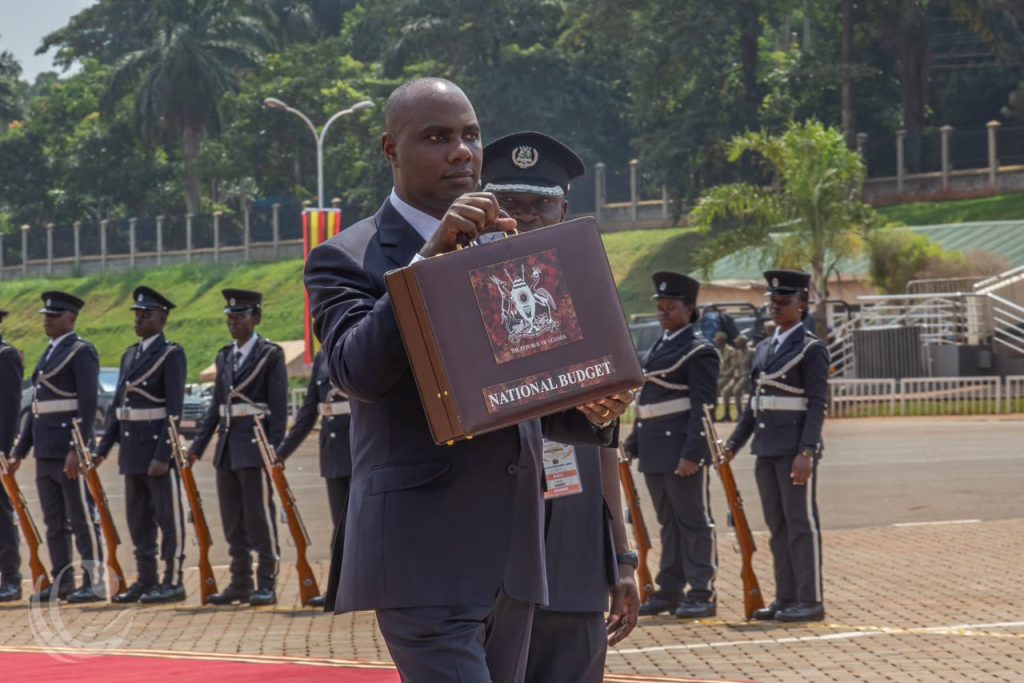
The Minister of Finance declared that the era of planning and debate is over and the era of implementation and results has begun. That is the only benchmark that ultimately matters. The common citizen—whether the smallholder in the highlands, the market vendor in the urban centre, or the aspiring young worker—is watching, not aggregate statistics, but whether the parish enterprise prospers, the market stall expands, or the child’s prospects measurably improve. Execution has become the decisive test of public purpose. Results is now the ideology.
Morrison RwakakambaCoffee Farmer and [email protected]