Why great teachers need both the heart to care and the mind to reason
How household poverty, reasoning, discipline and practical knowledge are shaping learners at Bukakata Seed Secondary School
By Brian Mugenyi
mugenyijj@gmail.com
Bukakata, Masaka: One by one, learners stream through the corridors of Bukakata Seed Secondary School, carrying books, school bags and the hopes of families looking to education for a better future. These are the lawyers of tomorrow, journalists and Ministers of the next cabinet in the next thirty years.
But Head Teacher Emmy Kasule says behind the classrooms and examination statistics lies a less visible challenge: household poverty is keeping some children away from school this term.
Averagely, a total of many students missed lessons and early education as they were unable to attend school due to lack of money and requirements to attend school in time.
Kasule, an experienced educationist and Makerere University graduate, says some families struggle to meet the costs associated with secondary education, leaving parents unable to return their children to school on time or keep them there consistently.
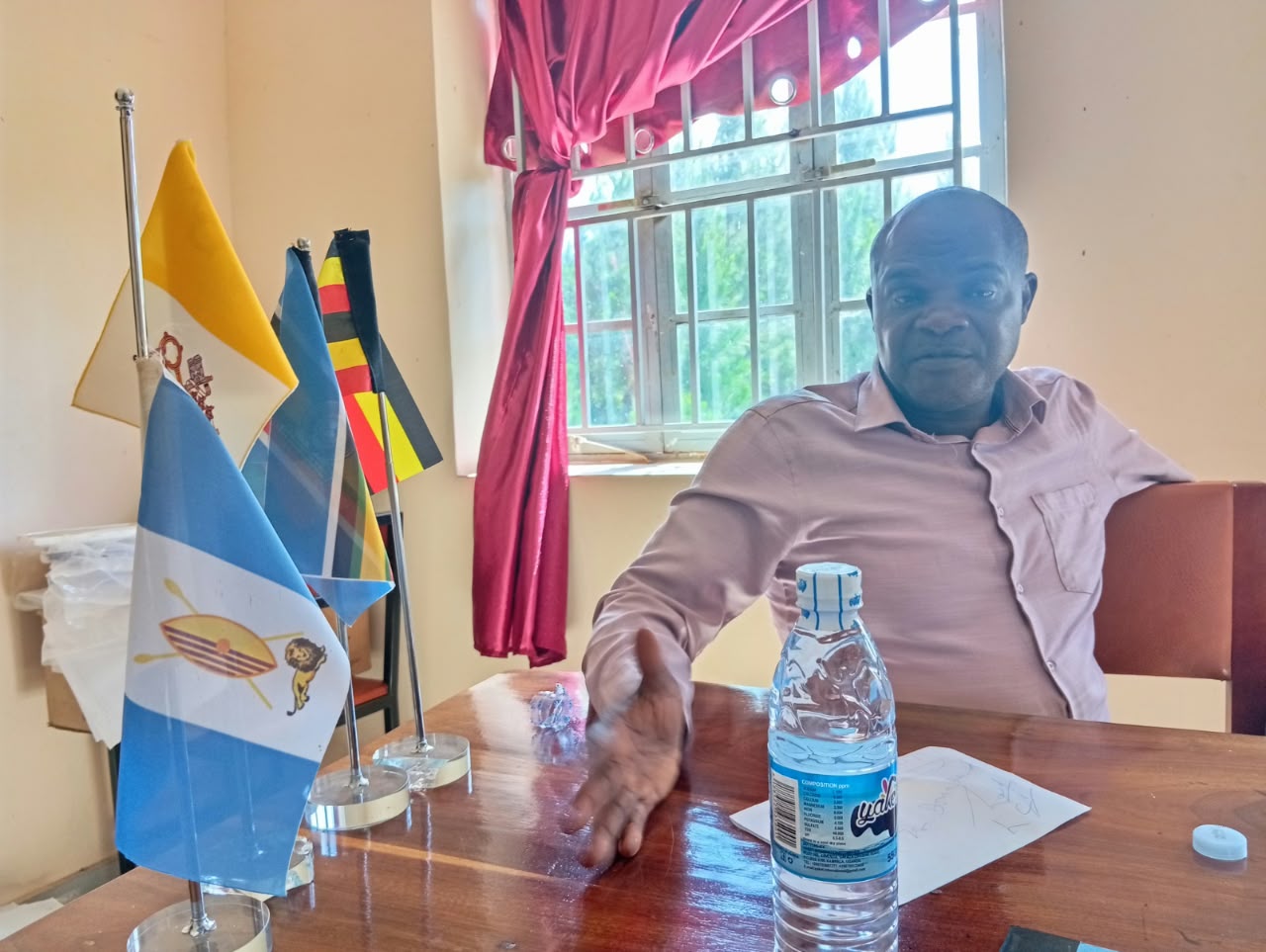
“In Bukakata, parents stay with their children in bedrooms and you expect them to be earning much?” Kasule said in an interview with this journalist on Saturday, describing the difficult economic circumstances facing some households.
He added: “The households are poor. The high level of poverty is the cause of the low turnout. Parents cannot afford taking students back to school in time. If it is not government help, there is a need for more intervention.”
His observations put a human face on a wider education challenge: access to a government school does not necessarily remove all the economic barriers that prevent children from attending consistently.
THE SCHOOL THAT GREW FROM 12 LEARNERS
Bukakata Seed Secondary School began in 2012 under the Government of Uganda’s Seed Secondary School Programme with only 12 pioneer learners.
The school has since grown to more than 450 learners, drawing students from Bukakata, Lambu Landing Site, the Kalangala Islands and surrounding communities.
For Kasule, the enrolment growth demonstrates the demand for secondary education in the area.
But it also exposes a difficult contradiction.
While the school can attract a large number of learners, some children in neighbouring communities continue to struggle to remain in school because of household economic circumstances.
“The households are poor,” Kasule said.
His argument is that government intervention has helped expand access, but families still face other costs associated with keeping children in school.
Uniforms, books, meals, transport and other scholastic requirements can become significant burdens for low-income households.
For a family struggling to meet basic needs, education can become difficult to sustain.
THE EMPTY DESK TELLS A STORY
Inside the classrooms, every learner carries a different story.
Some grasp lessons quickly.
Others require repeated explanations.
Some confidently ask questions, while others remain silent, afraid of making mistakes.
And as Senior Four candidates prepare for their October 2026 examinations, consistent attendance becomes increasingly important.
A learner who misses lessons risks falling behind classmates.
Repeated absence can create learning gaps, affect confidence and ultimately increase the risk of dropping out.
This is why Kasule believes a teacher must understand more than the academic performance of a learner.
The teacher must understand the circumstances behind that performance.
An empty desk may indicate illness.
It may indicate distance.
It may reflect family responsibilities.
Or, as Kasule argues in Bukakata, it may be a symptom of household poverty.
TEACHING IS NOT JUST ABOUT A LESSON
Kasule says teaching demands qualities that go beyond subject knowledge.
“Teaching is not like any other profession, such as the army or elsewhere. It requires a reasonable amount of reasoning and an emotional approach, while also ensuring that problems in schools are identified and solved,” he said.
For him, a teacher must combine professional knowledge with emotional intelligence.
A learner who is struggling academically may need another explanation.
A learner dealing with difficulties at home may need encouragement.
A student who repeatedly misses school may require the teacher to understand what is happening beyond the school gate.
This is where the art and science of teaching meet.
The science involves subject knowledge, lesson planning, assessment and reasoning.
The art involves patience, empathy, communication and the ability to understand individual learners.
THE HEART AND THE BRAIN
A teacher needs the brain to reason.
But a teacher also needs the heart to care.
The brain provides knowledge, analysis and problem-solving.
The heart provides patience, compassion and understanding.
Kasule’s approach suggests that the two should not be separated.
A teacher can maintain discipline while treating learners with dignity.
A school can demand high academic standards while recognising the challenges facing families.
A learner can be corrected without being humiliated.
For Kasule, discipline should ultimately help young people develop responsibility rather than simply create fear.
SCIENCE, ARTS AND THE QUESTION OF PERFORMANCE
The debate over whether science students perform better than arts students also requires evidence rather than assumptions.
Actual examination results and comparable school-performance data would be necessary to establish differences between the two groups.
What is clear is that Uganda needs both areas.
Science education develops analytical, technical and problem-solving abilities.
Arts and humanities contribute communication, creativity, history, culture, social understanding and critical interpretation.
The engineer needs communication skills.
The scientist needs to understand society.
The entrepreneur needs analytical ability.
The journalist needs research and communication skills.
The teacher needs both subject knowledge and the ability to explain it.
The country’s education system therefore needs to develop diverse talents rather than treating one field as automatically superior to another.
FROM 12 LEARNERS TO MORE THAN 450
The growth of Bukakata Seed Secondary School illustrates the demand for secondary education in rural communities.
From its 12 pioneer learners, the school now has more than 450 students.
But growth brings new responsibilities.
More learners require more teachers, classrooms, learning materials, ICT facilities and other infrastructure.
The challenge is to ensure that increased access is accompanied by quality.
Enrolment figures may tell us how many learners have entered a school.
They do not, on their own, tell us whether every learner is attending consistently, understanding lessons or receiving adequate support.
That is where school leadership becomes important.
WHEN ELECTRICITY CHANGES THE CLASSROOM
The school is also entering a new phase following the arrival of a power transformer.
For years, the absence of reliable electricity affected ICT lessons, evening studies and security.
The new electricity connection is expected to improve ICT learning, support evening preparation and strengthen security for learners and staff.
The development highlights an important reality.
Even the most committed teacher cannot deliver modern education without the necessary infrastructure.
A teacher may want to teach ICT, but computers require electricity.
A science teacher may want practical lessons, but laboratories require equipment.
Learners may want to study in the evening, but adequate lighting is necessary.
Education therefore depends on both human capacity and the learning environment.
THE TEACHER AS A MENTOR
For many learners, a teacher is more than an instructor.
Teachers can become mentors, role models and trusted adults.
They can identify talent, encourage struggling learners and guide young people towards careers.
But they can also become early observers of social problems.
When a learner repeatedly misses school, performs poorly or changes behaviour, the teacher may be among the first people to notice.
That makes the teacher part of a wider community response to challenges affecting children.
POVERTY AND THE FUTURE OF EDUCATION
Kasule’s observations raise a broader question for policymakers.
Building schools increases access.
But access alone may not be enough when families cannot consistently meet the costs associated with sending children to school.
For poor households, the difference between attending school and staying at home may sometimes be determined by a uniform, a meal, transport or scholastic materials.
This means efforts to improve education outcomes must consider both the school and the household.
A child cannot learn a lesson they were unable to attend.
And a teacher cannot teach a learner who is repeatedly absent.
EDUCATION AS AN INVESTMENT IN HUMAN CAPITAL
Today’s learners are tomorrow’s workforce.
They will become teachers, doctors, engineers, farmers, entrepreneurs, technicians, scientists, public servants and business leaders.
Every lesson therefore contributes to Uganda’s human capital.
A mathematics lesson may help prepare an engineer.
A science lesson may inspire a researcher.
A communication lesson may nurture a journalist.
A history lesson may deepen a young person’s understanding of society.
The impact of teaching is often not immediately visible.
Its greatest results may emerge years later.
THE FINAL LESSON
Kasule’s story brings the debate about teaching back to two essential qualities: the heart and the brain.
The brain provides reasoning, knowledge, analysis and problem-solving.
The heart provides patience, compassion, affection and understanding.
But there is another lesson emerging from Bukakata: a teacher can only do so much when poverty keeps learners away from the classroom.
The school has grown from 12 learners to more than 450.
Electricity is opening new possibilities for ICT and evening studies.
Yet household poverty remains a challenge for some families.
That means the future of education depends not only on what happens inside the classroom, but also on what happens outside it.
A teacher can explain.
A teacher can encourage.
A teacher can discipline.
A teacher can mentor.
But the learner must first have the opportunity to be present.
And behind every occupied desk is a young person whose education could eventually contribute to Uganda’s economy and society.
The future of Uganda is therefore being shaped not only by what teachers teach, but also by whether families can afford to keep their children in the classroom long enough to learn it.