35 health, legal, Government and pharmaceutical stakeholders examine patents, innovation and access to essential medicines
Kampala: A medicine can be discovered in a laboratory, protected by a patent and manufactured by a pharmaceutical company, but for a patient waiting at a health facility, its value ultimately comes down to one simple question: Is it available when I need it?
That question dominated discussions in Kampala on Thursday as health experts, lawyers, Government officials, pharmaceutical manufacturers, regulators, patient representatives, academics and medical professionals gathered to examine Uganda’s intellectual-property system and its implications for access to medicines.
The national dialogue sponsored by KELIN , an organisation and International Treatment Preparedness Coalition held at Protea Skyz Hotel in Naguru, brought together about 35 participants representing the Justice and Trade sectors, Parliament, regulatory bodies, local manufacturers, the media, legal experts, academia and medical professionals.
Representatives of people living with HIV, tuberculosis (TB), hepatitis C (HCV) and cancer also participated.
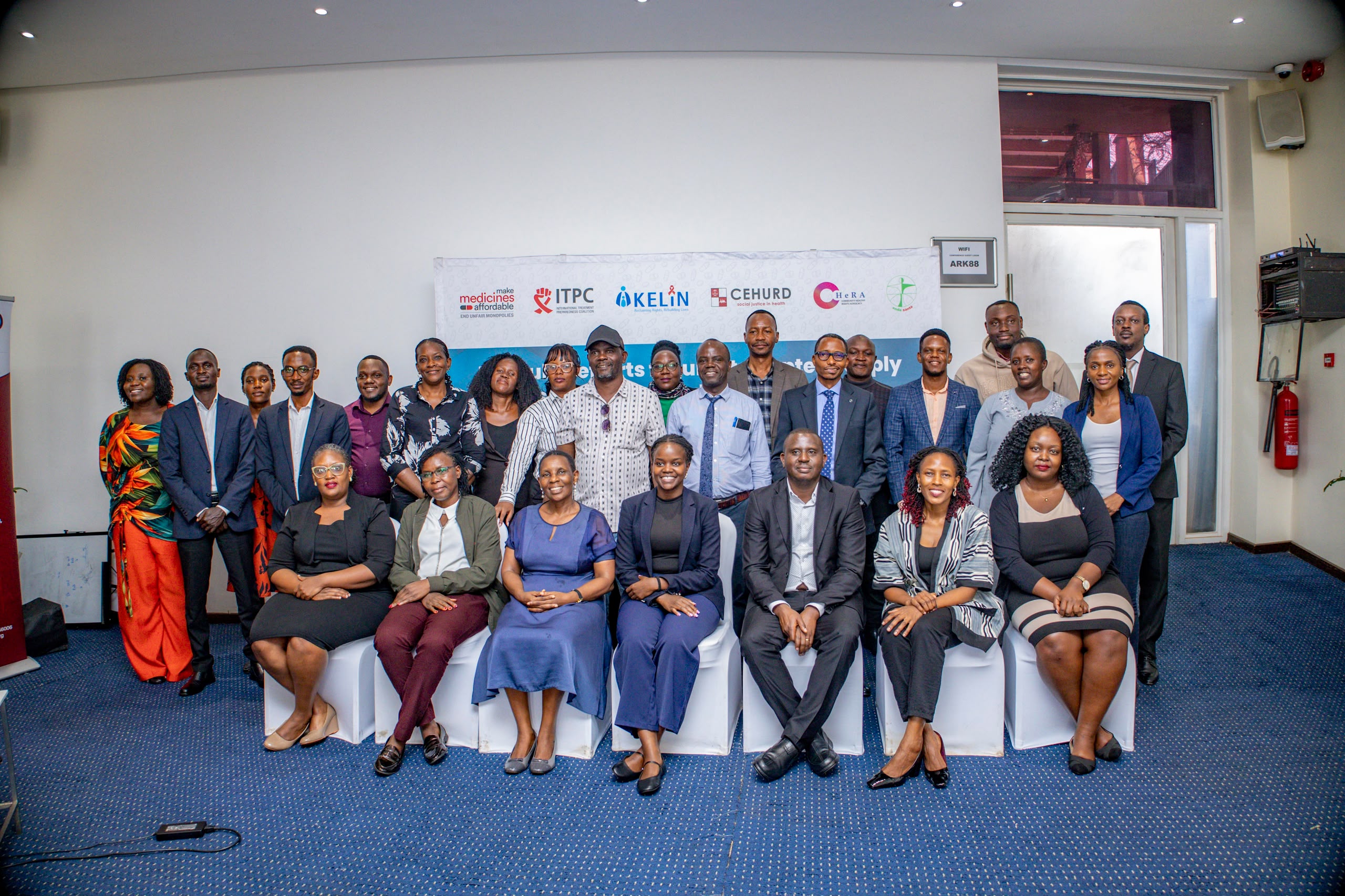
The discussions centred on a delicate balance: how Uganda can encourage pharmaceutical research and innovation while ensuring that patents and other intellectual-property protections do not unnecessarily restrict access to essential medicines.
“I GAINED A LOT OF KNOWLEDGE”
For Gloria Imodia, a Programme Officer at Dumaic Global Health, the symposium was more than another professional meeting.
It was an opportunity to understand how intellectual property can influence health policy and development.
“Today, I gained a lot of knowledge and, in my training, if all is put into practice in the national intellectual property, it needs countries such as Uganda to be able to develop,” Imodia said during an interview with this writer at Protea Skyz Hotel.
Her message was simple: knowledge must eventually be translated into practical policy.
For a country such as Uganda, where health needs continue to compete with limited resources, intellectual-property decisions can have consequences far beyond courtrooms and legal documents.
They can affect medicines.
They can affect prices.
And ultimately, they can affect patients.
NIMWESIGA: INNOVATION MUST BENEFIT PEOPLE
Lawyer Seth Nimwesiga, representing the Centre for Health, Human Rights and Development (CEHURD), challenged participants to look at intellectual property through the eyes of both innovators and the public.
He emphasised the importance of encouraging medical innovation while ensuring that legal mechanisms such as compulsory licensing are properly understood and considered where applicable.
“If someone develops a drug, he or she has to register that drug,” Nimwesiga said.
He argued that intellectual-property systems should not only protect those who develop medicines but should also enable society to benefit from those innovations.
“People need to benefit from intellectual property and need to benefit from essential medicines,” he said.
His argument placed the patient at the centre of a debate that can easily become dominated by technical language about patents, licences and pharmaceutical rights.
THE KIRABIRA QUESTION: DOES UGANDA HAVE ENOUGH CAPACITY?
Dr Denis Kirabira, Chief Executive Officer of Dumaic Global Health, said Uganda’s intellectual-property policy framework is evolving.
But, he added, the country needs stronger capacity among the people and institutions responsible for interpreting and implementing it.
Kirabira said lawyers, researchers, regulators, health professionals, policymakers and pharmaceutical manufacturers need to understand how intellectual-property decisions can influence innovation, local production, medicine availability and affordability.
He also stressed the importance of partnerships.
For Kirabira, Uganda cannot address the pharmaceutical challenge through one institution working alone.
Government must engage manufacturers.
Researchers must engage policymakers.
Legal experts must understand public-health needs.
And patients must have a voice in decisions that ultimately affect their treatment.
KONDRATYUK OPENS THE PATENT QUESTION
The international dimension of the symposium was brought into focus by Sergey Kondratyuk, an intellectual-property expert from the International Treatment Preparedness Coalition (ITPC), who shared insights on patent applications, patented medicines and pharmaceutical “evergreening”.
Evergreening is broadly associated with efforts to obtain additional intellectual-property protection around an existing medicine through further claims involving matters such as formulations, modifications or uses.
The discussion raised questions about how patent systems can reward genuine innovation while preserving legitimate opportunities for generic competition and access to medicines.
Kondratyuk also discussed Uganda’s position as a lower-middle-income country and the importance of understanding the policy mechanisms available to countries seeking to improve access to pharmaceutical products.
He referred to a medicine costing about US$28,000, using the example to illustrate the importance of exploring mechanisms that can make essential medicines more accessible.
“Partnership is the way to go,” Kondratyuk said.
THE UNINTERRUPTED SUPPLY CHALLENGE
For people living with HIV, HCV and TB, treatment is not a one-day event.
It requires continuity.
The same applies to cancer patients and women requiring cervical-cancer prevention, diagnosis and treatment services.
An interruption in the supply chain can therefore become more than a logistical problem.
It can become a health problem.
Participants called for stronger systems to ensure essential medicines and health commodities are available consistently.
The discussion covered the role of Government, pharmaceutical companies, regulators, researchers, medical professionals and patient organisations in strengthening medicine security.
LOCAL MANUFACTURING: CAN UGANDA PRODUCE MORE?
Another major issue emerging from the dialogue was local pharmaceutical manufacturing.
Stakeholders discussed the possibility of strengthening domestic production as part of Uganda’s broader effort to improve medicine security and develop its industrial base.
Local pharmaceutical manufacturing can create opportunities for employment, technology transfer, research and investment.
But participants noted that factories alone are not enough.
Uganda also needs skilled personnel, research institutions, effective regulation, investment and an intellectual-property system capable of supporting innovation.
The connection between health and industrial policy is therefore becoming increasingly difficult to ignore.
PATIENTS BRING THE HUMAN STORY
While lawyers discussed patents and experts examined intellectual-property systems, patient representatives brought the discussion back to the human experience.
For someone living with HIV, TB or HCV, the question is whether treatment is available.
For a cancer patient, it is whether the required medicine or health technology can be obtained when needed.
For health workers, it is whether they have the tools required to care for patients.
That is why participants said intellectual-property policy should be examined alongside medicine procurement, pharmaceutical regulation, local manufacturing and health-system capacity.
A BALANCE BETWEEN INNOVATION AND ACCESS
The Kampala dialogue highlighted a difficult but important policy balance.
Pharmaceutical innovation requires investment.
Patent systems can provide legal protection for inventions.
But public-health systems also require affordable and reliable access to medicines.
Uganda therefore faces the challenge of strengthening its capacity to navigate intellectual-property rules while protecting public-health interests.
The discussions also highlighted the importance of partnerships between Government, local manufacturers, international experts, researchers, lawyers, civil society and patient organisations.
As Kirabira and other participants emphasised, the debate cannot end in a conference room.
It must eventually reach the health facility.
It must reach the pharmacy.
And most importantly, it must reach the patient.
Because behind every patent application, every pharmaceutical innovation and every policy document is a human being waiting for treatment.
For Uganda, the real measure of an effective intellectual-property and pharmaceutical system may ultimately be simple: whether the medicine reaches the person who needs it, when they need it.