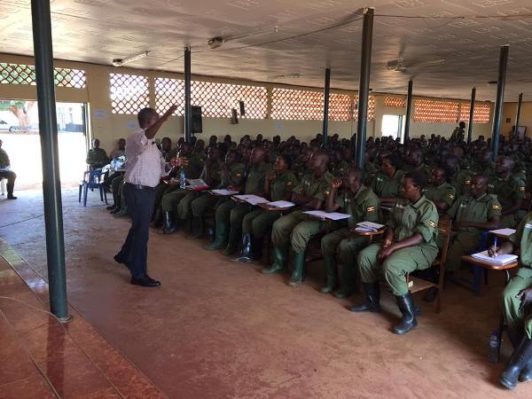
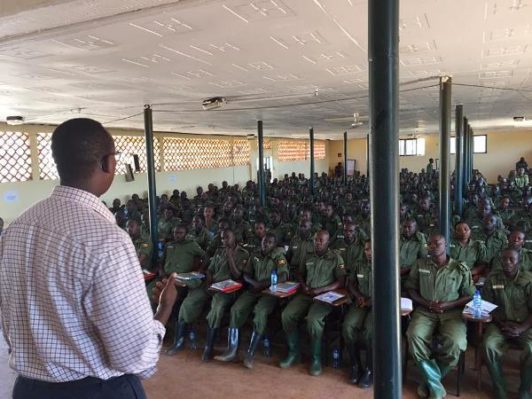
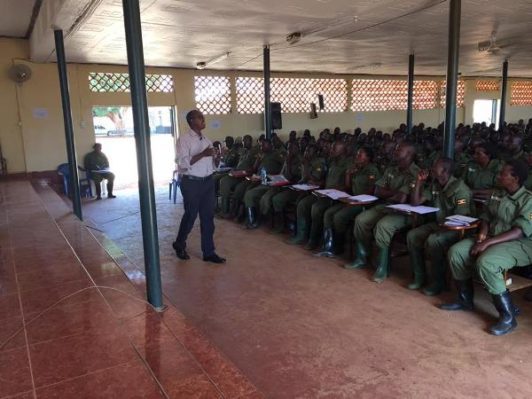
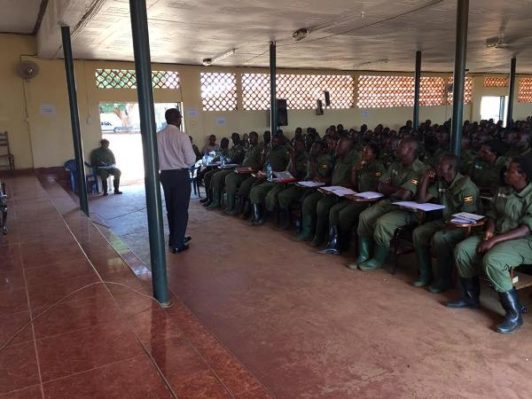
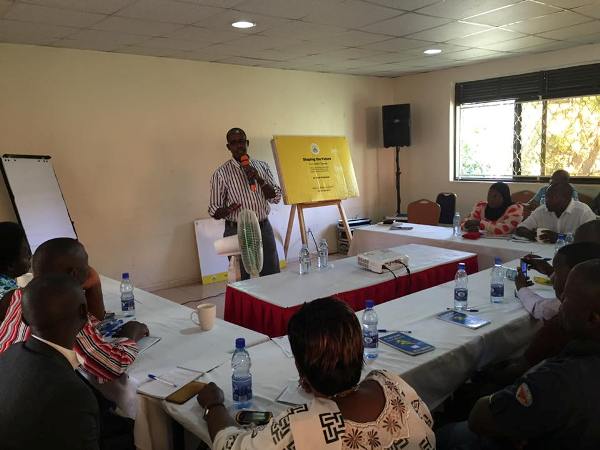
Together with his team, Odrek Rwabwogo on Thursday preached to over 250 trainees on social and economic triggers of a revolution at the National Leadership Institute Kyankwanzi.
“We spent today February 23, at the National Leadership Institute (NALI) at Kyankwanzi speaking to the over 250 trainees. A good crop of educated, semi middle class people from all parts of the country, they gave good attention to the topic “Social and Economic Triggers of a Revolution: What should our generation care about for a future Uganda?”.
We were honored to deliver the lecture and it is always a wonderful opportunity and pleasure to be in NALI and see the team of committed Ugandan leaders and instructors who wake up every morning with one aim: To change the mindset of our people and Prepare them for a more united and prosperous nation with responsible citizens,” Rwabwogo posted.
One of my weekly installments in the ideology and mentorship column in the New Vision seems to have drawn the ire of Mr. Mafabi who chose to pull his pen out and vehemently object. This is as well that those who should lead these matters by virtue of their deployment or perhaps even conviction but quite often choose silence, are finally speaking. I am also glad that this might begin a debate for our generation over the interpretation of the elements and key adaptations of the Movement ideology through the changing seasons. Mr. Mafabi adds his voice to this debate and I welcome it.
Here are some corrections I would like to make in regard to what he posited:
“Rwabwogo’s article contributes to ideological confusion and is a study in eclecticism”.
There is a tendency to see the ideology of an organization as ONLY growing organically and to vehemently object to other ways in which one can improve and adapt it to the changing times. For many organizations that don’t overcome this dogmatic thinking, they have deep trouble growing beyond the founders. ‘Eclecticism’ (a tendency to borrow from various styles, thoughts and traditions) for which Mafabi accuses me, is actually the natural way ideas in an organization or nation grow and later discarded, if necessary, if they don’t measure up to the needs of society. For example Architecture, psychology, medicine and governance ideas are all eclectic. Let me explain:
The Mesopotamian kingdom around the Tigris and Euphrates rivers (present day Iraq) built the first roads in 4500BC. The Romans, centuries later, picked the idea and built excellent cobbled roads we still see in Rome, parts of Greece and France and in 1820, John McAdam, a Scottish engineer, pioneered stone crushing and compaction for firmer roads. By 1870 with the discovery and drilling of the first oil well in Texas in 1859, an American professor invented the use of asphalt. A few years ago in Uganda, Dr. Bagampadde of Makerere university devised a new method; that of solidifying ant saliva and using it to make roads that last 30 years or more, a much higher proposition for a country that spends billions on the road infrastructure that collapses within 15 years.
Would you say that the development of the road making idea is wrong and humanity shouldn’t borrow from each other to solve our problems? Many years ago, scientists told us that if someone is sick, doctors should bleed them so that less blood in the body will help a patient recover. Today we know that this wasn’t right and caused a lot of death. We instead do blood transfusion. We put blood in the body instead of draining it. Is it bad to learn from others or circumstances and experiences to improve our thinking and behavior?
If you agree that learning and gelling ideas is a fine tradition, you need to know that the Movement Ideology too is partly eclectic. Our theory of fighting a protracted guerrilla warfare and working with peasants in the bush was largely adopted from Mao Zedong, our tools of analysis of the laws of social motion were learned, adapted and developed from Karl Marx and other philosophers of his time, our practice of teaching the common person to use a weapon was formed and tested in Frelimo’s liberated zones in Mozambique and since 1987, we have adjusted progressively to suit the political and economic demands of the time.
If it weren’t for this, would we have changed from a Movement system, even if this was largely in form not substance, to the multi-party system? A life well lived whether that of an individual or an organization, in my opinion, is eclectic and we should not be ashamed of saying this especially if we strike from firm principles such as those core to the Movement (Democracy, Nationalism, Panafricanism, Social economic transformation). We have borrowed and have remained flexible in order to be something to everyone and to be understood by all so as to govern and grow the country.
“Rwabwogo doesn’t specify the historical epoch. The mercantilist epoch was predatory and rapacious and the basis of construction of democratic institutions”
I am not sure that the lack of naming the period takes away the principle embedded in the argument. Yes, the mercantilist epoch was bad but I also know that there are nations that have used it in a rather commercial and competitive way without necessarily launching a war and pillaging in the 20th century and achieved immense success.
I think we should desist from picking only the negativity in a situation simply to justify our position. We need some rounded intellectual honesty if we have to face our problems and find solutions to them. Just to clarify for those who might lose meaning in the translation, Mercantilist behavior in simple terms, means taking raw materials from one country and processing at home and thereafter export back to that country where the raw material came from, your finished products. This is what colonialism was about; source the raw material for your industry and secure a protected market for your goods. Mercantilism also means imposing high taxes on export of raw materials from your country and giving huge export incentives for finished products out of your country. This gives a country a favorable balance of trade.
You can accuse Japan for the brief of occupation of China in the 1890s or her role in Korea, Burma etc but you can’t get away from the fact that South Korea, Malaysia, Singapore, or even Japan in large respects in the last 40 years, focused their companies on importing raw materials in post war years and building local processing and export capacity that has built their ascent out of poverty.
Yes, we were invaded in Africa but so were many of these nations. Their ability to rapidly heal and use all their civil service commitment, business community acumen, discipline and institutions to compete for a top place in the world, simply takes the wind out of many of our arguments about our history and our nation building exercises in Africa. So, while we can be cynical in our approach to studying mercantilism and how it was bad, clearly we have a self inflicted black eye that we got to face and treat. How come others make good out of a bad situation pretty quickly (go visit Vietnam and see) and we make a lot more excuses for our people and our weaknesses?
“The Ugandan ruling class was an appendage of Managers of the enclave economy”
I don’t think in any way in my article I alluded to this not being a fact. I think rather than expand his view, Mr. Mafabi simply took a little thread out of my broader argument and made a case for this narrow prism that he wanted his readers to see through.
My broader argument was that if you take the three classes of the French society in 1789 as your starting point of analysis, you will notice how modern day ruling classes in Europe emerged. The French society on the eve of the revolution had the Clergy at the top of the food chain who owned monasteries and, therefore, controlled the transmission of knowledge. They paid no tax. These were followed in importance by the Nobles who sat both at the King’s court and in the provinces and extracted food, money and youth conscription into the army from the third class- the peasants and generally the commoners, who were highly taxed. The nobles too paid no tax.
Tucked away in the third category along with peasants and commoners at the bottom of society, was a rapidly growing segment of the French society feared and hated in equal measure by the establishment because of their influence, capital and knowledge. These were the emerging bourgeoisie class- the artisans, merchants, lawyers, doctors, etc who also bore the burden of tax and bribes to be able to trade. It is this last group that mobilized the peasants and other classes along the ideas of ‘Egalite, fraternite and Liberte’ to rebel against the status quo. It is these who eventually owned capital and the means of production, employing millions of workers flocking into cities from rural areas and eventually destroyed the privileged aristocratic classes of Europe replacing them with a new ruling elite that they (the haute bourgeoisie- bankers, industrialists etc) had immeasurable influence over.
I hope Mr. Mafabi knows that in the Agricultural age, land was the main raw material and those who owned large chunks of it, had power and influence; in the Industrial Age, Iron became the raw material and those with capital, factories and goods, led the charge in power relations. Today, those who own and control big data, one of the biggest tools to determine the treatment of today and tomorrow’s diseases, our food, education, science will have power in this and the centuries to come.
It is, therefore, always the struggle between the owners of the means of production and those who they employ, that eventually shapes power relations in society, produces compacts on which to base governance and allows or disallows those who become rulers.
My question was: Where do you place African countries that collapsed when the “appendages of managers of the enclave economy” as Mafabi put it, failed?
My argument was that the emergence of the ruling classes in these post-colonial nations was irregular, inorganic, not negotiated based on any economic or class stimuli and thus was prone to conflicts based on parochial and vertical interests (tribe and religion) and; those who won these conflicts and restored order, tend to become institutions in themselves and it behoves all societies that want to continue growing and answering the questions of tomorrow, to have a transparent debate about internal democracy of the institutions chiseled out of conflicts in a fragile society.
It this assessment Mr. Mafabi missed to pronounce himself on and instead focused on definitions of terminologies and he search for historical dates and their accuracy. While I acknowledge terminologies are important, they don’t dim the importance of the underlying principle of my argument.
“The state is always an instrument of the economically dominant class”
Certainly, no doubt about this but what point is being made here? What light is Mr. Mafabi shining here for those who want to find meaning? I thought Mr. Mafabi would acknowledge that a modern state derives and can only keep its coercive power from among other things, those it is able to tax in order to spend on that society in areas such as defense, education, health, technology etc. In fact a modern State’s capability to enforce tax compliance shows its ability to govern and its broad acceptability. It goes without saying, therefore, under normal circumstances, that those it taxes can and should hold it accountable or change the leadership of the state and alter its institutions if they like, its being “an instrument of the dominant economic class” characteristic not withstanding.
Fukuyama’s works is Neo- liberalist orthodoxy
I think this is another area that perhaps Mr. Mafabi wanted more to prove he has read Fukuyama’s work and less to challenge my argument. Just for the reader’s clarity: I used Fukuyama’s quote in my article in the context of his (Fukuyama) admiration of the performance of the strong Singaporean leadership and its state that gets things done even if this isn’t fully the traditional western liberal values it runs on. I didn’t use it in any way to deny the fact of Fukuyama belonging to the western chest thumping triumphalism school.
“There is a clear developmental framework in place going beyond recovery, construction and take off”
We have a major challenge here with Mr. Mafabi’s position but I think he needs to be forgiven, given that he might be speaking from a theoretical, hands-off perspective and yet my own approach to the matters of economy are real life scenarios based on day to day constraints we face in the private sector from production, to processing and marketing of the country’s products.
Let me give the reader just one example. In the last election campaign, the Movement government made a commitment to double the amount of exports in the next five years from USD3.2bn to at least USD6bn so as to help transit to middle income country status. To achieve this, we posted a requirement for additional capacity of USD300m from Milk, Rice USD376m, USD190m from Tea, USD2bn from coffee exporting 16m bags etc. The Ugandan milk market is just about less than one third of the Nigerian one, the latter at about USD1bn largely supplied by Western Europe. For UGANDA to supply this market, one must reduce the cost of air flight of cargo currently at an average of USD1.5 per kilo. In the current set up of the ministries of Finance, trade, works and foreign affairs, there is no export infrastructure, no uniform command centre organized in any way to support firms trying to export. We just have silos of ministries and departments disconnected from the most important agenda of the country. Yet for every business that attempts export, therein lies seeds of innovation, getting into the global value chains etc.
And the world is not short of examples on how to circumvent these problems and bring significant thinking in this area but there is no place to deliver this advise and it is effectively consumed.
So when someone says there is a “development framework for take off” I feel that they are simply either walking on egg shells trying to not offend anyone and so they choose jargon over truth or they perhaps are disconnected from what a country needs to transit to a new level of competitiveness or they suffer from both strains of the disease that cause induced blindness.
” There is ENOUGH internal democracy in the NRM”
I prefer not to stork more fires on this point but i am not sure Mr. Mafabi reflected on the use of the term ‘Enough’ in his text. There isn’t and shouldn’t be such a word immediately following the word ‘democracy’ because there can’t be a position of “enough” in the field of expanding the frontiers of debate, human freedoms and democracy in any institution in any country.
Humanity should be allowed to continue challenging itself to get to the best of worlds.
“Some of the more youthful echelons have started confusing biology with ideology”
I sincerely hope that this allusion to ‘biology being confused with ideology’ isn’t meant for me.
At 47 and my own worldview from when I was a university student some 23 years ago, looks down on judgments about people based on age, origins, money, looks, religion, names, Colour, relations, friends or any other shallow externalities that people use to pass sentence on others.
It isn’t just simply repugnant to me but such a waste to put any man or woman’s purpose on earth on such fleeting externalities as these.
Human beings are more than what their age or political inclination is.
Odrek Rwabwogo has called for farming and agriculture support across the country. Odrek who was on a farm tour in Northern Uganda and Hoima over the weekend said agriculture is key to development.
He crititised some of the ministries’ officials of government have been discouraging farmers from growing Shea butter trees and yet offer no alternative to the farmers who have for several decades grown this crop.
Odrek also called for sensitization of farmers on commercial farming.
“I met this young man in Keri Muco, Longira parish in Upper Maddi in Koboko district yesterday. He is doing his best to preserve some of the Shea butter trees that peasants have been cutting and burning for charcoal. Shea butter has natural vitamins and is often used for skin therapy. A large part of Northern Uganda have these trees growing naturally. This young man is a trained agronomist from Gulu and oversees the planting of a large eucalyptus tree plantation of 103 acres expecting a growth of 515,000 trees in the next six years.
The trees will be bought by the Tobacco curing companies instead of the people cutting down natural forests. Some of the ministries’ officials of government have been discouraging farmers from growing the crop yet offer no alternative to the farmers who have for several decades grown this crop.
I was so pleased to find one person making a difference to recover our natural environment and help keep the Shea butter tree rejuvenating,” Odrek said.
“Today I spent the day with the farmers of Opit in the new Omoro district, formerly Gulu, before crossing over to Kiryandongo where I met Eseru Paul and his wonderful team of extension officers and later, Buhanika in Kyabigambire in Hoima district.
In Hoima we took time and calculated the total annual income from one common crop they grow- Tobacco. At about an acre, the average for a farmer both in Bunyoro and West Nile, with 12,000 seeds, a farmer makes up to UGX3m for one cropping a year. Because government does not offer fertilisers, crop finance and other inputs, for the crop sector, the tobacco sponsoring companies offer these and instead recover well over UGX1m off the 3m they pay to the farmers.
If we assume a figure of UGX120,000/= a month the farmer retains, we calculated with them their monthly needs which include: Paraffin, soap, sugar, salt, school fees for the I children, family medication, small amount of air time at 10,000/= a month (because almost all the farmers have a cellphone), transport to the shops etc, we got a total expenditure at a household level of UGX150,000/=.
This means the farmer simply can’t live on one acre of Tobacco even if the incentives might be good. You must introduce to him sorghum or maize or a crop to supplement both the food and income.
This gave me an Idea. Suppose government did a partnership with private companies that are already in the sector; some of them have very highly trained extension service officers (remember the whole of NAADS and OWC doesn’t have even half of the 5000 extension officers needed by our country to reach at least a minimum of two parishes for one officer- Uganda has about 7500 parishes), who only handle one crop. The companies among themselves have about 500 extension officers in villages and parishes who they pay monthly and on average 80% of them have a motorbike.
Let’s assume NAADS signed a partnership with these companies and utilized the private sector resources now used on simply one crop, would we not introduce another cash crop for the farmers at a fraction of the current government expenditure on extension service?
These are matters that bother me and lack a platform in our party and government to drive the current slow processes so as to introduce these incremental changes in our systems,” Odrek Rwabwogo said.
Odrek Rwabwogo has quashed rumours that he wrote a dossier or missive calling on President Yoweri Museveni to step down for young blood.
Odrek Rwabwogo
Odrek said the article that run in Uganda’s leading Tabloid and attributed to him was not true. He said the work is his normal weekly movement ideology and mentorship column which runs in the New Vision every Monday.
This is what he said;
1) There was NO dossier or missive, as they crookedly chose to term it, which was specially written to anyone. The so-called dossier is a piece out of our normal weekly Movement Ideology and Mentorship column run in the New Vision every Monday.
2) We have produced these pieces for 59 weeks so far with a detailed account of the history, values, foundations and application of the Movement Ideology through the times; including the generational challenges we face in learning, growing and adaptation to the changing times.
3) We proffer for every piece what we think are solutions to adopt for the building of the Movement of tomorrow; we run through new ideas on re-tooling the economy, health, trade, science, education and governance to build a better Uganda. There was, therefore, no specialness about this piece, except for the cockeyed misrepresentation.
4) I ask our readers and those who care for an informed and mature debate about the future of our country, to kindly ignore the so called dossier or missive. Thank you. Odrek Rwabwogo
On Friday, Tomosi Farm Bwesharire hosted animal feeds processors from Flanders in Belgium. This is aimed at improving the production of animal feeds at the farm.
Odrek Rwabwogo said, one of our major agricultural industry’s problems is the lack of supplementary feeding for animals to maintain consistent production in both dry and wet seasons of the year and if such is worked on, the production may not be hindered by dry spells.
“Yesterday February 3,2017, we hosted animal feeds processors from the region of Flanders in Belgium at Tomosi’s Farm Bwesharire.
One of our major agricultural industry’s problems is the lack of supplementary feeding for animals to maintain consistent production in both dry and wet seasons of the year. Almost all our production is rain fed causing huge farmer losses and increased raw material prices in the dry seasons. The price of milk now in our area at the chilling Centres is above UGX1000 but the farmer still gets about UGX700 and the UGX1000 won’t hold for long as the rains come in March as expected.
Producing feeds for animals will even out these highs and lows allowing farmers to negotiate prices over a long haul especially with increased processing capacity in the dairy industry. Since government largely abandoned farmers both at a production and commodity marketing level, we can only find commercial partnership with feeds manufacturers for the communities to make any headway. The Inve Belgie Company is one of these key partners and we hope something good for the community can come out of these visits to the area,” Odrek Rwabwogo said.
Ideology preacher Odrek Rwabwogo last week joined a training session to mentor and raise caliber of young leaders with a sense of history. Rwabwogo while posting on his social media wall said the training was meant to help young leaders understand the economy and what drives growth and the fundamentals of building a new and better Uganda.
“Yesterday we participated in a training session to mentor and raise a caliber of young leaders with a sense of history, understanding of the economy and what drives growth and the fundamentals of building a new and better Uganda.
The training was facilitated by Tunaweza group which works with many supporters of the Movement mainly residing in over 57 slum areas of Kampala. These are places like Kasokoso, Ki-Mombasa, Kifumbira etc. Tunaweza offers them small loans and teaching to help them start their own businesses.
For the people who might look down on slums today and judge them and ignore their inhabitants, this is just a little history of the word for you.
In the 1490s when exploration and the Holy Roman Empire was at its peak in Europe, in Venice, one of the then developed parts of Italy, there were slums humming with production.
The difference is that they were called Ghettos then but the meaning was clearly the same as slums of today anyhow. Those ghettos were largely occupied by the Jews who would have found no work with the citizen Venetians. The ghettoes became the source of knowledge and the empowerment to start foundries of Europe that made steel, glass and Employed thousands of people.
The ghetto men and women eventually became the most sought after people with skills, transiting from slum people into the middle classes of the time.
Anybody therefore underestimating the ingenuity, power and industriousness of slums either doesn’t know the source of future factories for Uganda or simply plays politics without a purpose with these people. I am glad I was, together with my team, part of the teaching,” Rwabwogo posted.
In a related development Odrek Rwabwogo discussed the role of ideology in shaping the future of the Movement and the tasks for the next leadership of Uganda at Urban TV on Tuesday.
Odrek Rwabwogo earlier in the week also saw off their team to the National Leadership Training institute, Kyankwanzi.
Tomosi Group of companies ended the year in style by throwing a staff party to celebrate end what Odrek Rwabwogo described as a difficult year in business terms. The party was held last week.
But despite the year being difficult business wise, Tomosi managed to introduce new milk packed product in the market called MilkMan yogurt.
“This evening, the Tomosi group staff held an end of year party to thank God and our team for persevering through a year that has been tough in terms of business with high interest rates, low sales and slow growth.
The group incorporates agriculture, travel, Security, media and warehousing. We thank all clients, our board members and staff that have stayed with us, guided us and improved our resilience capability throughout a challenging business season,” Odrek Rwabwogo said.
City businessman, politician and lawyer Odrek Rwabwogo has revealed that he is glad to have replied Charles Rwomushana’s submissive about him. Here is his explanation regarding his objection to reply Rwomushana;
Dear friends on this forum,
A number of people called me to say there wasn’t any need to reply Mr. Charles Rwomushana’s rant in the first place but I am glad I objected and followed my instinct and replied him anyway.
This is because I have now seen the various responses and many of them confirm to me that we need to continue the engagement and teaching since our demographics have fundamentally changed as a nation and so has been the lowering of learning, debate and public discourse standards, unfortunately.
Odrek Rwabwogo
There are about three key areas I would like to respond to that were raised here and in another forum. However, the trouble with social media is that many times you don’t know who you are speaking to, how old they are, their interest in a discussion and whether they have the time required to internalize something and make use of it or they simply want to abuse and walk away.
But since in Buganda we say “Embulila tefa yoona” (not all preaching goes to waste. It may save a soul), let me try and answer some of the things raised here:
1) Why is it that Rwabwogo is the only one teaching ideology yet there are better people to do it and they are not funded?
Answer: Ideology is simply the “world view” or outlook of an Organization on key issues and how it defines its role in the world and with its followers. It includes such things as values, norms and what it takes as important in its life.
The people who shaped the Movement thinking and practice as an organization, weren’t the most educated or rich or had any special abilities. They were common people like you and me led by some committed individuals and simply wanted a better country than they had found. No one chose those individuals; only perhaps circumstances did. Each and every one had “Omwooga” or talent and they put it to good use in the service of the organization, irrespective of their position or status in life. It is this rich tradition that I keenly follow. No one asked me to teach, nobody approved my teaching and nobody supports my research, writing, training and mentorship. When I set out on my own in May of 2015, it was largely out of frustration that an organization which had been built on so much good will, had lost its shine and veered off the road in many respects. Knowing that to go back to the roots of a thing leads to its healing process, we did and continue to speak plainly and teach these foundations to both the young and old when opportunity provides.
In the Movement, many of us know commitment and conviction has been replaced by both money and position and, to those who might not read the signs of how organizations are born, raised and die, today’s raw power, not so much the skill and heart to serve, has become our ultimate focus. I didn’t know how to bring some change in this situation if I didn’t go through an electoral process inside our party. Therefore, there is no specialness in either me or what I do. I welcome all those willing and able to commit time and resources to help. All of us can do it if we remove our eyes from the party chairman and president and strive to do our best wherever God has placed us. A party is not built by an individual. Individuals play a vital role as leaders but they cannot replace the role of a people United for a cause larger than them as individual citizens.
The history of the Movement serves us well in this respect. As an example, in September of 1983, both Wakyaato and Ngoma sub counties in today’s Nakaseke district, raised 21,000 heads of cattle for the Resistance. It is this contribution that lasted six months of no purchase of food in the bush that helped the attack on Masindi barracks on January 20, 1984. If peasants could do this, how about the educated elite with some means?
Charles Rwomushana
This brings me to the question of Budgets and funding. Let me state it here very clearly that we aren’t funded to teach by the party or the President. Nothing has he given us to go and teach ideology.
The President instead made a contribution in November 2015 to start a call center. But as you know this was for elections and since our party only seems to work during election time, there hasn’t been a mantianence palm for this effort. Since February 2016, several friends, Movement supporters and my own business at Luzira through our small charity arm, The Tomosi foundation, have kept us going. My background believes in ‘Tithing’ part of our earnings into public work by offering one’s time and whatever amount of resources we have. In one of the faiths in Uganda, we know this as Zakat. We also produce brand artifacts (shirts, books, DVDs etc) that we sell for small amounts of money to keep us on the road.
I am deeply indebted to those who come to our aid regularly in finances and materials because they show us their maturity and commitment to the cause of the Movement beyond fighting for positions in government and party. One of those I thank very much is the New Vision newspaper that allowed us a full page every Monday to put some of the guiding thoughts to the public. That page in advertising revenue terms is equivalent to UGX9m per week. In value, this is over UGX468m in a year! I saw someone on the forum calling it useless because “ideology is just in newspapers”.
Well, the Baganda again say “Nezikokolima Gali Maggi” (there is a always a beginning of a thing, however small).
I would like to throw more light on this issue of budgets for work of the party. To budget for something, among other sources, one must assume you are taking a thing to the market for sale to earn before you spend. I truly believe that part of the NRM problem has been budgets that don’t show or even care where funds come from. The funds of the party come from the President of the country and chairman but no one asks where the President gets this money from. What happens when he is no longer in that position and it is occupied by the opposition? Should the party cease to function normally and go into delinquency? Shouldn’t that existential threat worry those who are members of the Movement? Shouldn’t it make us stop and think and stop the bickering and support every effort to do independent work?
Every time I have had chance to attend political meetings in Entebbe state House or other places, I have been deeply embarrassed at the kind of financial demands made to the President by the leaders of groups and his remarkable willingness to pay for each of those meetings in transport and other expenses. It always leaves me wondering what will happen if this President or any future one is unable to do this. Will he or she or their party keep the support of such groups? The point at which the use of money in politics starts is the very point the gravesite (Entaana) of CONVICTION is dug to bury an organization. Conviction build commitment and this is why faith groups continue to grow even when they may not have much resources. Money should be for only those necessary and vital aspects of an organization not the sole reason people join the party.
Therefore, while I would love to listen to those who claim every activity must have a budget and therefore, anybody working out of conviction must have the President’s ear and support, I am disturbed at the lack of soul searching and the honest confrontation of the stark reality we face. This Reality is that even when the party used more money and had a lot of Infrastructure along with a strong candidature to win the 2016 elections, the opposition gained 1.5m more votes against the Movement’s 400,000 votes. Shouldn’t this say something to all of us about this rush to start every conversation with a budget instead of a plan and conviction?
The demand for money as a starting point also makes the party solely dependent on the leadership and not the people who elect these leaders.
I want you the reader for once to imagine a hypothetical scenario where the party president opposes something which the members deeply know is a solution to a long standing problem.
How will the members mobilize on their own to convince the leadership that this is good and should be adopted, if all members do is supplication and requests for financial support from the leadership?
These are matters to reflect over if we really love the Movement and want to save it for the future.
2) What is the difference between First Family and the Ruling class and why is Rwabwogo running away from the first family tag?
Every word has a story and we should choose carefully what we use. I am one who doesn’t like to use terms I am not conversant with. I am deeply embarrassed by this term in Ugandan politics for two reasons:
a) This was a term used by the English colonial settlers in the US state of Virginia starting around the year 1642. These settlers grew rich on selling slaves and tobacco. The the first settlers were also called second sons for inheriting titles from the English gentry. How on earth should the leaders of a country assume derogatory titles of this nature whose history they know nothing about?
b) The characterization of ‘first family’ assumes there is a “middle” and “last family” of a people who are citizens in your nation! Why would you want to classify your own citizens in such a manner?
The worst part of these titles is that they have a long term effect on the conscience of leaders as many pretenders use them simply to embellish their leaders and sing praises for them. Many of us on this forum are old enough to remember Obote had songs composed about him, such as “Nyamurunga” (a beautiful rare bird) in Bushenyi just as Mobutu was called Seseko Wazabanga (the lion) or Haile Selaise in Ethiopia was taken as a demigod!
How can anyone one want their leaders put on a pedestal in this manner and then turn around and complain that the leaders aren’t listening to the people. Well, it is the people who make their leaders undemocratic by elevating them beyond servants and turning them into providers of everything from wives, rain to medicine, health etc!
The ruling class emerges from a class struggle. Classes emerge from what each one of us does for for a living. If you sell a good/commodity/ service that good/commodity must have capital and Labour as elements of its ingredients. The struggle between those who own capital and those who labor to produce goods, changes the normative behaviors and ideas of both groups. A better informed worker, for example becomes outspoken in demanding for better wages and working conditions while the owner of capital knows he/she can keep it mobile (shift to new industries or countries if he/she don’t get what they want). The tension and outcome of this struggle produces an agreement (constitutions, laws, institutions etc) on HOW and WHO governs the people. Since these classes weren’t fully formed by the time of our independence in 1962, the replacement was the military and a small civil service educated by the British. You still see the effects of the absence of this class struggle in Uganda. For example the civil servants at the Ministries are considered higher than elected leaders in terms of dispensing public resources, policy formulation and execution. Even when you have such stratospheric unemployment for the youth in our country, many of the civil servants are “permanent and pensionable” caring for nothing in the world as the nation heads for trouble with youth unprepared for the world fraught with danger.
Class struggle today is what is forcing out liberal parties in Europe (France and Hollande, America for Trump, Italy against Renzo, Britain against Europe etc) and returning anti-Semitism and extremist groups in power.
This is because the middle class is shrinking on account of globalization as the rich become richer and the poor becomes poorer. We also are witnessing this rise of inequality in Uganda.
I really don’t have much time for this class struggle explanation here. I will explain later or those who don’t know how classes emerge, should invest in reading or perhaps attend our sessions when we teach.
3) Rwabwogo’s candidature wasn’t about his capability. It was Kyaligonza’s use of ‘family rule’ that he was stopped from serving the NRM.
Answer: When you reinforce the perception that people should be judged by where they marry from, their sex or age, the areas they come from, you are no better than the British who wouldn’t allow a somehow capable leader in Benedicto Kiwanuka who won pre- independence elections in 1961, to govern simply because he was Roman Catholic and they needed to install an Anglican Prime Minister. That decision left Uganda with Milton Obote in a KY marriage and history, perhaps, would have been different had the British done the right thing. For me, I have learnt in life that I would rather be right than loved. If Kyaligonza, Otafiire and many of the founding leaders of the Movement who opposed me on such a frivolous issue as who I am married to, and these are leaders that we used to respect in the 1990s now they are turning revisionists and they use religion, tribe, family as a basis for their remaining in the party or even the sole fact that they “fought” and thus shouldn’t be touched, then all of us should be concerned and find a solution. Their actions are akin to those of a father who preaches monogamy to his children by day and go marry other women and produce more children in secret. That father will be found out with time. I think we as members of a party have a responsibility to oppose this kind of behavior rather than rationalise, justify and condone it. This is because the net effect of this kind of behavior is to chase away good people from the party.
And for someone to say “now Rwabwogo is teaching ideology and NOT Kyaligonza who should and therefore Rwabwogo is more influential” is pretty absurd. In more than 13 years of the leadership of this gentleman in western Uganda, he has held not a single session or spoke at any training or been in radio to teach or supported any efforts by young people or farmer groups struggling to understand the role of the party they elected. In fact in many places when I was running, people would wonder what this position is about and whether it wasn’t a new contrivance by me because “we have never heard about it or seen the current holder”.
So Rwabwogo now should go silent since “thinking” also should be handed over to Kyaligonza? Right?
If you make a case to keep such leaders, be careful what you are doing to the future of the Movement. If you are an honest Supporter of the NRM and you wish it well, you need to think again. These leaders will go with the party and we will be left standing in the rain.
I hope these answers genuinely help.
If anyone needs a group training session, our Ideology and mentorship coordinator is Mr. Matthew Bagonza on 0759005000 and Ms. Jane Ebuk.
They also have some materials for sale to support this work and the coordinator for this is Mr. Ibra Sebbata.
Tuongee team celebrated their Christmas in style last week at a dinner in Bugolobi. The mentorship team held an end of year and Christmas party to celebrate what they achieved in 2016 ahead of 2017.
“Our team at Tuongee teaching and mentorship group had end of year and Christmas dinner at Bugolobi,” Odrek posted.
The team agreed to continue their mentorship and teachings in the New Year which starts on Sunday.
We need a newer and better kind of politics for our generation. I think it was Hon. Amanya Mushega, then of Igara East constituency, in his characteristic debating style in the 1993-1995 constituent assembly deliberations, who said: “Mr. Charles Rwomushana from Rujumbura, suffers from schizophrenia and no one should give what he says any bit of attention”.
Amanya had been a minister for Education and Sports at a time when the Makerere university guild led by Rwomushana was advocating for reinstatement of “boom” or student allowances, as it was then termed, and had had a difficult time understanding the kind of politics, leadership and general direction Rwomushana was taking the students guild.
While I really don’t like to be drawn into facetious bickering over the mental status of my brother and friend, with the latest missive Charles Rwomushana penned about me and some of the words I have heard on air in the past from him, Hon. Mushega seems, with hindsight, to have been prescient in his assessment.
Odrek Rwabwogo
First things first: It is a low mental and social threshold for a man to wish death or rejoice in the death, real or imaginary, of another human being, later alone that of a friend or his spouse. This, in spite of whether that friend might be ideologically and politically standing with or opposed to you.
It is a very low moral turpitude and goes against the grain of any form of spiritual, cultural or social relations since man begun to walk the earth. I would certainly not even entertain such a thought, let alone wish or appear in the corner of those who celebrate such thinking about friends or foes.
None of us on earth orders life or takes it away. It hasn’t been our realm as human beings at all, thus far and If anyone does it, they are pretty presumptuous; they tempt fate for their own lives. But, it is the substantive argument running in Rwomushana’s message that somehow aggravates me and to which I thought, for the benefit of the readers, I needed to do this reply, reluctantly as I have, against the advice of many of my friends and colleagues who read his missive.
First, he assumes a sort of joint family governance in politics, a contrived monarchical type of thinking that shouldn’t come from someone who has gone to school. He seems to say since Rwabwogo is married to a relative of one of our leaders, he, therefore, together with his wife and children should carry the responsibility of the mistakes of the governing group in the Movement. This argument along with the theatrical choice of words he uses, isn’t only severely atrophied but lacks any intellectual exactitudeness, it is devoid of a factual and moral base and bears no hope. If it weren’t for its ridiculousness, I perhaps wouldn’t have sought to answer it.
Here is an explanation for Charles and people who think like him: Governance is a class struggle between capital and Labour; capital coming from those who own the means of production (land, machinery and factories and have converted them to both soft-(money) and hard capital- (equipment) and Labour (those who seek to work for capital and in the process transit from the working class (proletariat) to new classes such as the middle class and eventually morphs into the owners of the very capital employing them and later into the upper class).
It is this struggle that generates the nature and type of ruling class a country has along with the systems and institutions of government that it runs on. This struggle between these two elements progressively builds social norms and values that give us the much cried about democratic behavior among leaders.
In Africa, the peculiarity of our situation is that this kind of struggle wasn’t there in the first place or in the right volume/tenor or it happened, If at all it did, in a rather different way.
The absence of this struggle means that the military (even if it is a civilized, conscientized and politically mature as the UPDF) becomes the foundation of state because many of the other institutions are either young, weak or have been obliterated in a civil War.
Charles Rwomushana
In Uganda, Rwanda and Ethiopia for example, where there was outright military victory (1986, 1994 and 1991 respectively), this is the kind of situation that obtains. If you remove the facade, it is the army that holds the state structure and not other institutions.
In South Africa under its unique circumstances, where there was a negotiated settlement and the military wing of ANC (umkoto we sithwe) didn’t achieve an outright win, capital belongs to the white people and the black people use both their numbers and state power to negotiate for it.
The unraveling of the ANC is clear to all and sundry today on account of lack of control of the means of production. I should add that the military tries as much as it can to cede some of the elements of its power to the civilian institutions such as Parlaiment for it to be able to govern. These institutions are only tolerated if they don’t seek to overturn the social and political order.
Therefore, the ruling class in Africa traditionally have had to use state power to generate the missing link of capital and since Labour is also largely from a peasantry background with a little sprinkle of educated and business people, they have had to rely on distributive politics (give a job there, offer money here, give out a reward such as kingdoms and districts there etc) to keep power.
The ruling class from this analysis therefore, is not necessarily defined by family or kinship relations. It is rather defined by the economic interests which determine both the values the ruling class espouses and the power it wields.
If my brother Charles cared to invest in some unbiased reflection, he would know I am one good example of those who exposed the ruling class’ pretension at internal democracy.
If by family association as he assumes, I get into decision making of the NRM and l, therefore, should carry the responsibility of the performance of some of our leaders, why would President Yoweri Museveni, Generals Kahinda Otafiire, Matayo Kyaligonza, Nalweyiso, Henry Tumukunde, Hon. Dr. Kirunda Kivejinja, HAJI Nadduli, all fall in one camp against my candidature that sought to rebuild the foundations of the Movement?
All I asked for was an opportunity to lead the NRM in my region and through sound teaching, prepare our generation to face the challenges of our times? Why were all the ideas we espoused, ideas that sought to restore policy debate about our struggling economy where currently both policy and execution authority is captive in the hands of fat cats at the ministry of finance and not the NRM structures that elected the government, ideas that sought to fix our agricultural systems, design a modern industrial policy for Uganda and making both financial and commodity markets work for the youth, improve the productivity and training of young people and build a better tomorrow; bringing all these ideas into the structures of our party and freeing the party from the current lethargy they are caught in; why were these ideas roundly rejected without even inviting me to CEC to hear them out?
I can tell you the reason if you care. It is because I DO NOT belong to the ruling class. These ideas threatened the very values of the class that has governed us for the last 30 years. I couldn’t touch Mr. Kyaligonza without laying naked the ground on which the entire edifice the ruling class sits on! I, therefore had to be stopped from Proceeding any further.
If Charles cared, he wouldn’t have been bitterly opposed to me as he was in that campaign in which he specialized in calling me names. He would instead have known that by continuing to project governance as a family affair as he likes to do, he is narrowing the prism of what would otherwise have been a healthy discourse about what ails our country.
He would have known that by opposing me, he was joining the ruling class and ideologically impoverishing the friendly forces of our generation that seek to prepare a better Uganda than we have been given by the older generation. I hope Charles also knows that in distributive politics, both the ruling class and some of those opposed to it tend to share one class when it comes to corruption.
As an example, I have known senior FDC leaders who have running tenders and contracts with some of the institutions of government such as the electoral Commission, supposedly by day espousing transparency but at night, sharing the loot from the taxes that many of us pay through our noses.
This means that if Charles were politically mature, he would be joining us on the road to teach and to build a new kind of politics for the country because at the end of the day, when one group removes another, the incoming ones are simply looking for access to government resources to reward their cronies too.
Those of us who want to chart a new way must of necessity act differently and together instead of tearing each other apart as a generation. The second aspect I take issues with, is Charles’ use of our generation’s history, the schools we have been fortunate to attend and the lives we have all shared as a group at Makerere, to throw mud at my work and my family. In this, he confirms one of the sayings of the people of Busoga: “Akaliba akendo akabonela ku mukonda” (a sampling of a pumpkin that will make a good gourd is seen when it is still sprouting).
In Ankore, the same saying goes: “ekihambo kirakutambire kikubanza obutuutu” (loosely translated, a pumpkin that will be of help to you, gives you the early saplings for a meal in a dry season). Charles doesn’t have a history of good leadership. Instead many of us know him as a squanderer of very many leadership opportunities that came his way.
Without going into details, at Makerere, a group of friends of mine convinced me to stand down for him for the position of the guild president that I was preparing to run for. In the interest of the team, I accepted. We all switched support and campaigned hard for Charles on condition that the leadership of our time wouldn’t repeat the mistakes of then outgoing group; that we would work hard to restore genuine student participation in the life of the university and the issues of the country then.
On winning the poll, Charles’ first action shocked us all. He diverted UGX7m from the guild account to purchase a car for the “Guild President”. This was never a campaign promise we made to the students in that election. Why would a guild president working on campus for student issues, need a car? Sensing betrayal of our ideals, I worked with some of my colleagues to challenge this decision.
This is because we didn’t think a guild leader from a humble background should begin with cars to zoom from one hall of residence to another. We all resigned as a group of student leaders from his government when we realized that this wasn’t the kind of leader we needed for the times we faced. Charles, then went headlong into the service of government after university as a security agent and later, an advisor on politics to the president.
The Baganda say “akakyaama amamela bwokagolola kamenyeka”. (What for bent badly at a young age, will break if you straighten it when it is old). I am, therefore, not sure that even under the new politics we seek after, Charles qualifies unless there has been some change in his characteristic diversion of public funds that begun at the university.
The Banyankore say “eriisho rirakutemere embiire Ninga enyamwonyo orireeba Kare” (an eye that will do good for you is seen early). We already have an idea about Charles’ leadership skills. They aren’t anything to write home about. At the risk of drawing comparisons which are absolutely unnecessary today, I would like the reader to know that I had no connections right from my primary school to university other than the grace of God that kept me alive and taught me to work hard and earn every little thing I got and not to beg anyone for anything. When charles worked for the government he now shamelessly accuses me of belonging to simply because of my marriage relations as if government decisions are made by osmosis through marriage, I went to work as an inquisitor and a reporter over the same government. When I realized this wasn’t working, I started a small company to fully utilize my skills and later went back to the little farm that my father left for me in 1999 when he passed on. Together with my Neighbours, we created a small cooperative society to increase milk production and, in due course, we attracted a processing partner for the community’s dairy products.
Charles should therefore know that it isn’t “luck to have a farm” as he claims. Instead, It is refusing to let my life be defined by peers, social proof and those who see government as the beginning and end of life. This luck of mine hasn’t come on a silver platter. It comes with staying up 20 hours a day every single day and enduring endless abuses from people like Charles who think lives begin with government raining manna on their heads. It is refusing to be part of the lamentation groups. It is doing whatever I can to make a difference, however small. I am certain Charles too can find his “luck” in Bugangari, where his parents had a farm than suffer dementia that comes with mid life crisis in the city as I can now see from his dispatches. And just for the record, it takes an emotional bond with a system to become its spy as Charles was until recently.
So, who should have a deeper emotional connection with the NRM and, therefore, responsible for a number of its weakness: Rwabwogo who has never worked for NRM and who has been severally rejected and stopped at all levels and asked to go to LC1 or Rwomushana who spied for the system for long, earned from it and advised its leader at the topmost level on politics? In the end, it is really absurd to live life backwards.
St. Paul in the Bible says when he was a baby he did what babies do. When he was a mature person, he did what mature people do. It isn’t entirely the schools we went to that made us who we turned out to be. No. It is rather what was inside of us that we carried to those schools that mattered most. That which we carried inside our hearts then has either shone brightly with time or deemed so badly along the way for some people.
I went to the worst of schools of the time; from a deeply rural Naama as my primary school, to what was called TATA school of Bujaga in Rwampara, to Mbarara school for higher education and eventually made it to the university and on to Europe for a masters degree. To those rural schools and beyond, I am forever deeply indebted for what they contributed in my life whatever shape and form those schools were in.
But i also know some people who went to First class schools and haven’t contributed much to their communities and country or turned out well as expected.
So, rather than glorifying the past of being a needy student leader and using it as a permanent emotional bargain on people so as to soothe his conscience about a train that has already left the station, Charles should know that comparing the height of midgets doesn’t really lead the measurer anywhere. It is instead what God puts inside the hearts and minds of those midgets and their resolve to live out their purpose that, in the end, really matters and sets people apart. I hope this helps.