Tag: Uganda Census

  • Report Shows Loopholes In Child Birth Registrations in Uganda

    Report Shows Loopholes In Child Birth Registrations in Uganda

    The relevant Ugandan law creating National Identification & Registration Authority (NIRA), among others, provides for every child birth to be registered. This is one of the many important ways through which key Uganda population characteristics can be established.

    Yet ironically, the newly-released final report for the 2024 population and housing census shows that this isn’t something many Ugandans are taking that seriously as yet even when it’s a requirement to enable one’s child access some of the key GoU services.

    For instance, when processing a passport for a minor or even during travel visa processing, such documentation will be a mandatory requirement as will be the case with any parent desiring to make a minor a shareholder in a formally registered company which has to be incorporated through URSB.

    The census report shows that only 3 in every 10 children getting born in Uganda, as of May 2024, had their parents applying for and obtaining the birth notification document. And only 1 in every 10 such children had their parents go out to obtain for them a birth certificate whose vitality can only be equated to that of an adult Ugandan having a national ID.
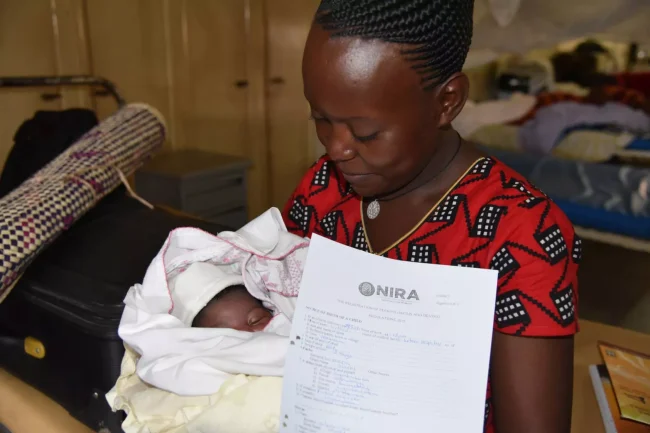
    This above-referenced process is of paramount importance because its the one through which a child’s birth is entered and recorded in the national civil registry of government, which NIRA is mandated to man.

    Child birth registration is also one of the ways through which a child’s Ugandan nationality can be demonstrated, ascertained, validated and authenticated. Every child, once born, has a right to being given a name, which formally can only be evidenced and authenticated by the government through registration and entry into the civil registry.

    In order to ensure that every newly-born citizen of Uganda is promptly registered and enrolled into the civil registry, this vital registration service even ought to be given free of charge. And it should be done at birth or shortly after and as quickly as is practicable.

    Broadly, speaking it can only be through child birth registration that the GoU can, with certainty, establish the number of children in Uganda and proceed to engage in the appropriate resource allocation and planning for them in terms of access to quality education and health care among other essential services.

    And a comprehensive national civil registry, detailing child birth-related demographic, data can guide evidence-based allocation of government resources going into provision of learning and health centers for those children.

    Led by UBOS Governing Board Chairman Dr. Albert Byamugisha and the Executive Director Dr. Chris Mukiza, the final census report authors assert that Ugandan policy makers, elected leaders, researchers and other stakeholders can leverage these findings to engage in meaningful and evidence-based advocacy that can push government into coming up with appropriate programme interventions aimed at mitigating the situation.

    Only 11% of Uganda’s households had their child birth registered with NIRA as is provided for under the relevant laws, while 32% merely had notifications. Kampala had the highest birth registration rate at 22%, while the statistical sub region of Teso had the lowest number of children with birth certificates at only 8%.

    Other statistical sub regions of Uganda faired as follows when it comes to having children with birth registration certificates: West Nile 9%, Madi 8%, Acholi 11%, Karamoja 9%, Lango 9%, Sebei 11%, Bugisu 10%, Bukedi 10%, Busoga 10%, Buganda 14%, Bunyoro 11%, Tooro 11%, Ankole 10.9%, Rwenzori 13% and Kigezi 12%.

  • Sub Regions With Well-fed, Most Food Secure Ugandans Revealed in New  Census Findings

    Sub Regions With Well-fed, Most Food Secure Ugandans Revealed in New Census Findings

    In strict adherence to the standard reflected under the globally-accepted eight Food Insecurity Experience Scale (FIES) questions, the UBOS enumerators prudently used the May 2024 census enumeration exercise to ask people in Uganda’s 10.7m households the appropriate food security-related questions.

    Specifically, these are questions like how often household members ever worry about not being sure of getting their next meal, how often do they go a day without food, how often are they compelled to eat less because of financial constraints in the household, how often do they fail to put a meal on table and how often do they generally encounter difficulties accessing food etc.

    Globally, it’s through adhering to those 8 FIES questions that governments and other stakeholders get to establish food security levels or even food insecurity-both moderately and severely through public surveying. Using the above referenced FAO-approved methodology, the UBOS enumerators were able to assess the extent to which the food security situation in Uganda complies with the ideals enshrined in Sustainable Development Goal (SDG) number 2.

    This specific SDG seeks to achieve for communities food security, improved nutrition, hunger elimination and promotion of sustainable agriculture. The same objectives are replicated under AU’s Africa-wide Agenda 2063, the EAC Vision and Uganda’s own Vision 2040.

    In response to the enumerators’ questions, respondents representing each of the 10.7m households shared their food security-related experiences as encountered during the 12 months preceding the census months of May 2024.

    THE FINDINGS:
    And gratefully, it was established that not less than 54% of the households in Uganda are food secure, the remainder being moderately insecure and a few severely food insecure. Food insecure households implies families which experience frequent and prolonged periods of insufficient food intake largely due to lack of money and other related constraints.

    Such financially vulnerable households are forced to skip meals or even taking a day or days without meals. That is categorised to be severely food insecure.

    The newly released 2024 final census report shows that the statistical region of Karamoja has the highest number of households enduring food insecurity at 63% and Ankole had the lowest at 18%.

    The other statistical sub regions of Uganda faired as follows: 63% of the households in Kampala are food secure; 69% in Buganda are too besides 50% in Busoga and 31% in Bukedi.

    Other statistical regions ranked as follows in terms of household level food security: Bugisu 41%, Sebei 47%, Teso 28%, Karamoja 19% (meaning food insecurity is at 81% there), Lango 38%, Acholi 51%, West Nile 31%, Madi 38%, Bunyoro 63%, Tooro 67%, Rwenzori 52%, Ankole 70% and Kigezi 61%.

  • Here’s Why Gen Salim Saleh Must Read Chapter 12 of 2024 Census Final Report

    Here’s Why Gen Salim Saleh Must Read Chapter 12 of 2024 Census Final Report

    We know he is naturally a very busy person but President Museveni’s brother Gen Salim Saleh should create time and personally read chapter 12 of the newly-released 2024 census final report.

    It’s a 351 pages report whose authors, led by UBOS ED Dr. Chris Mukiza and Governing Board Chairman Dr. Albert Byamugisha, dedicated chapter 12 (pages 155-162) to disseminate findings regarding the impact of several wealth creation programmes and interventions the GoU has been putting in place over the years.

    Examples of these interventions include PDM, emyooga, Youth Livelihood Programme, the Social Assistance Grants for Empowerment (SAGE) for older persons aged 80 & above, National Agriculture Advisory Services (NAADS), the Uganda Women Entrepreneurship Programme (UWEP) to deepen women entrepreneurs’ access to financial services, Special Enterprise Grant for Older Persons (SEGOP) for older persons aged 60-79 and Gen Salim Saleh’s Operation Wealth Creation (OWC).

    Even when they are targeted at different gender and age groups, these programmes were all aimed at increasing incomes and improving the quality of life for the targeted groups or households across the country. This is one thing that all these wealth creation interventions had in common.

    His busy schedule notwithstanding, Gen Saleh ought to put aside time and at least read that part on his OWC impact and performance. The census enumerators did ask people in the individual households as they went about the enumeration work in May 2024 specifically about how they had benefited from each of these interventions.

    OWC Boss Gen. Salim Saleh

    Assuming the respondents were being truthful, what is contained in the UBOS report shows that the multi-billion OWC, like all the others, impacted far much fewer citizens than had been targeted.

    They each sought to impact Ugandans living under the subsistence bracket that comprises households whose dwellers are financially vulnerable and have no much interaction with the money economy and live hand to mouth. These are established to be not less than 3.5m households out of the total number of 10.7m households the census enumerators established Uganda to be having as at May 2024.

    Being chiefly coordinated by Gen Saleh, who is aided by hundreds of army officers each one of whom is charged with a sub region, a district or a city, OWC seeks to transform millions of subsistence farmers into commercial farmers.

    The stated overall objective is to end household poverty among the intended beneficiaries who had to be all financially vulnerable adults aged 18 and above.

    During the census exercise, the enumerators kept asking households if they had benefited or not. And by the time the final tabulation was done, it was established that less than 1% (0.4% to be exact) of the intended beneficiaries had been impacted by or benefited from the OWC intervention.

    This is something that must intrigue Gen Salim Saleh who has dedicated a lot of effort to get things done, through distribution of high quality seedlings and other farming inputs, across the country since the year 2013 when the OWC operation started.

    Assuming that the people in the households who answered the questions weren’t being deceptive in their answers, this anomalous situation that only 0.4% of the intended households had so far benefited from or had been impacted by OWC would equally disturb the President himself too.

    OTHERS EQUALLY STRUGGLING:
    The situation was hardly any better with all the other similarly-targeted interventions like Youth Livelihood Programme (YLP) which the census report establishes to have impacted only 0.4% among the targeted households in which vulnerable youths aged 18-30 live.

    PDM had impacted only 832,746 which is 24% of the targeted 3.5m households as of May 2024. It was 18% for SAGE which began in and has been on since 2011. Under SAGE, older citizens aged 80 and above were originally facilitated by the GoU with an upkeep of Shs25,000 per month through the Ministry of Gender, Labor & Social Development.

    Yet that isn’t all. The now disbanded NAADS (which was enacted in the 2000s to increase commercialisation of agriculture
    while accelerating and enabling agro-processing and value addition besides improving household food security and income) only managed to impact 0.9% of the intended beneficiary households as of May 2024.

    Finance Shadow Minister in Parliament Semujju Nganda, who is also a renowned pundit, says that this is extremely shameful given than hundreds of billions of shillings were sunk in all these wealth creation programmes over the years.

    The best performance under these interventions was registered under the little known SEGOP, which supports older persons aged 60-79 into income generation activities. Under this intervention, the census exercise established that 7% of the intended beneficiary households were impacted or had their older persons benefit.

    Under the Emyoga intervention, which aimed at transitioning 69% of the targeted 3.5m households from subsistence to the money economy space through getting them into market-oriented production, the census exercise established that only 0.4% of the intended households had at least one member who had received or got the attendant cash!

    One can only imagine or wish that those responding to UBOS census enumerators’ questions didn’t answer truthfully otherwise 0.4% is alarmingly low given the hundreds of billions of shillings that have been sunk into the Emyoga programme.