Tag: President Yoweri Kaguta Museveni

  • Mbarara City Drums Up Support for President Museveni

    Mbarara City Drums Up Support for President Museveni

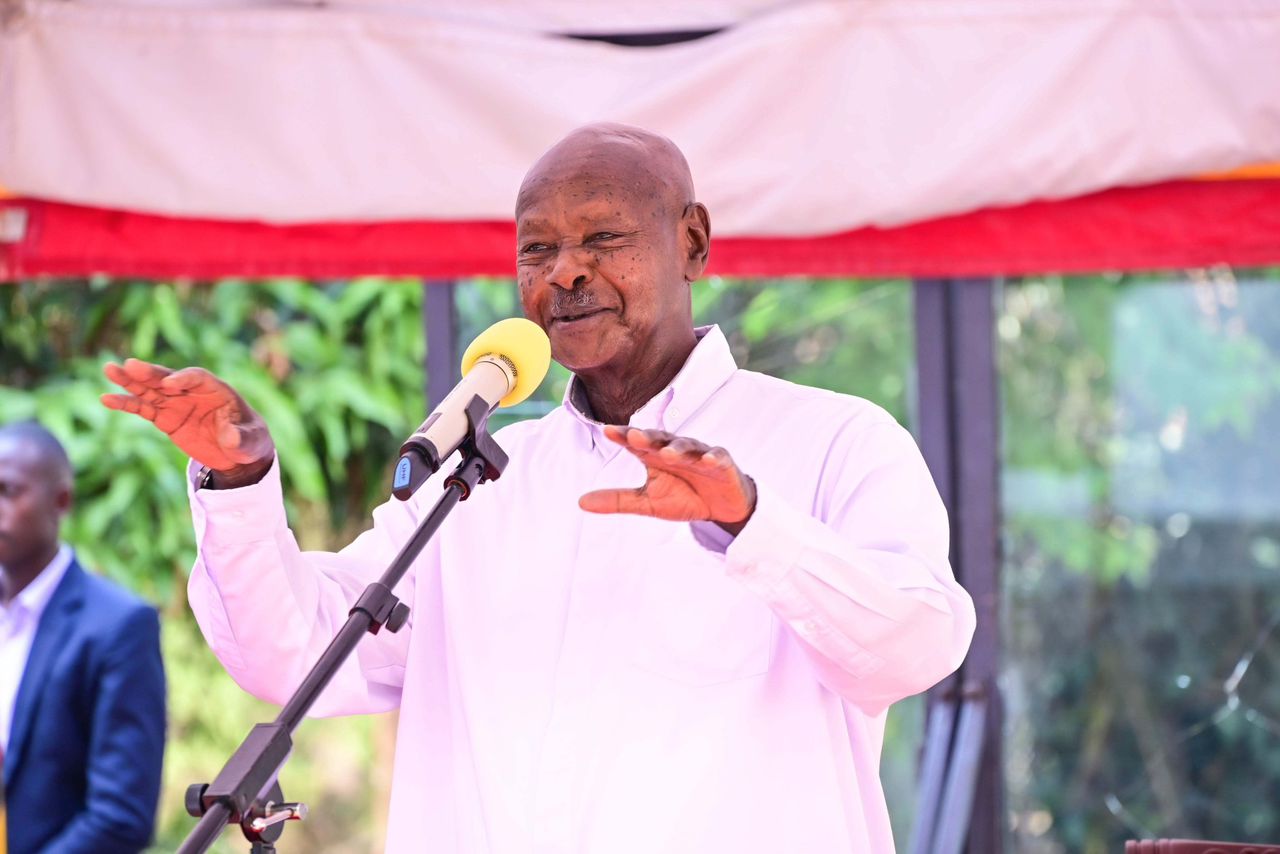
    President Yoweri Kaguta Museveni who is now in campaigns for another term come 2026 has once again underscored his enduring message of peace, stability, and socio-economic transformation pillars upon which the National Resistance Movement (NRM) government has built its legacy over nearly four decades.

    As the President traversed districts such as Soroti, Kumi, Katakwi, Bukedea, Amuria, and Serere, where many people have welcomed him. His message was consistent and clear: peace is the foundation of development, and wealth creation is the next frontier for every Ugandan household.

    President Museveni has commended the people of Mbarara for their steadfast support toward the NRM and for safeguarding the peace that the country enjoys today. He reminded them that Uganda’s transformation did not come by accident but through deliberate policies centered on security, infrastructure development, and economic empowerment.

    “The peace and progress that Ugandans enjoy today did not come by accident. They are a result of our consistent efforts under the NRM to ensure security, promote development, and empower households to create wealth,” President Museveni said.

    President Museveni urged residents to take advantage of government wealth creation programs such as the Parish Development Model (PDM) and Emyooga. These initiatives, he argued, are designed to lift households from subsistence to commercial production.

    Indeed, the President’s emphasis on individual and community productivity mirrors the broader NRM philosophy of self-reliance — a concept that has guided Uganda’s socio-economic planning since the 1990s. His remarks on job creation also tied directly to this principle.


  • President Museveni invites Algeria to Uganda for Coffee value -addition joint venture

    President Museveni invites Algeria to Uganda for Coffee value -addition joint venture

    President Yoweri Kaguta Museveni has invited Algeria to join Uganda in setting up a joint venture with an aim of adding value to the East African country’s coffee.

    The President made the call yesterday August 8th, 2023. during a meeting with a delegation from Algeria at the sidelines of the ongoing G-25 Africa Coffee Summit at Speke Resort Munyonyo.

    President Museveni told the delegation led by the country’s Minister of Commerce and Export Promotion, Hon. Tayeb Zitouni, that Africa, Uganda inclusive has supported Europe economically, but the Western countries have not reciprocated the favour.

    “You know when I buy from you something, I’m supporting your prosperity and we have been using our pockets for the last 200 years to support Europeans by buying their vehicles, buying their aero-planes and medicines. When we say that okay you support us also by adding value to our coffee and you pay us more, they don’t understand it,” the President said.

    “Therefore, what I propose are joint ventures. The country will get more money from coffee through the joint venture than what we are getting now for raw coffee. For raw coffee, we may be getting USD2.5 per kilogram, when we add value together, we may get USD25. Even if Uganda was to get USD25 together with our joint venture and then the external operations take USD10 or 15, it will be a win-win situation and then create more jobs. That is why we want our Northern African friends and those from the Middle East to come and cooperate with us in this USD25 share,” he added.

    Hon. Tayeb welcomed President Museveni’s proposal, saying that as a country they are willing to join the venture.
    “Businesspeople are coming here in September to look through the possible cooperation. We consume coffee worth USD300 million per year.  We progressed on importing milk from Uganda and we shall also see what we can do with coffee value addition,” he assured the President.

    In the same meeting, the Uganda Coffee Development Authority (UCDA) Managing Director, Dr. Emmanuel Iyamulemye thanked President Museveni for being a champion of the promotion of the African coffee sector.
    “There’s big potential and we thank you for championing value addition because most of our coffees are participating in competitions and they have proven to be of very high quality and can create a good market,” he said.

    The meeting was also attended by Uganda’s Minister of Foreign Affairs, Gen. Jeje Odongo among other dignitaries.

  • Huawei to boost digital inclusion in Uganda with DigiTruck project

    Huawei to boost digital inclusion in Uganda with DigiTruck project

    Kirihura District: Ugandan President H.E Yoweri Kaguta Museveni officially launched a Huawei DigiTruck project in Uganda to provide free digital skills training for more than 10,000 beneficiaries over three years.

    With the launch taking place at an event celebrating International Women’s Day (IWD) in Kiruhura District, the DigiTruck project falls under the umbrella of Huawei’s TECH4ALL initiative, the company’s long-term action plan for driving inclusion and sustainability across the globe.

    President Yoweri Museveni remarked through his tweet about the Huawei DigiTruck, “I launched the Huawei DigiTruck project in Uganda. A project that will benefit over 10,000 Ugandans in a span of 3 years especially jua-kali, enterprise owners, women, young girls and students through Digital Skilling.”

    He added that, “Digital transformation is one of the key drivers of effective human capital development, it therefore gives me pleasure to launch this Huawei Project.”

    In line with the IWD theme of ‘DigitAll: Innovation for a gender equal future’ and Uganda’s national theme of ‘Equal Opportunities in Education, Science Technology for Innovation and a Gender Equal Future’, a priority beneficiary of the TECH4ALL initiative and the Uganda DigiTruck project is youth, Jua-Kali and women.

    “Digitization of Jua-Kali enterprises will create sustainable livelihood opportunities for the informal sector as it will enable small businesses to participate in regional and national trade. It will expand the customer landscape and allows businesses to provide clients with a greater range of services and products. The training will also improve financial inclusion through improved ability to operate mobile money operations. The training will expand employment opportunities especially in rural areas, where some youth can start enterprises such as mobile money, secretarial services among others.” Said Col. Rtd Okello P. Charles Engola, Minister of State for Labour, Employment and Industrial Relations.

    Running in partnership with the Ministry of Labour, Gender and Social Development and an international social enterprise Close the Gap, the Uganda DigiTruck project is aligned with the nation’s 2040 vision, National Development Plan, and Education Digital Agenda Strategy.

    The focus of these initiatives includes promoting digital foundation skills, digital communications and information, digital transactions, using the Internet for problem-solving, online safety, civic responsibility, and data privacy, which will promote digitalization of the Informal Sector (Jua-Kali) enterprises for productivity & Job growth in Uganda. Alongside women, other intended beneficiaries of the Uganda DigiTruck are youth, people with disabilities, and those involved in ‘Jua Kali’ businesses – Uganda’s informal sector of micro and small enterprises. “As an international social enterprise that exists to bridge the digital divide, Close the Gap believes that access to digital skills is key to empowering individuals economically and socially,” said Francisca Muema, DigiTruck Project Manager from Close the Gap. “To reach underserved communities in remote areas where there is no power and connectivity, we designed the DigiTruck: a state-of-the-art mobile classroom that’s solar powered and fully connected. The DigiTruck program is coordinated with development and training partners globally to close the access and knowledge gap in digital literacy so that no one is left behind.”

    Converted from a used shipping container, DigiTrucks are mobile classrooms mounted on trucks. Fully solar-powered, their mobility enables them to be driven to remote and underserved communities that lack training facilities and, in some cases, a power supply.

    Each 40-hour course trains students in digital literacy skills such as how to use devices, office software, and the Internet, alongside soft skills such as writing a resume, applying for jobs online, and running an online business. Connected by 4G, each DigiTruck can accommodate 20 learners in one session and comes equipped with the Huawei IdeaHub smart screen, 21 Huawei smartphones, and 21 Huawei laptops, all of which run on solar power installed on top of the truck.The project is also part of Huawei’s broader approach of building ICT skills capabilities in Uganda with its partners.

    “The Huawei DigiTruck project aims to transfer ICT skills to the jua-kali enterprise owners in the 4 main regions of Uganda. This project will enable people in the most rural areas of Uganda to obtain ICT Skills which will boost their already existing enterprises and ideas to tap into e-commerce platforms like marketing etc. ICT is a key driver in for economic empowerment and with this we will be able to contribute towards narrowing the digital divide in Uganda.” said Gao Fei, Managing Director for Huawei Uganda. “This is why we have our slogan ‘A better You for a Better Uganda’ and ‘Leaving No one behind’ because it starts with you to have a better Uganda and we need to ensure that we are all leaving no one behind as we all promote the digital agenda.” Present at the launch ceremony of the Digitruck project was H.E Janet Museveni, the First Lady and Minister of Education & Sports, H.E Jessica Alupo, The Vice President of Uganda, Hon. Dr. Monica M. Musenero. Minister Science, Technology and Innovation, Col. Rtd Okello P. Charles Engola, Minister of State for Labour, Employment and Industrial Relations and Gaofei, Huawei MD.

  • UK Prime Minister’s Trade Envoy, Lord Popat in Uganda to build Uganda’s economy through increased UK investment

    UK Prime Minister’s Trade Envoy, Lord Popat in Uganda to build Uganda’s economy through increased UK investment

    The UK Prime Minister’s Trade Envoy to Uganda, Lord Popat of Harrow, was in Uganda this week promoting the UK’s honest and reliable trade and investment opportunities that deliver value for money to ensure ALL Ugandans benefit.

    Lord Popat was appointed UK Trade Envoy to Uganda in 2016.  He has visited Uganda a number of times in this role, most recently in November 2021. As a successful businessperson, he brings this experience along with his love for Uganda, the country of his birth.

    One of the key priorities of this visit was a meeting with H.E. President Yoweri Kaguta Museveni. This meeting focused on several investments which require swift action now.  Government of Uganda approval to progress these critical investments should move Uganda’s potential into real growth and opportunity.  We also discussed the Africa Free Trade Agreement.  It is estimated the agreement will be able to lift an additional 30 million people out of extreme poverty by 2035 and increase exports by 8%, and the UK was delighted to announce that the UK Government has committed £35m to support negotiations and implementation.

    H.E President Museveni, Lord Popat, H.E Kate Airey British High Commissioner to Uganda and other dignitaries at State House Nakasero last week

    A direct flight route between the UK and Uganda will be vital to increasing trade between the UK and Uganda. The route will bring greater tourism opportunities and will greatly extend the opportunities for getting Uganda’s fresh produce onto UK supermarket shelves. Lord Popat is passionate about getting this Uganda Airlines route off the ground, and he met with the Minister of Works and Transport to discuss progress and offer UK support.

    There are a number of investment opportunities in Uganda that the UK is keen to explore, most notably in the sectors of infrastructure, Minerals, and energy. Lord Popat met with stakeholders including Hon. Francis Mwebesa, Minister of Trade, Industry and Cooperatives; Hon. Ruth Nankabirwa Ssentamu, Minister of Energy and Mineral Development, Mr Robert Mukiza, DG Uganda Investment Authoritity; and Dr Diana Atwine, PS Ministry of Health, to explore these opportunities further.

    It is an exciting development that British Investment International (formerly CDC group) has invested $50m in Equity Bank to support their Recovery and Resilience Plan sets their ambition to transform the lives of 100 million people in Africa by 2025.  Lord Popat met with Equity Bank CEO Dr James Mwangi to discuss this investment and what it could mean for Uganda.

    Lord Popat’s business background meant he felt particularly at home meeting with a range of both Ugandan and British business and discussing the further growth of UK trade and investment.  They discussed how the private sector can work alongside the UK government to bring mutual prosperity to both the UK and Uganda. Greater private and public sector collaboration is in the interests of all parties, with all Ugandans standing to benefit from creating jobs, breeding innovation, and transferring technology.

    Trade Envoy Lord Popat said:

    “I recognise the immense potential of Uganda, but now is the time to turn that potential into tangible commercial outcomes. The aim of my visit this week is to turn opportunities into deals, but I need the support of the Government of Uganda, business, and most importantly, the people of Uganda if we are to strengthen trade relations to grow our mutual prosperity”

    H.E. Kate Airey OBE, British High Commissioner to Uganda added:

    “We pride ourselves on being a responsible investor in Uganda. The UK does not believe in short term gain, instead we want to ensure that any investment made in Uganda will have long term sustainable outcomes that will deliver for generations to come. The UK is partnering with Uganda using our unique prosperity offer to support Uganda to catalyse economic growth and boost UK and Uganda’s mutual prosperity.”

  • Frank Tumwebaze launches Health & Water projects in Kibale, lauds government for the support

    Frank Tumwebaze launches Health & Water projects in Kibale, lauds government for the support

    The Minister of Gender Labour and Social Development Hon. Frank Tumwebaze has continued to show fruits of his services in Kibale East constituency in Kamwenge district.

    He this week launched two important projects to help in service delivery in the area.
    The milestone projects are Bisozi Health Centre IV and Malere water project.

    He thanked the leadership of NRM government under president Yoweri Kaguta Museveni for supporting development in the area.


    “Quite a busy and happy day for me in the constituency as i commission a number of service delivery milestone projects. I started with the launch of the completed infrastructure at Bisozi HC1V under the DRDIP Opm-Ug program in the Office of the Prime Minister. On behalf of our community, I thank the NRM government under the able leadership of H.E Yoweri Kaguta Museveni for supporting refugee hosting communities to overcome displacement impacts that come with hosting refugees. I later again launched another great service delivery milestone for my constituents of scaling up safe water coverage in Malere, Biguli sub county supported by Water 4 People In partnership with Ministry of Water and environment. The commissioned reservoir will serve more 13 villages in the area,” Frank Tumwebaze said.

    The Minister is already assured of another term in Parliament next year because he is up opposed in Kibale East Constituency parliamentary seat.

  • Photos; NRM Candidate M7 rallies for support in Apac

    Photos; NRM Candidate M7 rallies for support in Apac

    President Yoweri Kaguta Museveni and NRM Candidate has spent second day doing scientific campaigns in Lango region.
    On his second day of campaigning, M7 met NRM party leaders in Apac district. Below is his full statement on the second day of campaigns in Lango region.
    “On my second day of campaigns in Lango sub region, I Interacted with NRM party leaders  in Apac District.
    We decided not to conduct mass rallies nor hold processions in these campaigns because it would put the public at risk in light of the raging Covid-19 pandemic.
    Our strategy is that I hold meetings with a few leaders who thereafter, together with other party supporters, undertake a house-to-house vote-hunt. We must avoid large gatherings and protect our people.
    On issues of Lango, we are going to increase the cattle compensation budget to Shs50 billion per sub-region (plus Acholi and Teso) so that we settle this matter once and for all.
    Lira City and the other eight districts in this sub-region have fairly good infrastructure. However, we are going to rehabilitate the Lira-Kamdini Road, reworking its base.
    The Government is also set to upgrade the Rwenkunye-Apac-Lira-Puranga-Acholibur Road, the length of 191 km.
    Meanwhile, besides the now functional MV Kyoga-2 Ferry, the government will add the Zengebe-Namasale Ferry, while the Acwa Bridge has been completed.
    Finally I remind you about the need to shift from subsistence farming to commercial farming so as to improve your household income, and fight poverty. Operation Wealth Creation has given and will continue to give farmers inputs to help in this drive,” M7 said.
  • ‘I am not a Munyarwanda – M7

    ‘I am not a Munyarwanda – M7

    President Yoweri Kaguta Museveni has said he is not a Munyarwanda but a Musiita from Western Uganda. He said you can’t find any Bunyarwandism in him. Below is his full statement which he posted on his social media;

    A follower identifying himself as Mwoyo Gwa Gwanga declares how he is not against Banyankore but only against Banyarwanda like myself.

    He is also wondering whether Banyarwanda are an “Official” tribe of Uganda. First of all, I am not a Munyarwanda.

    I am a Musiita and my mother is Mweene Rukaari and you can go to the beginning of creation, you will not find any Bunyarwandism in me.

    However, it would not have mattered if I was a Munyarwanda.

    The NRM talks of Africa, not just the small tribes or even just Uganda. We want the unity of East Africa, of Africa. Moreover, at a personal level, I have many Banyarwanda relatives by marriage. Yes, the Banyarwanda are one of the indigenous tribes of what became Uganda.

    Why? Two reasons. One reason is that a part of Rwanda, Kisoro, was put in Uganda by the colonial borders. They are indigenous Ugandans and they are Kinyarwnada speakers (Kifumbira).

    Secondly, a part of Mpororo, Omutara, was put in Rwanda by the Colonial borders. A number of Bahororo clans actually have their origins in Omutara: The Bagina from Kichwamba, the Bakimbiri from Rutuungu, etc. There are other clans like Bakurungu, Baturagara etc. who are said to originate from Omutara; then, the area near Katuna is occupied by Abakiga.

    Therefore, those who waste their time trying to find which Samia is from Kenya, which Mukoonjo is from Congo, which Alur is from Congo, which Kakwa is from Congo or South Sudan, which Madi is from South Sudan, which Acholi is from South Sudan, which Karimojong is from South Sudan, which Sabiny is from Kenya, which Mugisu is from Kenya, which Munyankore or Rakaian is from Karagwe or Buhaya in Tanzania, are not part of our Pan-African vision. Since time immemorial, these peoples have always interacted in spite of the myopic chiefs that fomented wars among out people.

  • President M7 to address the nation over COVID-19 lockdown

    President M7 to address the nation over COVID-19 lockdown

    As the 21-day lockdown extension comes to an end tomorrow, President Yoweri Kaguta Museveni will tonight address the nation on whether he will extend or ease the lockdown.

    The county’s tough measures have seen COVID-19 cases stay low more than other major East African states.

    “I will address the country tonight at 8pm, guiding on the way forward as the 21-day lockdown extension comes to a close tomorrow. I urge you all to continue observing the guidelines from our health experts as the battle against the Covid-19 pandemic continues,” President M7 tweeted.

  • Huangpai comes to rescue of Ugandans with a donation of 40 tonnes of Food

    Huangpai comes to rescue of Ugandans with a donation of 40 tonnes of Food

    Uganda is facing an unprecedented challenge with communities everywhere affected by the COVID-19 pandemic, most especially a 14- day lockdown which has seen businesses come to a halt and several Ugandans with their families are counting loses.

    However, people of different races in all sectors have come together to help respond to this catastrophe following President Yoweri Kaguta Museveni’s appeal to all able individuals to contribute towards towards this national cause.

    The President asked for car, money and food donations which would then be be distributed to families affected by the lockdown.

    In championing the cause a Chinese Firm, Huangpai Food Machines has outpoured its solidarity by donating 40 tonnes of food which was received by the Prime Minister as the head of COVID-19 Response Taskforce.

    The Prime Minister while receiving Huangpai’s donation said the support exhibited in this shared challenge has been phenomenal.

    This website has learnt that strong NRM movement Cadres, Mr. Denis Ogandi and Mr. Nzaire Sedrack the young brother of President Museveni who doubles as party chairman for Kiruhura District presented two groups to Prime Minister.

    The first group is China Huangpai Food Machines (U)Ltd and the second one is The Revolutionary Guards which is loyal to Museveni.

    The Chinese investors (Huangpai) were represented by Directors Mr. Li Quang, Mr Li Feng and General Manager Mr. Nelson Ojwiya and donated 30 tonnes of Maize Flour and 10 tonnes of wheat Flour to the tune of 120 million.

    The General Manager of Huangpai Nelson Ojwiya Christopher assured the Prime Minister of their continued support and promised to look out for more support.

    China Huangpai Food Machines is a local Manufacturing company for food and Agro machinery with an experience of 20years.

    The Revolutionary Guards (RG), donated 5 tonnes of Maize Flour, “The Revolutionary Guards is a strong group of Professional NRM Carders that believe in withholding and protecting the efforts of the revolutionaries that fought for the Country,” Chairma Okello Francis told the PM. They also vowed to use their structure of cadres countrywide to volunteer in the effort of fighting this global pandemic in Uganda.

  • President M7 gives more guidelines on the preventive measures in the fight against COVID-19 global pandemic

    President M7 gives more guidelines on the preventive measures in the fight against COVID-19 global pandemic

    The President prohibits all movement, closes non food selling business, Salons and Lodges  for 14 days immediately
    President Yoweri Kaguta Museveni in a bid to curb down the spread of COVID-19 caused by Coronavirus has prohibited all movement and imposed a curfew from 7pm- 7am. Below is his full address;
    Countrymen and countrywomen
    I am here, to again address you on the issue of the corona-virus. I first, addressed you on this issue on the 18th of March, 2020. Before I addressed you, together with the experts, we had discussed, in depth, the science of this virus. In that study, we had discovered the following characteristics of this virus.
    1. It spreads through inhalation if somebody with the virus coughs (okukororra) or sneezes (okwetsyamura) near you ─ within four metres from you. It will, then, infect you through the inhalation of the rwooya (vapour) of the sick person that would have coughed or sneezed.
    2. The second mode of spreading is when the infected person pollutes surfaces such as tables, door handles, etc. If you touch the polluted surface and, then, touch yourself in the soft parts of the body: eyes, nose or mouth, you also get infected. The virus cannot go through the normal, intact skin of a human being. It only goes through the soft parts mentioned above.
    Although the healthy people afflicted may survive, it can kill alot of people that already have other medical conditions such as Aids, blood-pressure, pregnancy, diabetes, sickle-cells, cancer, the elderly, etc. In China, its kill rate was 4.05%. In Italy its now 11.03% and Spain, its kill rate is now 8.4%. It even kills the young people in some circumstances, like the young doctor, Li Wenliang, of Wuhan in China, who first identified this problem. He was only 33 years old.
    Given its spread methods ─ sneezing and coughing by an inconsiderate and careless person in a cluster of people bunched together as well as an individual’s own carelessness of touching the soft parts of your body (the eyes, the nose and the mouth) without washing your hands or sanitizing them first, after careful study, we decided that this virus will spread fastest if it gets into large concentrations of people, some of whom may be behaving inconsiderately or carelessly as stated above. We, therefore, adopted the strategy of dispersing any concentration that may provide fuel to this virus.
    In my address of the 18th of March, 2020, I put out 13 actions that dealt with this problem, in part, as well as other associated matters. The 13 measures were:
    (1) Close all the Educational Institutions which accounted for 15 million young Ugandans;
    (2) Suspend communal prayers in Mosques, Churches or in Stadia and other open air venues;
    (3) Stop all public political rallies, cultural gatherings or conferences;
    (4) Banned Ugandans from moving to or through category one (I) countries that had had a large number of corona cases by that time;
    (5) We allowed returning Ugandans provided they underwent mandatory quarantine, at their cost, for 14 days at a venue identified by the Ministry of Health;
    (6) We allowed the non-agricultural gathering points to continue but with SOPs (Standard Operating Procedures) put out by the Ministry of Health; and these gathering points were: factories, hotels, large plantations, markets, taxi-parks, etc.;
    (7) We discouraged the hexagonal, extravagant Ugandan-style weddings; if in a hurry, we encouraged the couples to go for the scientific weddings by the actual stakeholders, accompanied by a few people;
    (8) Burials could not be postponed, but it should be for a few people ─ the concerned homestead;
    (9) With the 33 million farmers, according to the 2014 census, there was no problem because they are dispersed in their farms, plantations, etc.; the only issues to deal with here were the monthly or weekly cattle auction markets (ebikomera); and obutare (food markets); these were suspended;
    (10)At that time, we thought that we could continue with the public transport systems of buses, mini- buses, taxis, boda-bodas, etc., provided they were given SOPs;
    (11)The discos, dances, bars, sports, music shows, cinemas and concerts were all suspended;
    (12)Number 12 was hygiene and enlightened (not kikafiri behavior ) behaviours of not coughing or sneezing in public, no spitting, washing with soap and water or using sanitizers, regularly disinfecting surfaces such as tables, door handles, etc. and not touching your eyes, nose or mouth with contaminated and unwashed hands; and
    (13)Ended with nutrition to strengthen the body defence system.
    We quickly, however, learnt that some of the actors were not obeying these measures and that, for instance, the returnees from abroad, from the high risk countries, were escaping from the quarantine even when it was mandatory. The ones in self- quarantine were also escaping, e.g. the Chinese that were arrested on the Congo boarder, in Zombo or the returnee from Kisumu that is the father of the Iganga baby that turned up positive that went into hiding. These gaps could cause us serious problems.
    These gaps were undermining the strategy of denying the virus the fuel that it could ignite and sustain its expansion by ensuring that there is no match-box and there is no dry grass ─ no virus and no concentrated masses. Therefore, on the 25th of March, 2020, on the 41st Anniversary of the battle of Rugaando, I announced two new measures:
    1. Stopped all passengers coming into Uganda by air, land or water; this affected in-coming planes, buses, taxis or boats;
    2. Also prohibited from entry were the pedestrians ─ people walking on foot from the neighbouring countries.
    In all these measures, we were careful to clearly state that cargo planes and cargo vehicles, within Uganda and between Uganda and the outside, should continue with only the crews for the air-crafts and 3 persons per cargo vehicle.
    Then, on the 21st of March, 2020, we announced additional measures as follows:
    (i) All public passenger transport vehicles are stopped and those were: taxis, coasters, buses, passenger trains, tuk-tuks (tri-cycles) and bodabodas;
    (ii) Secondly, in order to scale down the numbers of the populations in the markets, we announced that only food sellers should remain in the markets; the non-food sellers should suspend their activities.
    However, private vehicles could continue but with only 3 people maximum per vehicle. However, ambulances, army vehicles, garbage collection vehicles, etc., would continue.
    Since that time, we have been monitoring the situation. It was good we took all these measures. However, there are still windows through which the virus can continue to spread. As of today, the 30th of March, 2020, 31 Ugandans and 2 Chinese have been confirmed as being positive with the virus.
    Almost all of them are imported cases by Ugandans returning from mainly Dubai (UAE), Europe, the USA and Afghanistan. Only 3 are the ones that received it from the importers. These are: the wife and daughter of the Masaka man and the baby from Iganga whose father had returned from Kisumu in Kenya. Out of the 33, the number of eight (8) were intercepted at Entebbe, in the quarantine or, even, at the airport, like the case number one, who was detected by the temperature monitor and another 7 that were first identified by the temperature monitoring system. This means that 14 out of the 33 had already entered the ekibuga (city, town), the lujja (compound) and some had even entered omuunju ─ munyuumba (inside the house) since we did not detect them at the Eireembo (the main entrance) or they escaped from the Eishaazi ─ the holding ground ─ by escaping from the quarantine. How many other Ugandans did they interact closely with to infect them? That is what we need to discover and soonest. It is good that those who start feeling the symptoms report themselves, like the case from Hoima did. However, this disease has two characteristics that make the work of fighting it tedious and quite challenging and need maximum vigilance.
    One characteristic is that some of the infected people may not feel sick and may not even know that they are infected. Yet, they will continue spreading the disease, of course, through the carelessness of the general population of, for instance, polluting surfaces and touching oneself in the soft parts of one’s body: the eyes, the nose and the mouth; and sitting very close to one another even if the infected person is not coughing. After further careful analysis, we have come to the conclusion that to be on the safe side, it is better we err on the side of caution than to wait for a possible situation like of some countries where a 1,000 people are dying per day from this disease.
    The second characteristic of this virus is that those that are infected, even when they survive, they take long in the hospital. In China, one case took 2 months. This has caused the filling up of all the hospital places even in the countries with advanced medical systems, until a situation where the medical authorities have to decide on who should be allowed to die and who should not.
    Therefore, with these cases that had entered in the house, we should not wait for that situation. Incidentally, we now have under quarantine, a total of 839 persons. Even those that are alleged to have escaped from the quarantine, have all come back. How many people had they interacted with and how careless are they with the sitting close to one another and with the carelessly touching their soft parts? We, therefore, think that there is less risk in taking the risk of the bitter medicine of maximum restrictions for a limited time than gambling by assuming that pollution was limited when we are not absolutely sure. Since we started this campaign of sensitization, if everybody listened by not coughing and sneezing near other people, by not sitting too close to one another when the infected person has got no symptoms and by not carelessly touching oneself in the soft parts, the cases that entered into the house would not have spread the disease. The question, however, is: “Did all our people listen?”
    That is why it is better not to take any risk by being complacent and assuming that everybody took heed when many may have not taken heed. That is why we have decided to take additional measures as follows: 1. Measure number one is to prohibit all people to people movement by everybody including those using their private vehicles, bodabodas, tuk-tuks, etc. Why? Two reasons: (i) some private car owners have turned their cars into taxis, transporting the two people we had permitted, assuming that they would be members of one’s family, when in fact they were passengers being charged the exorbitant fare of shillings 50,000/- from Kampala to Jinja. Hence, the problem we were trying to cure of allowing the mixing of people from different sources was not being addressed. Instead, it was taking new forms. The people with private cars were now the new public transporters without licences and facilitating the dangerous mixing in the process. Secondly, even more importantly, even if the private car owners had been disciplined and only moved around with only the 2 members of their families, still that movement would be dangerous because we do not know who has the virus now and who does not, given the penetration of the imported cases into the society, short-lived though it may have been. The ban on privately owned passenger vehicles will take effect from 2200 hours (Ten O’clock ─ Shaaha inna ez’ekiro), today, the 30th of March, 2020. I would have given the public time to adjust but on more scientific study, it was found that this would be a wrong policy. Why? A longer time would give people time to try and go to the villages. In so doing, they may transfer the sickness. We, would, then, not be curing anything. This freezing of movement will last 14 days from the 1st of April, 2020. This time it is not Fool’s Day; it is wise-person’s Day.
    2. The second category of concentrations are the shopping malls, arcades, hardware shops, which gather alot of people to sell and buy non-food items. These are suspended for 14 days starting with the 1st of April, 2020.
    3. All the non-food shops (stores) should also close. Only food stores, stores selling agricultural products, veterinary products, detergents and pharmaceuticals should remain open. The Ministry of Health should work out SOPs for those stores. Many people should not be allowed to congregate there and form lines to buy. Home deliveries should, instead, be encouraged.
    4. The Super-markets should remain open but with clear SOPs that should restrict numbers that enter and leave the site at a given time and the handling of trolleys within the super-markets. Alot of people can be infected by handling the unsterilized trolleys within the super-markets.
    5. The established Food Markets in Kampala and the other towns should continue to be open. However, two precautions must be observed. One, the distance of four metres to the front, to the left, to the right and to the rear ─ between seller and buyer and also seller and seller must be observed in all the markets. Secondly, the sellers must not go home during the 14 days. They must arrange to stay nearby for that duration. That movement between workplace to home and back, is part of the problem. How are the people you left at home and how do you move to work if there is no public transport? It is that mixing that we want to freeze ─ between home, enroute and workplace. Be in only one place for 14 days and we see what is happening.
    6. Saloons, Lodges and garages should also be shut for 14 days from the 1st of April, 2020.
    7. Like the farms, we would like the factories to keep producing because that is the life-blood of the country. However, the danger is in the workers going home and coming back. It is that daily movement that must be frozen. Let the factory owners arrange for the crucial employees to camp around the factory area for the 14 days. If they cannot do that, let them suspend production for 14 days.
    8. Construction sites should continue if they can be able to encamp their workers for 14 days. Otherwise, they should suspend construction for the 14 days.
    9. The essential services are: the medical, veterinary, telephones, door-to-door delivery, Banks, Private Security companies, cleaning services, garbage collection, fire-brigade, petrol stations, water departments and some KCCA staff should continue to operate. URA should also not close business on account of not paying taxes in these 14 days.
    These employers should, however, see whether they can encamp some staff near the workplace for the 14 days, which is the preferred way, or else get a special exemption from the RDC with the concurrence of the District Medical Officer.
    10. Cargo transport by train, plane, lorry, pick-up, tuku-tukus, bodaboda and bicycle, within Uganda and between Uganda and the outside, must continue but only with minimum numbers, technically needed as follows: Cargo ─ Air-craft ─ only the crew; Lorry ─ not more than 3 persons i.e. driver, tonne-boy plus one, etc., as will be directed by the Ministry of Transport, working with the National Task Force on the Corona virus.
    11. Gatherings of more than 5 persons are hereby prohibited.
    12. Except for cargo planes, lorries, pick-ups and trains, starting with the 31st of March, 2020, at 1900 hours (Saa Moja ya Usiku), there will be a curfew throughout the whole of Uganda. All other movements should stop. Let people stay in-doors in their homes except for the cargo-transporters. The exemption of cargo transporters does not apply to the bodabodas, tukutukus or bicycles in the curfew hours. Those should only operate during daylight hours.
    13. In order to deal with some unavoidable health issues like mothers in child birth or very sick people, permission can be sought from the RDC to use private transport to take such a person to hospital. Additionally, government vehicles that do not belong to UPDF, Police, Prisons or UWA, will be pooled and deployed at the District Health Offices, including the divisions of Kampala, with their drivers, staying in tented compounds, ready to help in those health emergencies. Those vehicles will be under the command of the District Medical Officer.
    14. On account of this pandemic, some sectors of the economy are suffering, such as the tourism industry, the entertainment industry, the transport industry, etc. However, as I said earlier, new opportunities are emerging in this misfortune. You have seen how the demand for sanitizers, face masks, bicycles, etc., has stimulated new industrial opportunities. Working with the IMF and the World Bank, we shall set up a fund in UDB to accelerate industrialization through import-substitution and export promotion. You have seen how dangerous it is for Africa to excessively depend on imports from outside. This is the time to wake- up.
    15. We are going to discuss with Banks, electricity companies and water companies in connection with the loans and bills, many people have with these units. It is not correct to disconnect water or electricity on account of non-payment during this time of shutdown or to seize properties on account of the non-payment of loans.
    16. Government workers should also stay at home for the 14 days, except for the Army, the Police, the Health workers, the Electricity, Water and Telephone workers. Even there, however, SOPs should be worked out for the soldiers, etc., that do not stay in the barracks. This problem of not staying near the workplace is something I have never supported.
    At one time, I wanted to shift and stay in Lubiri when it was still a barracks. The Army leaders, that time, pacified me by turning both Nakasero and Entebbe into barracks, including taking over Nsamizi Hill. People who do not stay in barracks, should either stay away for the duration of the shut down or camp in the barracks. The families of the soldiers and policemen should also be controlled moving in and out of the barracks should be suspended and so should the visitors.
    Otherwise, we can have a major outbreak in the barracks. The vehicles of the Army, Police, ambulances utilities’ vehicles, Prisons, UWA, etc., will continue to move on orders of the competent authorities.
    The Government anti-Corona-virus actions of stopping public transport and other measures have put the drivers and other people out of work. Besides, many of them live hand to mouth ─ the daily bread. Without those activities, especially in the towns, such people may not be able to buy food. The Government, after properly identifying these people will distribute food to them in the form of akahuunga (maize flour), beans, powder milk, sugar, salt, etc. In the meantime, I direct the Police to arrest the opportunistic and irresponsible politicians who try to distribute food for cheap popularity. Those are very dangerous to the health of the people. When you try to distribute food or money in such a situation, people gather around you. Many people can be infected in that process. You will, therefore, have caused the sickness or death of those people. Anybody involved in that effort will be arrested and charged with attempted murder. Today, Mr. Elumelu sent me US$150,000. I will use it to buy, may be, three (3) four-wheel drive vehicles to use, by the Ministry of Health to use in this effort. Those trying to take patients to hospitals, must also stop because they spread the virus in the process. If they have money, let them contribute it to the Task Force to use in a disciplined and safe way. In Mbale, the Chinese donated to me two four-wheel drive Jeeps. I have donated these to the Task Force of the anti-corona virus.
    However, the crucial point is the stopping of the epidemic. I do not want us to lose millions of our vulnerable people to this wholly avoidable epidemic just on account of indiscipline. What is the indiscipline?
    Coughing or sneezing where there are other people; not washing or sanitizing your hands regularly; touching yourself in the soft parts of the body with unwashed hands, the soft parts being the eyes, the nose and the mouth; and congregating in numbers when science is telling us to avoid this wholly avoidable danger, disperse and do not congregate.
    The idea, a Sheikh sent to me the verse from Isaiah, Chapter 26: Verse 20. It says: “Go home my people and lock your doors! Hide yourselves for a little while until the lord’s anger has passed”.