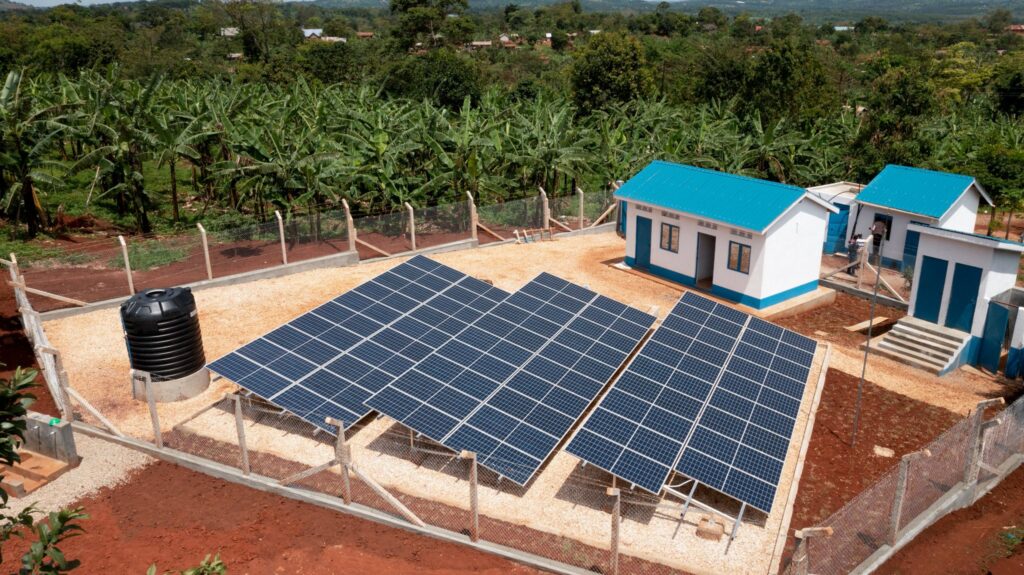
Kampala: Nexus Green Limited is on track to complete the construction of close to 400 solar-powered water irrigation sites in different parts of Uganda by the end of 2023 as part of the Government of Uganda funded Design, Supply, and Installation of Solar Powered Water Supply and Irrigation Systems Project.
Nexus Green is an innovative International Solar energy company that specializes in designing, supplying, manufacturing, and delivering affordable solar-powered solutions that reduce carbon emissions and provide cheaper cleaner energy.
The Governments of Uganda and the United Kingdom are jointly investing €111 million in the solar- powered water supply and irrigation project to enhance agricultural productivity, prosperity and the social life of at least 2.6 million Ugandans in water-stressed districts in the country.
The project is owned by the Ministry of Water and Environment and financed by the Ministry of Finance and Economic Planning and Development. It was approved by the Parliament of Uganda and the UK Export Finance (UKEF) in September 2019 and February 2021, respectively. The project commenced on July 26th, 2021 with its first implementation sites being handed over to Nexus Green in August and September 2021.
Nexus Green is expected to have completed all construction works of up to 687 solar- powered water irrigation sites in Uganda and handover over the project to the Government of Uganda by the end of 2024.
Addressing Members of Parliament from the Committee on Environment and Natural Resources, Parliament of Uganda, at a stakeholder project update briefing meeting in Jinja on Monday, 13th, 2023,
Rikki Verma, Chief Executive Officer, Nexus Green noted that so far Nexus Green is concurrently working on approximately 400 sites which are all at different stages of design and construction.

“We spent the first six months of year one of the project on making site verification including confirming site locations and checking the availability of water; stakeholder consultations including; harmonization of beneficiaries’ needs, acquisition of land for the project sites; undertaking detailed feasibility studies
and designs and procurement of materials (panels, pumps, pipes, fittings) for the first phase,” Verma
said.
“For this second year, our focus is now on construction, starting with the approved batches of designed sites. By the end of 2023 we will have built approximately 400 solar-powered water irrigation
sites,” he added.
Commenting on the benefits of the project, Verma explained; “This project will increase the number of productive seasons from two to four seasons in a year, there will be knowledge transfer, with the targeted farmers gaining agronomy skills on various high value crops (passion fruits, tomatoes, apples, watermelon, rosemary bush, macadamia, etc) through services of an agronomist on the project,
including information on access to markets, competitive pricing, farm management skills.

Overall, having constantly powered irrigation systems will guarantee UGX 5m worth of revenue per acre, per season
resulting in UGX 4.6 trillion which is over 3% of the country’s GDP year in and year out.”
The Committee members on Environment and Natural Resources in the Parliament of Uganda conducted an oversight visit to assess the project implementation by Nexus Green. The team visited over 10 districts in Eastern and Northern Uganda including; Nakasongola, Apitopat, Lira, Apac, Serere, Soroti, and Bukedea amongst others.
During the visit, Hon. Dr. Otim Emmanuel Otala, the Chairperson of the Committee, appreciated Nexus Green for the great work done so far, to improve the quality of life of Ugandans in rural areas through
providing quality water for both human consumption and for irrigation. “We are impressed with the investment put in by Nexus Green and call upon the government to ensure its counterpart funding is paid up to enable the contractor to finish their work in time. This project needs to be scaled up to cover most parts of the country,” Hon. Otala said.
Hon. Agness Apea Imat Ocere for Woman MP, Amolatar District observed that project was of great importance to not only the people in Amolatar, one of the beneficiary districts but also other parts of Uganda. “This project is going to enable our farmers to grow high value crops like vegetables including;
onions, tomatoes thereby enabling them to generate more income.”
The project is set to benefit at least 3,000 smallholder farmers. An average of 6 farmers on a 12-acre site will benefit from each solar-powered irrigation site, and on the water supply side, at least 5,000 people in rural areas will get access to clean drinking and cooking water while an average of 15,000 people will
gain access to urban water supply systems.
Gladys Kiseka Ndagire, a farmer and Irrigation scheme beneficiary in Mpumu in Mukono district testified about the use of the solar-powered irrigation scheme. “Due to changes in climate patterns, it becomes difficult to assess when planting or harvesting season will be. With the irrigation idea, farmers have full
control and can be able to plant anything from the start to the end of the year. I encourage fellow farmers to embrace irrigation and improve their yield outcome,” she said.

“After this project, urban dwellers in the target districts are expected to see a 60% reduction in water tariff on 220 urban water supply schemes, in addition to the benefits of green energy and carbon
footprint reduction. We expect at least 2.6 million people to see a reduction and prevention of common chronic sicknesses such as typhoid, dysentery, and cholera generally leading to improved health and standard of living within the beneficiary communities,” Verma added.
Additionally, 2,300 farmers will also gain agronomy skills on various high-value crops like passion fruits, tomatoes, apples, watermelon, rosemary bush, and macadamia, among others through the services of expert agronomists on the project, including information on access to markets, competitive pricing and
farm management skills.