Tag: National Medical Stores (NMS)

  • Rotary Club of Medical Stars 2nd Medical Camp set for this Saturday at NMS Kajjansi

    Rotary Club of Medical Stars 2nd Medical Camp set for this Saturday at NMS Kajjansi

    The Rotary Club of Medical Stars is set to host its second Mega Medical Camp this Saturday February 21st at National Medical Stores (NMS) heads offices at Kajjansi.

    “We are excited to announce the return of the 2nd RC Medical Stars Mega Medical Camp, scheduled for 21st February, 9AM 2026 at the NMS Grounds, Kajjansi,” RC Medical Stars said in a statement.

    The camp is this time bigger, better and more Impactful.

    The Guest of Honour is Mr. Francesco Arezzo, the Rotary International President. Entrance is totally free for all.

    “Join us as we come together to serve, heal, and transform lives in our community. Your participation will make a real and lasting difference. Let’s showcase the true spirit of Rotary in action,” Sheilla Nduhukire of RC Medical Stars said.

  • Sheilla Nduhukire reminds citizens on how to identify Government drugs being sold

    Sheilla Nduhukire reminds citizens on how to identify Government drugs being sold

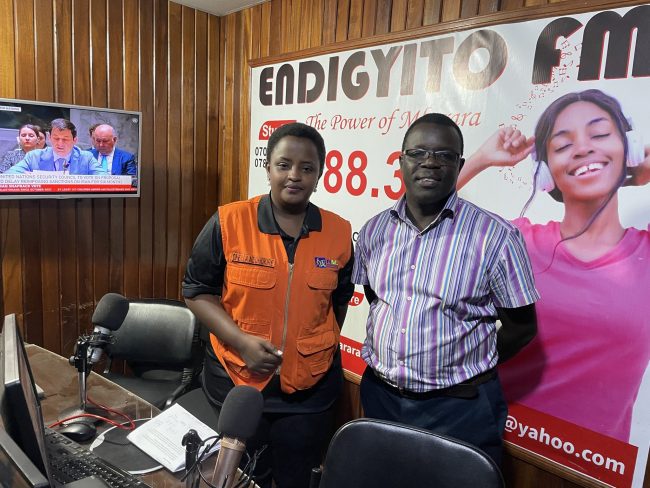
    Ms Sheilla Nduhukire, The Principal Public Relations Officer at National Medical Stores (NMS) was last evening hosted on Endigyito FM in Mbarara together with her colleague Mr. Rodgers Ochan, NMS’ Senior Regional Customer Care Officer for Ankole and Greater Kigezi subregion. This was part of NMS wider National Awareness Campaign on the Pilferage of Government Medicines.
    The two reminded listeners that as a patient/citizen, you can easily identify government medicines because all are clearly labeled “GoU-Not for Sale.” Even the smallest tablet/vaccine vial/ampoule carries the mark “UG” and should be free of charge.

    Please report any suspicious cases or culprits to the nearest police station or the State House health monitoring Unit
    on 0800 200 447.

    Sheilla Nduhukire and Ochan at Endigyito FM last evening

    Nduhukire said that patients and stakeholders can track the delivery of medicines to health facilities by visiting dmt.nms.go.ug.

    In addition, dispatch and delivery alerts are automatically sent to district and national leaders whenever consignments from NMS are dispatched and delivered to their respective facilities and districts.

  • Jessica Alupo gives credit to NMS for its innovations to address challenges in delivery of drugs across the country

    Jessica Alupo gives credit to NMS for its innovations to address challenges in delivery of drugs across the country

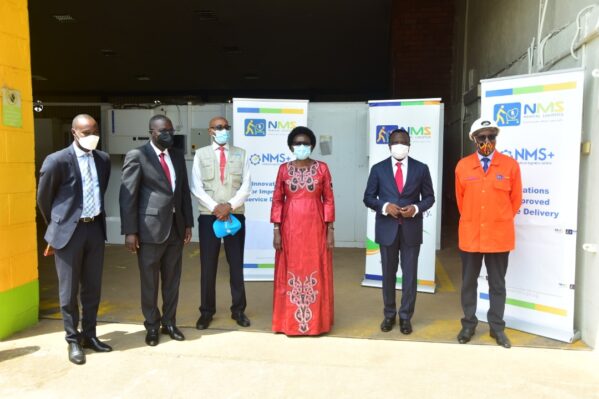
    The Vice President of the Republic of Uganda H.E Jessica Alupo has lauded National Medical Stores for strengthening the drug supply chain to improve health service delivery in Uganda.

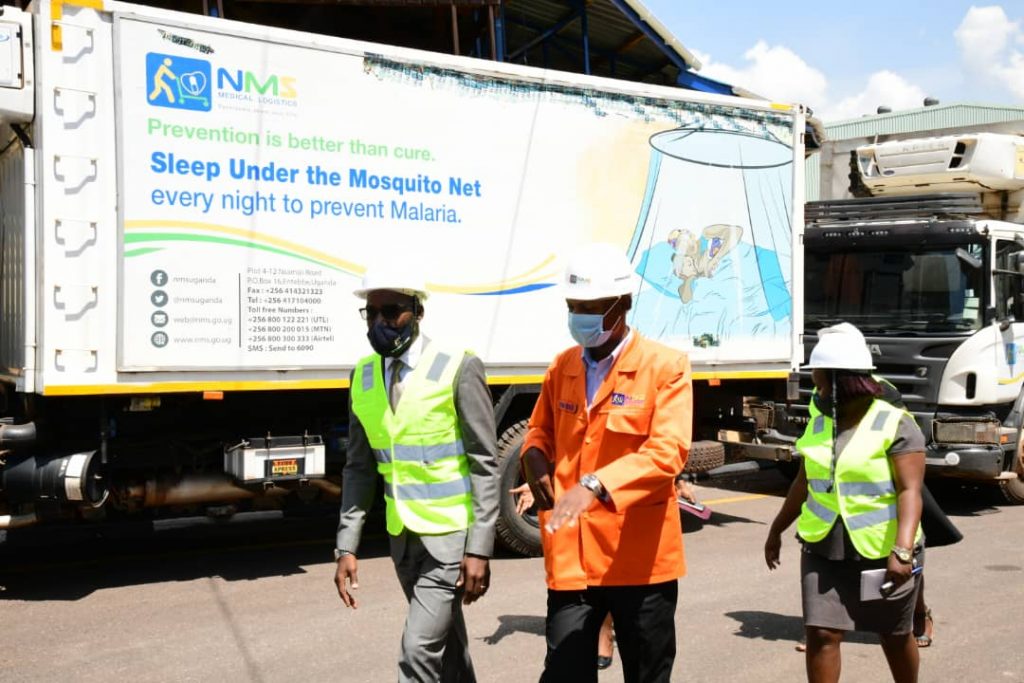
    While touring National Medical Stores Headquarters in Entebbethis Friday morning, Alupo acknowledged the gaps being exploited to steal drugs from health facilities, saying these will be addressed with the latest innovations put in place by National Medical Stores.

    “The Ugandan population need medicines in government health units and sometimes they are disappointed when they hear stories of medicines getting stolen. I am happy to discover from here today that whereas NMS has sufficient volumes of medicines in their stores for all government facilities and delivers them to the respective health facilities as per their mandate, there is a grey area that we need to pay attention to as government so that all these health facilities benefit’’, said Alupo.

    The National Medical Stores’ mandate is to procure, store and distribute medicines and medical supplies to government health facilities.

    However, once NMS delivers medicines to the respective health facilities, in–charges of the respective government-owned health facilities are charged with the responsibility of ensuring that medicines are secured and administered to patients free of charge.

    ‘‘We have discovered that there is a gap from the time NMS delivers drugs to health facilities as our mandate dictates, and when the drugs are administered to patients. We would like to call upon all Ugandans to be vigilant and report any cases of drug thefts in their respective facilities. On our part as NMS, we are innovating new ways to address these gaps by introducinginnovations to improve visibility in the ordering and distribution of vaccines,” said Mr. Moses Kamabare, the National Medical Stores General Manager.

    The Vice President noted that the introduction of the NMS+ERP tool, a new initiative of National Medical Stores with support from USAID, which is an online monitoring tool aimed at improving transparency and accountability in the ordering of medicines, will go a long way in improving visibility in the ordering and tracking how medicines are delivered and dispensed to patients.

    According to Kamabare, NMS plus will be rolled out in three phases: the first leg which is to digitalize the order system for hospitals, the second phase which will be connecting NMS to the stores of the respective health facilities, while the last leg will be to track who has received which kind of medicine.

    ‘‘The final phase is what accounts for what we have delivered to a health centre and connects it to the individual patient so that when you go to a health facility, you will only be able to get medicines after you have presented your National Identification Number and thumbprint. Even if you get on a bus and go to another health facility, and they prescribe for you the same drug, we will be able to know that you have already received this drug in another facility,” said Kamabare.

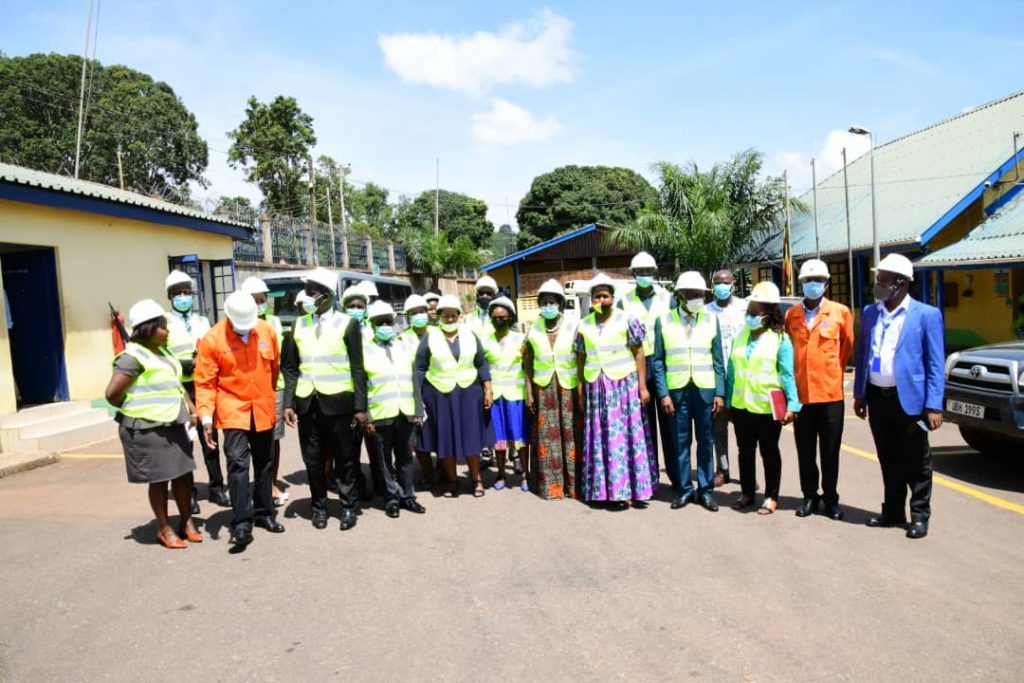
    Alupo toured NMS at the invitation of the management of NMS, as part of the organization’s stakeholder engagement initiative to raise awareness among national and local leaders about the mandate of National Medical Stores. She also acknowledged the efforts by NMS to expand to a bigger warehouse in Kajjansi to accommodate storage of more volumes of medicines.

    According to Kamabare, once complete, the Kajjansi warehouse will have capacity to produce at least 100 oxygen cylinders per day and is billed to be the largest government-owned medical warehouse in the East African region.

    “I am happy to note that you are working on solving the problem of storage through a modern pharmaceutical warehouse in Kajjansi. I was also very excited to learn that you store Ebola vaccines for other countries in the region and that other countries come here to benchmark,” Alupo noted.

    Alupo was accompanied by the State Minister in the Vice President’s office also the Buikwe Woman MP, Diana Mutasingwa.

    On her part, Ms. Mutasingwa, expressed concern over what she said was a deliberate misinformation of the public by a section of politicians on the availability of Mama Kits, a free specialized medical kit for expectant mothers in public facilities.

    “What we have been getting on ground is that Mama Kits are being sold. Because of propaganda, Ugandans are told that these mama kits are not delivered and yet NMS indeed delivers these Mama Kits. We must work together as leaders to inform the general public to correct this misinformation’’, Ms. Mutasingwasaid.

    Alupo was taken through the process of ordering, packaging and transportation of medicines to health facilities. 

    High ranking officials who previously visited the NMS facilities include President Museveni, Speaker Jacob Oulanya and Health Minister Dr Ruth Aceng and Members of Parliament others.

    The Vice President’s visit is seen as a big step forward for government as it seeks to address rampant theft of medicines from public health facilities.

  • NMS receives two refrigerated trucks to transport vaccines

    NMS receives two refrigerated trucks to transport vaccines

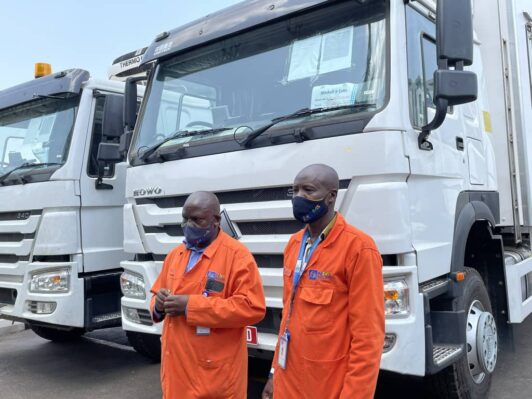
    The Minister of Health, Dr Jane Ruth Aceng has on Wednesday handed over two refrigerated trucks to National Medical Stores (NMS) to safely transport vaccines across the country under the required conditions.

    The two of the five refrigerated trucks were procured by the United Nations Children’s Fund (UNICEF) in Uganda with support from GAVI to support vaccination in the country.

    While handing over the trucks to NMS General Manager, Moses Kamabare, Dr Aceng said the vehicles were well equipped to ensure vaccines are kept at optimal temperatures while being delivered.

    She also said 5 out of 10 refrigerated trucks available at NMS were due for disposal.

    “Out of the 10 trucks currently available in National Medical stores, 5 refrigerated trucks are due for disposal. Our expectations are that the trucks will be deployed in supporting the immunization activities and other health related activities,” she said.

    She added that the trucks will support NMS to build a resilient fleet to distribute and support Immunization activities across the country.

    Kamabare said the trucks “are built to perfection, and we are glad that they have come out the way we agreed with the manufacturers.”

    He said the arrival of trucks was timely.
    “These trucks will help boost NMS at time when there is big demand for vaccines,” Kamabare emphasised.

    NMS has built capacity to store vaccines that require both high and low temperatures.

    On July 11, Kamabare said Uganda has the capacity to store Pfizer’s COVID-19 Vaccine which need to be kept at minus 70 degrees Celsius.

    “We are already storing Ebola vaccines at – 80 degrees centigrade. Yes, we can store Pfizer which is kept at minus 70 degrees Celsius,” he added.

    Meanwhile, UNICEF Representative to Uganda, Munir Safieldin said the remaining 3 trucks will arrive in Uganda in September.

    “These are the initial delivery of two trucks. Three more trucks will be arriving hopefully by September,” he said.
    The mandate of NMS is to procure, store and distribute essential medicines and health supplies mainly to public health facilities.

  • National Medical Stores: Dr Kakwemeire was Sacked for Incompetence

    National Medical Stores: Dr Kakwemeire was Sacked for Incompetence

    National Medical Stores (NMS) has clarified on an alleged petition on social media groups, explaining that an investigation by the Inspector General of Government into claims of buying short life drugs were false.

    The former NMS’ Chief pharmacist, Dr Atanasius Kakwemeire, 63, had petitioned the president’s office calling for an investigation into alleged abuse of office at NMS through procurement of fake and substandard medicines.

    He said he was being victimized and that NMS terminated his contract before forcing him out of office.
    In late 2020, President Museveni ordered the Inspector General of Government (IGG) to probe the matter.
    The six months investigation led by Deputy IGG Miriam Wangadya with the help of State House detectives found the charges against NMS were misleading.
    The petition to the presidency was on Friday circulated on social media especially WhatsApp with the date cropped out.

    This created an impression that this was a new case.
    “This is an old case brought to our attention in 2020 after the National Medical Stores Board terminated the complainant’s contract for incompetence at work,” said NMS in a statement on Twitter.
    “Following a formal disciplinary action, he was dismissed from NMS.”
    “Even after termination, the complainant refused to hand over the office. It took the effort of the police to cause him to hand over the office and NMS property,” said NMS.
    Kakwemeire, according to police, “reported to the IGG and the allegations were investigated and found to be baseless. He then reported to the State House Anti-corruption Unit. The allegations in the letter should be dismissed with the contempt they deserve.”
    During the investigation ordered by Museveni, detectives examined the three year framework contracts NMS has with a number of its medicines’ suppliers including CIPLA/Quality Chemicals (for the anti-malarials, ARVs and reproductive health items), LPOs and call off orders.
    Kakwemeire had reported that NMS was deliberately purchasing medicines with a very short life span before expiry deliberately to occasion loss to the government of Uganda.
    NMS explained that the problem of quick expiring medicines only related to medicines the Ministry of Health received as donations and passed on to NMS.
    The IGG discovered that quick-expiring donated medicines (valued at SShs140m) were handed over to NMS at a time when they “weren’t meeting the requirement of 75% shelf life,” something that no one can appropriately blame on NMS because the entity never participated in the medicines’ procurement (only received them as donations).
    It also was established that instead NMS deserved commendation for registering a medicines expiry rate (0.5%) which is way below the WHO recommended standard rate of 5%.
    This simply means that, whereas cases of procured medicines expiring in the warehouse can’t be avoided because it’s a must globally, in the case of NMS only medicines worth 0.5% of the total procurement in a Financial Year gets disposed upon expiring on the shelf.
    The WHO considers up to 5% as acceptable but the NMS management is now at 0.5% in comparison with the governing Board target of 2%.

  • National Medical Stores receives 175,200 COVID-19 Vaccines

    National Medical Stores receives 175,200 COVID-19 Vaccines

    National Medical Stores (NMS) has today received 175,200 COVID-19 vaccines from the Ministry of Health.

    The AstraZeneca vaccines will be stored at the NMS headquarters in Entebbe. NMS’ mandate is to procure, store and deliver drugs mainly to public health facilities.
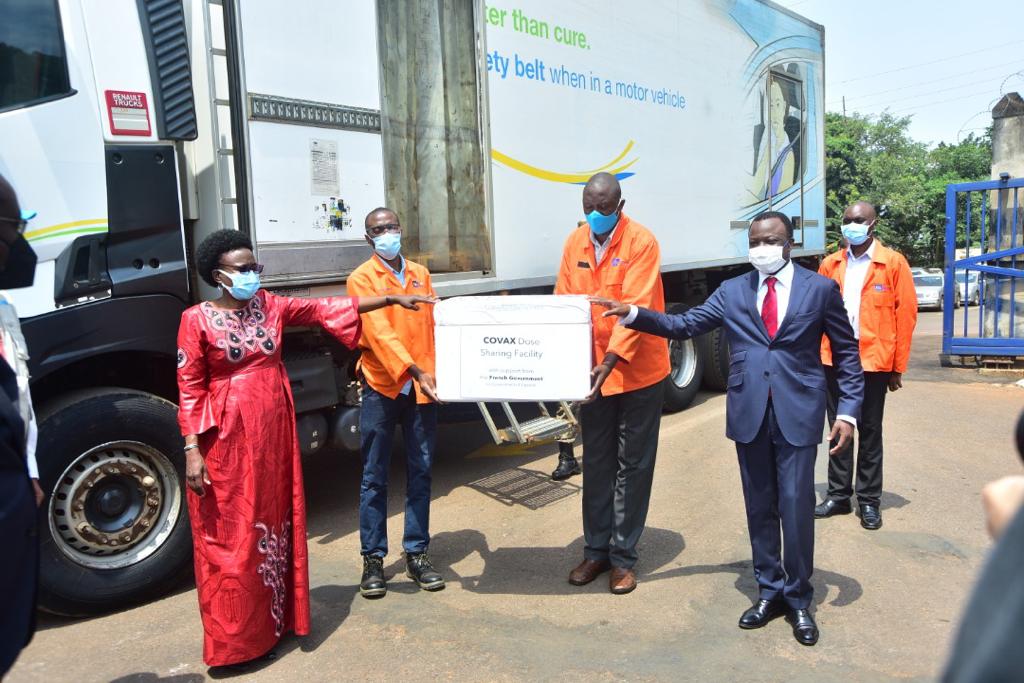
    The Minister of Health Dr Ruth Aceng received the vaccines from the donors – the French government represented by Ambassador Jules-Armand before handing over the consignment to NMS at the NMS HeadQuarters.

    The vaccines were delivered by a KLM flight which landed at Entebbe International Airport at 10:00pm.  

    This is the third consignment of COVID-19 vaccines to be received, stored and distributed by the NMS since March 2021. 
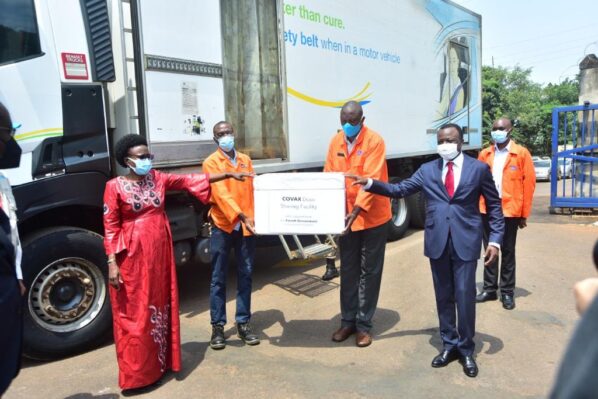
    NMS General Manager Moses Kamabare said: “Last night, NMS received 175,200 COVID-19 vaccines. These are part of the COVAX facility vaccines that came into the country at 10pm.”

    “We have already brought these vaccines from the airport to NMS – our central vaccines store.”

    Transportation and delivery of vaccines will commence immediately after NMS has received the distribution list from the Health Ministry.

    “That’s when we will know how many vaccines, how many doses to which place. As soon as we receive that distribution list, NMS will be starting the distribution immediately tomorrow morning to all parts of the country that Ministry of Health will have directed us to deliver to.”

    The COVAX Facility is the global pooled procurement mechanism for COVID-19 vaccines through which COVAX will ensure fair and equitable access to vaccines for all 190 participating economies, using an allocation framework formulated by WHO

    The vaccines come at a time the country is grappling with a surging number of COVID-19 cases. The Ministry of Health is reporting a daily average of 1,000 COVID-19 cases.

    The new doses bring to 1,139,200, the total number of COVID-19 doses received by Uganda since March 2021. 

    NMS has a modern 7,200sqm warehouse at Entebbe (present location) which is used for the orderly receipt, storage and packing of medical supplies destined to GOU Health facilities.

    French Ambassador to Uganda, Jules-Armand Aniambossou, hailed the good relations between Kampala and Paris. 

    “I am very glad to be part of this ceremony. This country did well in addressing the COVID-19 pandemic. However, the situation currently is difficult,” he said.

    “It’s our common responsibility to tackle this issue,” he added. 

    Minister Aceng thanked the donors for the goodwill gesture. She said the donation was timely considering the country is struggling to cope with the impact of the Coronavirus pandemic. 

    “There are some Ugandans who have not yet received the vaccines. This is timely. 

    “I thank the French for organizing and giving 175,200 vaccines. I also thank COVAX for their commitment to ensure African countries including Uganda have access to vaccines. I thank WHO and UNICEF for ensuring the vaccines arrived safely. Once we receive the vaccines, the work is just beginning. I want to thank NMS for receiving the vaccines in the middle of the night and taking care of it very well. Ensure vaccines reach the last person by delivering it to districts,” she said.

    She said out of the 964,000 does vaccines received by Uganda, 869,915 people have been vaccinated. 

    Dr Aceng said “every dose was utilized effectively. We have not heard any expiries.”

    She emphasised that the arrival of vaccines was very timely since “we have already exhausted what we have. Everybody is looking forward to getting vaccinated.”

    Aceng revealed that Uganda is expecting an extra 688,000 doses “very soon.” 

    She said COVID-19 continued to ravage the entire country. 

    “The number of admissions and death is so high,” said Aceng. 

    “In other words we are in state where we need all hands to address the pandemic. How did we get here? Ugandans were not listening. No amount of oxygen, no amount of vaccines or increase in ICU beds will get us out of this situation. The best vaccines is ourselves. We need to be responsible and follow COVID-19 prevention SOPS.” Aceng advised Ugandans to strictly observe the COVID-119 prevention measures such as cleaning your hands often with soap and water, or an alcohol-based hand rub; maintaining a safe distance from anyone who is coughing or sneezing; wearing a mask when physical distancing is not possible; avoiding touching eyes, nose or mouth and staying home if you feel unwell.

    Barbara Nel, Africa Region Country President, AstraZeneca, said:

    “The arrival of a further 175,200 doses of the AstraZeneca COVID-19 vaccine in Kampala is very good news for the people of Uganda.

    “On behalf of AstraZeneca, I would like to thank Dr. Aceng, our partners at the COVAX coalition, the World Health Organization, Gavi, CEPI and UNICEF for making this possible.

    “Our vaccine accounts for 94.61% of COVAX supply to date, with more than 76.7 million doses delivered to 127 participating countries, including more than 38 African countries. 

    “All partners in the vaccine alliance are working round the clock to ensure that as many COVID-19 vaccines can get to African nations as soon as possible. Today’s arrival in Kampala demonstrates the value of governments, industry and others working together to address our continent’s urgent need.”

  • National Medical Stores to digitalise Health supply chain to ensure transparency

    National Medical Stores to digitalise Health supply chain to ensure transparency

    National Medical Stores (NMS) has began training all health workers across the country ahead of the rollout of the new NMS plus platform, an initiative which will be used to enhance transparency in procurement and delivery of medicines across the country. 
    The NMS plus initiative will help hospitals in placing of orders, tracking order status, and receiving medicines.
    In the past, health facilities have made orders using paper trails which sometimes gets misplaced or are poorly quoted.
    The NMS plus initiative however, will change all that as it will ensure more accountability and transparency.

    Each health facility will be able to place their order, monitor their orders and we will now be able to see which hospital is ordering for what medicine to avoid issues of drug theft and expiration.
    The move was revealed by the National Medical Stores General Manager Mr. Moses Kamabare on a media tour of journalists at the NMS Headquarters in Entebbe.

    According to the NMS plus project head Mr. Stephen Kisuze, the initiative will help reduce the prifellage of medicines across the country.
    “The current problem was that with paper based processes, there are a lot of challenges you have to deal with. It’s not possible to share needs of health facilities quickly. Decisions are made based on assumptions”, Mr. Kisuze said
    The new initiative, which takes effect on 1st July 2021,  will be used to place orders, track order status, and receive medical supplies to promote transparency and accountability in our health facilities across the country.
    “So far we have carried out the piloting and training of 50% of the hospitals. We will soon train the remaining health centers in the first phase and upload them on the system starting 1st July,” Mr. Kisuze said
    NMS has so far conducted training in 144 health facilities out of the 268 targeted for the first phase (All Health Center IVs, general, regional and National referrals).
    Phase II will commence by August 2021 take care of Health Centre IIIs and below.
    On issues of internet connectivity, Mr Kamabare said,
    “We shall be giving modems and internet connectivity at our cost to all the health facilities that do not have access to the internet,” he emphasized.
    End of phase III will be in 2 years.
    DELIVERY SCHEDULE
    Kamabare also sensitized the media about the NMS delivery schedule which NMS’ most important document because it’s “our manifesto.”
    He said the delivery schedule “is the promise we give to health facilities. In this delivery schedule, NMS has divided the country into five regions and the districts in each region are given a timeline within which they should submit their order for medicines and medical supplies, and NMS indicates when the delivery will be effected.”
    He added: “In this social contract with the health facilities, we tell the districts in a given region that in case NMS has not delivered in the agreed time, there is a toll-free number to call and follow up.”
    No other government institution has this kind of exact schedule.
    Each government health facility gets medicines delivered once every two months.
    This helps health facilities plan well for their medicines and supplies’ need. “Previously, the health facilities would be waiting for medicines and medical supplies like farmers who depend on rain, without knowing when the rains would fall. But now the health facilities know exactly when deliveries will be made,” said  Kamabare
    NEW WAREHOUSE
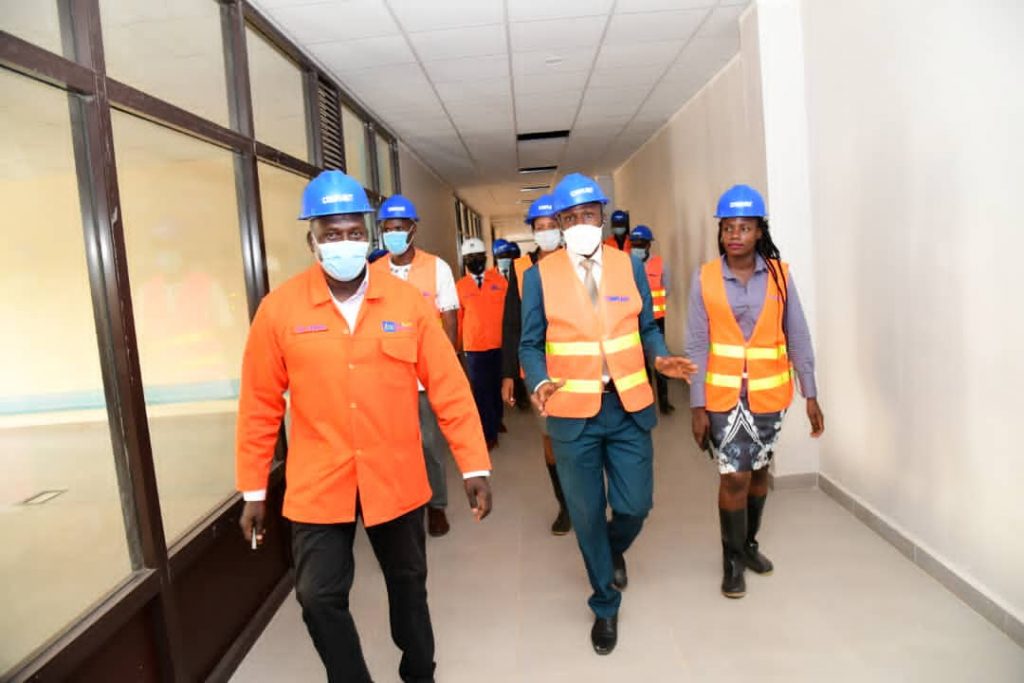
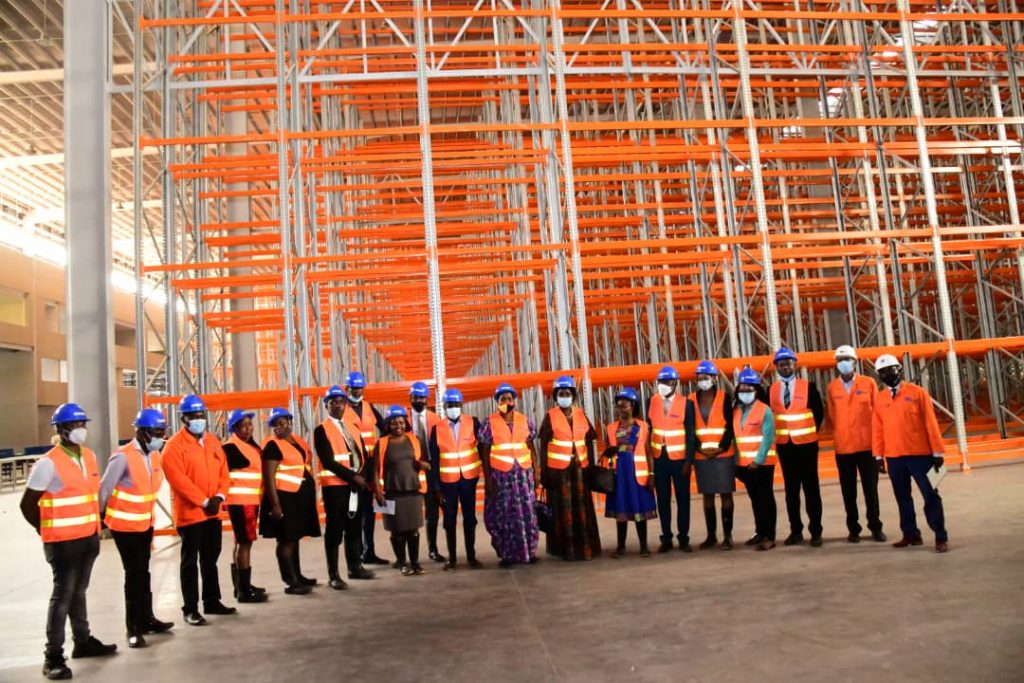
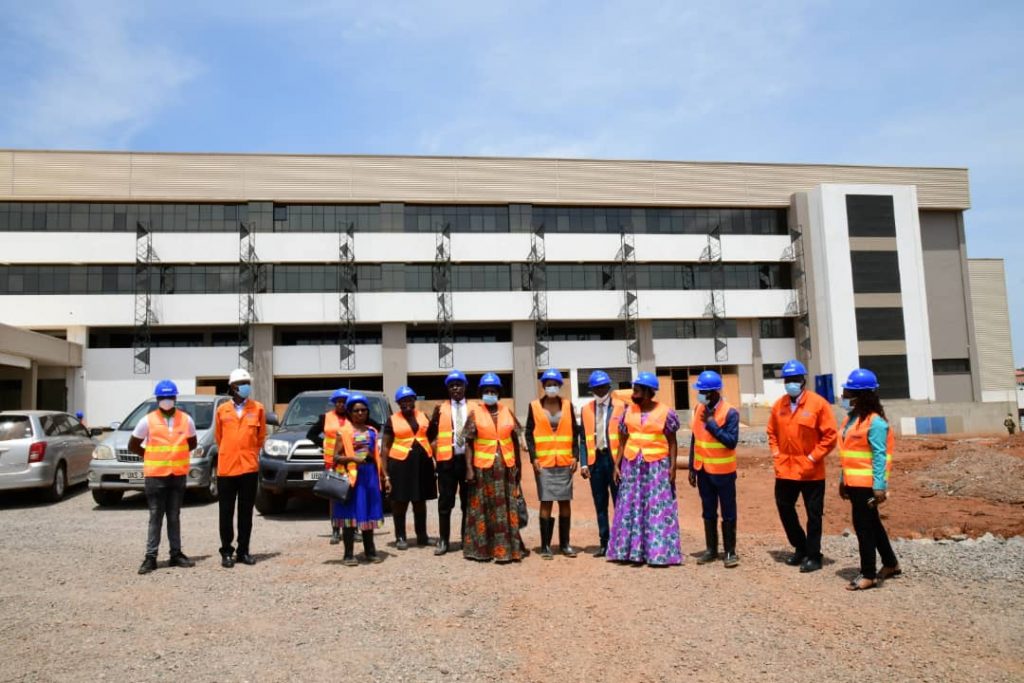
    During the tour of the NMS state-of-the-art warehouse in Kajjansi today, Kamabare said NMS has built the biggest medicines warehouse in Africa with support from Global Fund and GAVI.
    He said NMS wanted more space because the volume of products it handles has tremendously increased.
    By 2008, the value of products handled by NMS was worth UGX 60 billion, but last financial year they were worth UGX 1.3 trillion. Consequently, the warehouse at Entebbe is not enough.
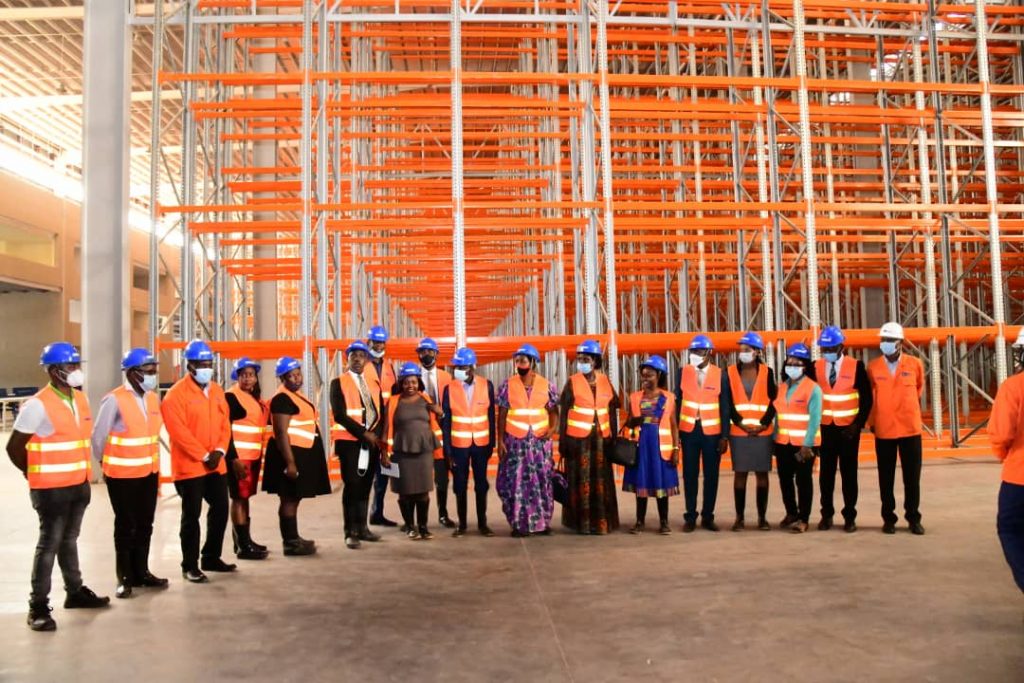
    “The new state-of-the-art warehouse at Kajjansi will increase the capacity to 30,000 pallet positions compared to the current 8,000 pallet positions,” said Kamabare.
    By 2008, the value of products handled by NMS were worth UGX 60 billion, but last financial year they were worth UGX 1.3 trillion. Consequently, the warehouse at Entebbe is not enough.
    He said the warehouse should have been commissioned by now but COVID-19 disrupted the plan. The new schedule is to have the warehouse opened by December this year.
    The new warehouse will also be environmentally friendly with 50% of all its power requirements being produced by solar. Medical testing will also be housed at the medical testing laboratory.
  • Members of Parliament visit NMS facilities to assess its abilities

    Members of Parliament visit NMS facilities to assess its abilities

    Members of Parliament have visited National Medical Stores (NMS) facilities to assess its abilities as the institution moves to fully automate its supply chain systems.

    “We have come to see what is on ground in terms of achievements and challenges in as far as implementation of government programmes in regard to delivery of essential medicines is concerned,” said Parliament Health Committee, Dr. Michael Bukenya (Bukuya County).


    “We toured the old facility in Entebbe and the new pharmaceuticals warehouse which is about to be launched soon,” he added.
    “We have appreciated how NMS is being innovative in delivery of health supplies and managing its finances.”
    Bukenya further said MPs would continue to monitor operations of NMS and other sister agencies to ensure the common man is able to access drugs in the remotest parts of the country.
    NMS’ mandate is to procure, store and deliver drugs to health facilities across the country.


    The Health Committee inspected the cold storage rooms where experts took them through the process of handling critical vaccines.
    The lawmakers were surprised to learn that the new NMS warehouse in Kajjansi off Entebbe road will use green energy to power its operations.
    NMS’ Chief Stores and Operations Officer, Paul Okware, told MPs that the huge structure sitting on 10 acres will not have air conditioning.


    “There will be plenty of fresh air. We also have over 200 solar panels to generate the electricity we need,” said Okware, adding, “a medical oxygen gas plant capable of filling over 100 cylinders will be installed as soon as possible.”
    The solar panels will generate 0.3 megawatts of electricity, leading to a reduction in power bills.


    The building boasts an extensive room for cafeteria, permanent dedicated space for breastfeeding employees, gym and office space for 200 staff.
    It also has a gym for staff to keep fit because they work for long hours.
    The spacious warehouse in Kajjansi will allow vehicles drive in to pick and drop medicines which is not the case at the stores in Entebbe.
    The cold rooms which store sensitive medical supplies such as vaccines and laboratory commodities will have their storage capacity increased five-fold at the new structure.
    To reduce the costs of servicing transport vehicles, space has been created for an in-house service centre.


    On his part, Okware emphasised the need to maintain NMS’ autonomy to remain flexible in managing the distribution of essential medicine.


    “We can’t even ask a health facility to wait for two weeks. If we kept our budget, we would remain flexible to serve our people better,” said Okware.

    Drug theft
    MPs said they were keen on plugging loopholes exploited by officials at the district and health centre levels to steal government drugs.
    To mitigate theft and other loss of EMHS along the supply chain, NMS is implementing an Enterprise Resource Planning (ERP) system that is intended to digitize the entire supply chain process end to end in order to ensure effective tracking of EMHS to the final users.
    Upon full operationalization of ERP, NMS will have the capacity to trace the medical supplies to the final user (patients and other healthcare clients) through individual identification using the national identification number (NIN) that will be captured into the ERP system.
    This will provide end user data that will then be reconciled with procurement and distribution data to ensure that there is no leakage in the supply chain.

  • Ministry of Health PS tours new NMS warehouse

    Ministry of Health PS tours new NMS warehouse

    The Health Ministry Permanent Secretary Dr Diana Atwine has this Monday afternoon toured the new National Medical Stores’ state-of-the-art pharmaceuticals warehouse in Kajjansi off Entebbe road.
    “We inspected the construction site for the new Medicines and Vaccines Warehouse that will also house offices for NMS in Kajjansi,” said Dr Atwine.


    She said the facility is expected to be completed and operational by end of June this year.
    NMS’ mandate is to procure, warehouse and distribute essential medicines and medical supplies, primarily to Government health facilities.


    The warehouse is expected to increase bulk store capacity area from the current 8,000 pallet locations in the existing premises, to a minimum of 30,000 pallet locations.
    The facility will also increase cold chain capacity to a maximum net storage volume of 2,500m3 purpose built as a Drive-in cold room (DICR).


    “One of our main objectives is to consolidate, centralize and operate NMS services and infrastructure in one modern, purpose built and efficient building, with a minimum sixty- year lifespan, on the specified site,” said NMS General Manager Moses Kamabare at a recent event.
    The facility will as well have a medical gas plant.


    “We now want to secure the future of oxygen in Uganda with a new plant capable of producing 100 cylinders per day,” he added.
    Kamabare said the gas will be supplied mainly to public hospitals across Uganda but private facilities will be considered too.
    Medicine availability across the country currently stands at 85 percent with a target of reaching 90 percent within the next 1-2 years.


    NMS recently hired clerks to follow up on drugs from the districts up to the rural health facilities under what is known as the last mile delivery model.


    In the year 2017/2018, NMS achieved higher than target score of 90 percent stock availability for Essential Medicines and 86 percent for Tracer items against a target of 75 percent set by Ministry of Health.

  • NMS Builds Modern Medical Oxygen Plant

    NMS Builds Modern Medical Oxygen Plant

    On January 5, Peter (not real name), was rushed to a private medical facility in Kampala in critical condition after testing positive for COVID-19.
    Just like most Covid-9 patients, Peter was desperately gasping for breath.
    The hospital where Peter was admitted had just run short of oxygen supply. The oxygen cylinders had been taken to Oxygas for refilling.
    By the time Peter secured oxygen, he had already slipped into coma.
    Medical oxygen is a lifesaving commodity, the lack of which can lead to severe complications and death.
    “It has been estimated that around one in five people with COVID-19 suffers respiratory distress sufficient to require oxygen therapy,” says Dr Priyanka Relan, a COVID-19 clinical management expert at WHO.
    “Without that therapy, COVID-19 can be fatal.”
    At the onset of the COVID-19 outbreak, medical oxygen plants, cylinders and accessories had to be imported by air to deal with the emergency situation.
    Securing the future of oxygen in Uganda
    However, this situation is set to change as the National Medical Stores (NMS) moves to install a state-of-the-art gas plant at its new state-of-the-art pharmaceuticals warehouse in Kajjansi off Entebbe road.
    “Many hospitals are asking for oxygen and currently they are competing with welders who pay cash,” said NMS General Manager, Moses Kamabare.


    “If you don’t pay cash, it is hard to get oxygen. We now want to secure the future of oxygen in Uganda with a new plant capable of producing 100 cylinders per day,” he added.
    The structure, which will house the gas plant, in Kajjansi is almost complete.
    Kamabare said the gas will be supplied to public hospitals across Uganda as well as private facilities.
    “During that time when all other oxygen plants are working well and have enough oxygen, ours will be for the private sector,” he added.
    “At no time should a Ugandan die because of lack of oxygen,” said Kamabare.
    Currently, Mulago National Referral Hospital has four new fully functioning Oxygen Plants which are able to generate 2,083 liters of oxygen per minute.
    In 24 hours, the Mulago plant can generate about 2,999,520 liters of oxygen which in normal circumstances can serve about 900 patients.
    The four are part of the seven plants procured by the Ministry of Health to meet the oxygen needs in the country.
    However, the majority of public and private not-for-profit facilities in Uganda do not have sufficient availability of oxygen and pulse oximeters.
    The last Uganda Services Availability and Readiness assessment conducted by the Health Ministry showed that only 36% of facilities offering services for chronic respiratory diseases had oxygen.
    The proportion of oxygen systems availability was even lower when facilities were assessed on availability of diagnostic equipment.
    Availability dropped further when assessment looked at staff trained on oxygen equipment which was lowest at general hospital and HCIVs compared to regional referral hospitals.
    Works underway
    At NMS’ pharmaceutical warehouse in Kajjansi, floor works will include setting up a rump at the filling station for easy transportation of refilled cylinder from the plant.
    The modern medical oxygen plant will allow clients to generate their own oxygen for their medical-grade requirements like EMS (Emergency Medical Services), ambulance, fire departments, small hospitals, clinics, nursing homes, veterinary and animal hospitals among others.
    The plant is mounted over a platform and acquires less space. With a simple mounting of plant, and plugging it in to a standard electrical outlet, NMS will be able generate medical-grade oxygen to fill cylinders on-site.
    Within a short period of time, NMS will be able to have emergency oxygen available for any increase in unexpected demand.
    Contractors expect installation works to be complete by end of this year.
    Dr. Moses Muwanga, the Director Entebbe Hospital, recently said a covid-19 patient in critical condition consumes about two oxygen cylinders a day.
    “And we can only refill these cylinders from the manufacturers in Namanve or other facilities or even Nakasongola when the Namanve plants are down,” said Dr Muwanga.
    Suppliers sell a full oxygen cylinder between Shs 40,000 and Shs 50,000. It has been very costly for critical COVID-19 patients to foot bills for the oxygen consumed while in ICU.
    But with NMS being able to produce oxygen, the cost will be reduced substantially. The process of filling and transporting of gas will be simplified too.
    NMS General Manager, Moses Kamabare said the gas distribution process can be simplified with the last mile system of distributing medicines and other health supplies directly to their final destination.
    “Once the cost of distribution is fully resolved, the country will be well served with oxygen,” said Kamabare, adding, “The advantage here is that NMS has already developed capacity for production of oxygen.”
    The installation of the medical oxygen plant underscores NMS’s increasingly enhanced capacity for generating internal revenue given the declining contribution from development partners.
    Revenue from the oxygen plant will serve as a new revenue stream to supplement resources from government and development partners.
    NMS’ new strategic plan is premised on repositioning the institution as a center of excellence in Essential Medicines and Health Supplies and cold-chain supply in the region.
    “The business model adopted by NMS will employ financial viability of business enterprise. The current strategic plan is based on strategic paradigm shift from government financing and pump priming to market oriented operations where NMS introduces a business arm which operates as an entity capable of recruiting staff, financing operations, provide services, make some profit and sustain her operations without entirely depending on government subvention,” said Kamabare.
    “The model makes a departure from the current system where NMS operates as an MDA and fully financed by a consolidated fund. By being recognised as centre of excellence, we expect to attract trainees across the region who will need to pursue courses in coaching, mentorship and change management in the field of procurement of EMHS and cold-chain supplies. Our target is to create a competitive demand for NMS as a Hub of learning in the region,” he added.