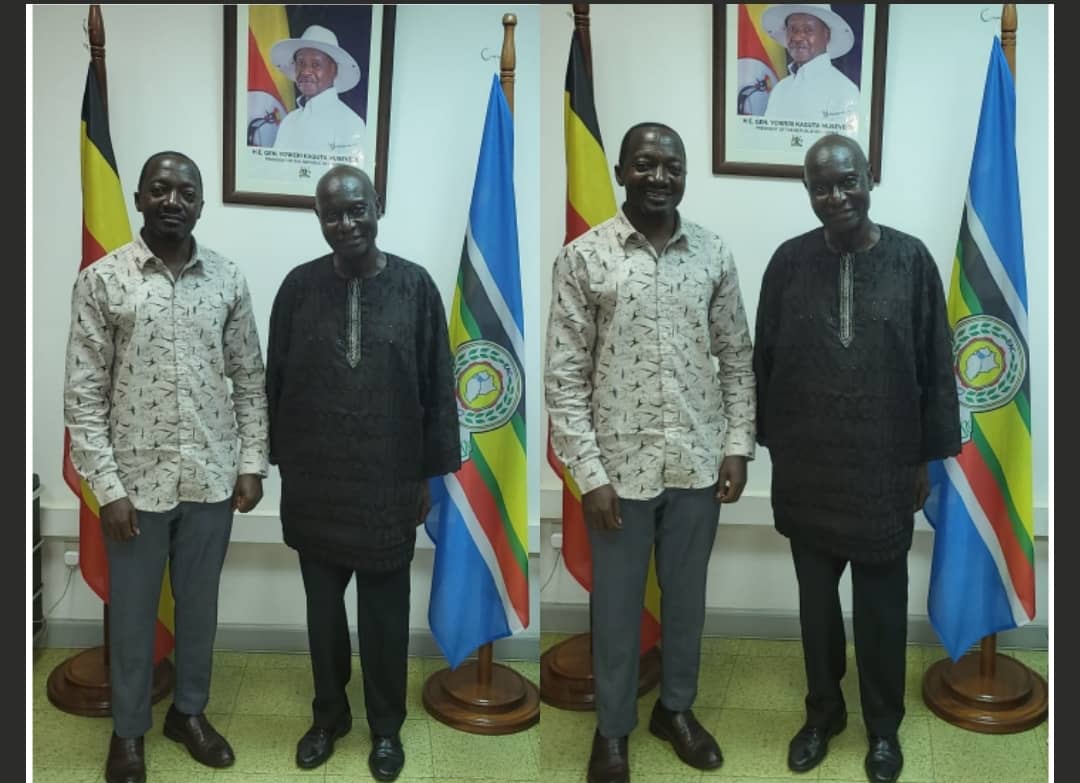
High-level diplomatic consultations were convened in Kampala as H.E. Olara Otunnu held a consultative meeting and strategic engagement session with Mr. Buyinza Adam Luzindana to deliberate on Otunnu’s candidature for election as the next Secretary General of the United Nations. The strategic session follows the official nomination and recommendation of Otunnu by the Government of the Republic of Uganda. He enters the global contest with the full backing of the Ugandan government, including President Yoweri Kaguta Museveni.
H.E Olara Otunnu is a prominent Ugandan diplomat, politician, and international lawyer born on September 6, 1950. His career spans over four decades in international diplomacy, human rights advocacy, and national politics. Widely acclaimed for his diplomatic acumen, vision, statesmanship, and consensus-building skills, Otunnu currently serves as President of the LBL Foundation for Children. His academic journey began at King’s College, Budo, where he was awarded the Queen’s Scholarship given to the top student in each of Uganda’s four regions. He went on to Makerere University, proceeded to Oxford University as an Overseas Scholar, and later attended Harvard Law School as a Fulbright Scholar.
Recognized globally for his contributions, Otunnu has received major international honors including the German Africa Prize in 2002 presented by President Johannes Rau, the Sydney Peace Prize in 2005, the Harvard Law School Alumni Association Award in 2007, and the Global Award for Outstanding Contribution to Human Rights in India in 2006. He was designated Ombudsman for Children and Armed Conflict by the International Children Jury for the World’s Children’s Prize for the Rights of the Child and continues to serve as its Patron. The United States has recognized him as a person of extraordinary ability and talent, granting him special O-1 status reserved for those who have risen to the very top of their field of endeavor. In tribute to his early leadership of student resistance against the Idi Amin regime, the road linking Makerere University to Mulago national hospital was named Otunnu Highway.
H.E Olara Otunnu held a strategic engagement and consultative meeting with Buyinza Adam Luzindana who brings extensive experience in diplomacy and investment advisory services to the engagement. He holds a Bachelor’s degree in International Relations and Diplomacy and is pursuing a Master’s degree in Diplomacy and Global Studies.
Buyinza Adam Luzindana serves as the team Leader/CEO of Public Opinions, a field-based organization working toward sustainable peace and development through diplomacy, investment advisory, information dissemination, public awareness, research, and recognizing responsible investments worldwide through the Responsible Investment Global Award. In the private sector, he is the Chairman and CEO of Buyinza Coffee Uganda, Director of Buyinza Foods, and an operator in the supply of building and construction materials. Politically, Luzindana previously served as a member of the National Executive Council of the ruling National Resistance Movement, where he held the position of Regional Chairman for the Kampala Capital City Region in the NRM Youth League from 2011-2015. He has privately advised the president of the Republic of Uganda H.E Yoweri Kaguta Museveni on issues of Diplomacy and International Relations.
H.E Otunnu’s career is marked by key leadership roles at both the national and international levels. From 1972 to 1973, he served as President of the Makerere University Students Guild and member of the University Council, leading student resistance against the Idi Amin regime. Between 1976 and 1980, he was Secretary-General of the Uganda Freedom Union, the United States-based opposition movement fighting the Amin regime. From 1978 to 1981, he worked as an Assistant Professor of Law at Albany Law School in New York, following earlier work as an associate at Chadbourne & Parke in New York City. In 1979, he was a Delegate to the Moshi Unity Conference preceding the removal of Idi Amin, subsequently becoming a member of the Uganda National Consultative Council, which served as Uganda’s interim Parliament.

From 1980 to 1985, Otunnu served as Ambassador and Permanent Representative of Uganda to the United Nations. During his diplomatic assignment in New York, he served as Chairman of the UN Commission on Human Rights, Vice-President of the General Assembly, Chairman of the General Assembly Credentials Committee, Chairman of the Contact Group on Global Negotiations, and Chairman of the Group of 77 for the Law of the Sea Negotiations. In December 1981, while serving as President of the United Nations Security Council at age 31, he devised the straw-ballot system known as the Otunnu Formula, which successfully broke the deadlock over the election of the Secretary General.
From 1985 to 1986, Otunnu served as Minister of Foreign Affairs of Uganda, carrying out a major reorganization of the ministry around professionalism and merit. From 1987 to 1989, he was a Visiting Professor at the American University in Paris and Visiting Fellow at the Institut Français des Relations Internationales. From 1990 to 1998, he headed the International Peace Academy, now known as the International Peace Institute, an independent UN-affiliated think tank in New York.
On August 19, 1997, Secretary General Kofi Annan appointed Otunnu for an initial period of three years as his first Special Representative to study the impact of armed conflict on children. From 1997 to 2005, Otunnu served as UN Under-Secretary General and Special Representative for Children and Armed Conflict, leading an ambitious international campaign to protect children affected by war, acting as their moral advocate, and promoting measures for their protection, healing, and social reintegration.
Otunnu’s work as Under-Secretary General led to major global innovations. He placed child protection on the agenda of the UN Security Council, built a comprehensive body of protection legal norms and standards, secured child-specific war crimes in the Rome Statute, established Child Protection Advisers, initiated the listing of parties to conflict who recruit and use children in the annexes of the Secretary General’s report, introduced the international monitoring and reporting mechanism, and launched the Era of Application campaign in 2002 to enforce standards.
He was the architect of the ground-breaking compliance regime adopted by UN Security Council Resolution 1612 in 2005, which established a formal monitoring and reporting system to document violations, publicly list offending parties, hold them accountable, and ensure compliance on the ground. In the course of his advocacy, he undertook field trips to numerous war-affected areas, including Afghanistan, Angola, Bosnia and Herzegovina, Burundi, Croatia, the Democratic Republic of the Congo, Kosovo, Liberia, Rwanda, Sierra Leone, Sri Lanka, Sudan, and South Sudan.
Following his UN tenure, Otunnu served as World’s Children’s Ombudsman starting in 2005 after selection by a worldwide network of millions of children. From 2010 to 2015, he led the Uganda People’s Congress as party president, running as its presidential candidate in the 2011 elections. Since 2014, he has served as Co-Chair of the St. Janani Luwum Memorial in commemoration of the archbishop murdered by Idi Amin in 1977.
Since 2023, he has served as Co-Chair of Rocco Paco, a non-partisan, community-rooted peacebuilding movement dedicated to rebuilding Northern Uganda alongside Chief Justice Emeritus Alfonse Chigamoy Owiny-Dollo. Since 2022, Otunnu has personally led a historic people-to-people reconciliation process between the Kakwa community and the Central Lwo community. Over his career, he has also served on the boards and committees of international institutions, including the Aspen Institute, Carnegie Corporation of New York, Carnegie Endowment for International Peace, International Crisis Group, Henry Dunant Centre for Humanitarian Dialogue, SIPRI, UNITAR, Hampshire College, Club of Rome, World’s Children’s Prize, the Carnegie Commission on Preventing Deadly Conflict, the Commission on Global Governance, and the International Task Force on Security Council Peace Enforcement.
In his candidacy platform, Otunnu outlines a comprehensive 10-point vision statement titled An Outline Agenda for the United Nations, aimed at reinventing and renewing the organization.
First, he emphasizes deploying the moral authority of the Secretary General derived from the UN Charter to benefit the international community.
Second, he advocates supporting state-driven UN reform under the UN80 Initiative to address liquidity crises and align resources with priorities.
Third, on peace and security, he proposes convening a global peace conference for Ukraine, combining Oslo and Abraham Accords frameworks for Gaza, supporting the Washington Accords in the Democratic Republic of the Congo, backing Quad and Quint frameworks in Sudan, and supporting comprehensive diplomatic agreements regarding Iran.
Fourth, he calls for stricter enforcement of existing rules protecting children and women in war zones.
Fifth, he proposes creating a special UN body to oversee artificial intelligence governance, safety, and societal impact while utilizing digital technology for poverty reduction.
Sixth, he advocates accelerating Paris Agreement climate implementation without harming energy security or deepening burdens on developing countries.
Seventh, he targets utilizing the UN’s convening power under the Sevilla Commitment to close development financing gaps for African nations, LDCs, LLDCs, and SIDS.
Eighth, he prioritizes establishing a seamless, humane global immigration consensus consistent with national sovereignty.
Ninth, he emphasizes engaging youth, faith communities, and women directly.
Tenth, he pledges to deepen institutional cooperation between the UN and regional organizations.
For a strategic engagement and consultative meeting on issues of sustainable peace and development, diplomacy, investment, tourism, ICT,International relations, relief and humanitarian, health, etc,please let us know and we arrange. Public Opinions can be reached at its official Email:admin@publicopinions.net,call/Whatsapp: +256774992426 and website: www.publicopinions.net